Other Parts Discussed in Thread: AFE4490SPO2EVM
请注意,本文内容源自机器翻译,可能存在语法或其它翻译错误,仅供参考。如需获取准确内容,请参阅链接中的英语原文或自行翻译。
器件型号:AFE4490 尊敬的:
在 AFE4490SPO2EVM 固件源 v1.4中有一个带通滤波器函数,遵循 processData();
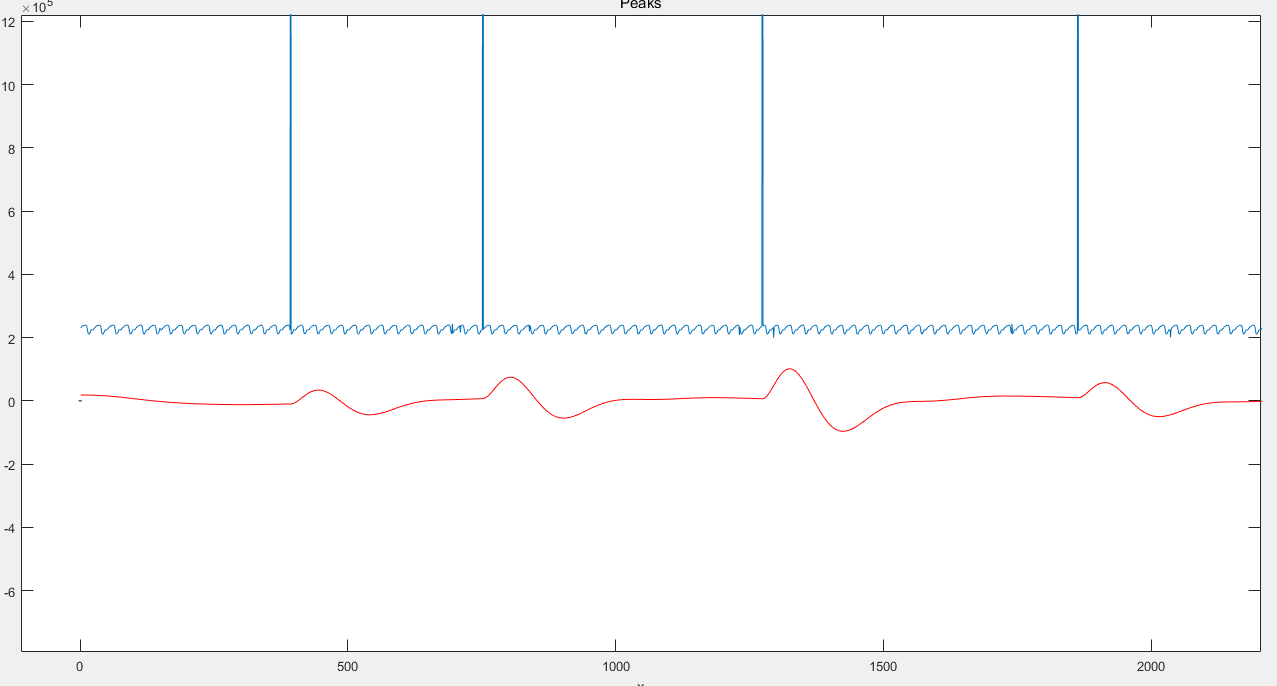
首先、我们得到 redcSample =collectRed()的 redcSample、并通过 MATLAB 将波形绘制为 Bule
然后、我们得到 filtIRSample = filter (redSample)、而 polt 波形由 MATLAB 显示为红色、 该 信号用于确定 信号是否通过零点并计算心率;
在图中、我们知道蓝色波形是正确的 SpO2 波形; 红色波形不 是正确的 SpO2;
我 想 知道为什么按 filter()处理不同的波形; 我知道该滤波器仅用于将波形移动到零点。
/**
*@brief 处理收集到的红色和红外值
*
*@param None
*
*@return None
*/
void processData()
{

static unsigned long i=0,j=0;
voltageCodeCounter++;

//跳过2秒后开始计算数据
if (voltageCodeCounter > 1000)
{
int index = voltageCodeCounter - 1001;

//从 AFE4400读取红色和红外值
long irSample = collectIR();
long redSample = collectRedd ();


//过滤 IR 值
//filtIRSample = filter (irSample);
filtIRSample = filter (redSample);
//GetIrData[i++]= filtIRSample;
//if (i=1000) i=0;


//GetFilterIrData[i++]= filtIRSample;
// printf ("\n\r\n\r\n%8ld %8ld %d\n\r\n、redSample、filtIRSample、j++);

//查找当前脉冲中的最大值和最小值 IR 和红色值
IF (脉冲启动)
{
if (irSample > maxIRValue) maxIRValue = irSample;
if (irSample < minIRValue) minIRValue = irSample;
if (redSample > maxRedValue) maxRedValue = redSample;
if (redSample < minRedValue) minRedValue = redSample;
}

PreviousValue = CurrentValue;
//CurrentValue = filtIRSample;
CurrentValue = filtIRSample;
//如果已过滤数据中有从负到正的转换
if (PreviousValue < 0 && CurrentValue > 0)
{
if (translions[0]=-1) transles[0]= index;//如果这是第一个转换
否则、如果(translions[1]=-1)//如果这是第二次转换
{
转换[1]=索引;
pulseStarted=1;//仅在2个确认的转换后设置脉冲启动标志
}
其他
{
//保留最后两次转换的索引以估算脉冲长度
转换[0]=转换[1];
转换[1]=索引;

//Call 信号函数、用于计算心率和 SpO2
心率= calcHeartRate (转换[0]、转换[1]);
PulseOx = calcPulseOx (maxIRValue、minIRValue、maxRedValue、minRedValue);


//Average Heart Rate with previous history of values
if (hist_count < 4)
{
decision_hist[hist_count]=心率;
HIST_COUNT++;
hist_sum = hist_sum +耳戴式;

心跳2 =心率;
}
其他
{
// if (耳戴>(HET_SUM/4+300)
) if (耳戴>(HET_SUM/4+3))
{
//cedrate2 = decision_hist[3]+(delta_hr)*100;
心跳2 = Decision_Hist[3]+(delta_hr)*1;
if (delta_hr <3)
Δ_hr++;
}
//else if (耳戴<(HET_SUM/4-300)
) else if (耳戴<(HET_SUM/4-3))
{
//cedrate2 = decision_hist[3]-(300 -(delta_hr)*100);
cedrate2 = decision_hist[3]-(3-(delta_hr)*1);

如果(delta_hr >0)
Δ_hr--;
}
其他
{
心跳2 =心率;

}

hist_sum = hist_sum - decision_hist[0]+ c心跳2;
decision_hist[0]= decision_hist[1];
decision_hist[1]= decision_hist[2];
decision_hist[2]= decision_hist[3];
decision_hist[3]=心跳速率2;

心跳报告= HIST_SUM/4;

}

//重置最大和最小默认值,以便在下一个周期进行比较
maxIRValue = 0;
minIRValue = 1000000000;
maxRedValue = 0;
minRedValue = 1000000000;
}
}
/**
*@0.5至3Hz 之间的短带通滤波
器*
*@param 采样 a long
*
@return long
*/

long filter (long sample)
{
// const long b_int [3][3]={
//(long)(SOS [0][0]* scale)、(long)(SOS [0][1]* 2)、
long (sos)(long/s)[0](long])、(sos)[0)、(long](sos [0]*)、[0) (SOS [1][0]*换算)、(长整型)(SOS [1][1]*换算)、(长整型)(SOS [1][2]*换算)}、
//(长整型)(SOS [2][0]*换算)、(长整型)(SOS [1][2]*

换算)、(长整型)(SOS [2]/[3]/长
整型)(SOS [3]/[3]/[0]/(长整型)(SOS [0]/[0]/)[*[*)[SOS[*[*[0]/(SOS [0]/长整型) (SOS [0][5]* Scale)}、
//{(long)(SOS [1][3]* Scale)、(long)(SOS [1][4]* scale)、(long)(SOS [1][5]* scale)}、
//{sos [1][5]* scale)、(sos [2][3]* scale)、(long)、(0、

0[0、
0]0

、0]0、0[0、0]0、0]0、0[0、0]0、0]0、0]0、0[0、0]0、0]0、0]0、0[0、0]0、0]0、0[0、0]0、0]0、0[0、0]0、0]0、0]0、0[0、0]0、0]0、0[0、0]0、0]0、


for (k=0;k<3; k++)
{
for (j=0;j<3;j++)
{
b_int[k][j]=(long)(sos [k][j]* scale);
a_int[k][j]=(long)(sos [k][j+3]* scale);
}


// long s_[4]*
(

s)、long scale (0)(s)(s [0)、s (s [0)、s (s)、s (s [0)、s (s [0)、s (s)、s (s [0)、s (s [0、s)、s (s)、s (s (s)、s)、s (s (s)、s (s)、s (s [0、s)、s (s (s)

for (j=0;j<4;j++)
{
s_int[j]=(long)(s[j]* scale);
}

static long dly[阶段][2]={0、0}、{0、0}、{0、0}};
长结果、wn;
long mysample =采样;
长 WA1、WA2、WA3;
长 wb1、wb2、wb3;

int i;
对于(I = 0;I <级;I++)
{
//二阶 LCCDE 代码
//(eqn 8)

WA1 =((long long) mysample * s_int[i])>>(TRUNC_BITS);
wa2 =((long long) a_int[i][1]* dly[i][0])>> TRUNC_BITS;
WA3 =((long long) a_int[i][2]* dly[i][1])>> TRUNC_BITS;
WN = WA1 - WA2 - WA3;

//(eqn 9)
WB1 =((long long) b_int[i][0]* wn)>> TRUNC_BITS;
WB2 =((long long) b_int[i][1]* dly[i][0])>> TRUNC_BITS;
WB3 =((long long) b_int[i][2]* dly[i][1])>> TRUNC_BITS;

结果= wb1 + wb2 + wb3;

//更新第一阶段的过滤器缓冲区
dly[i][1]= dly[i][0];
DLY[I][0]= wn;
mysample =结果;//以防我们必须再次循环


}

返回(长)结果

;}