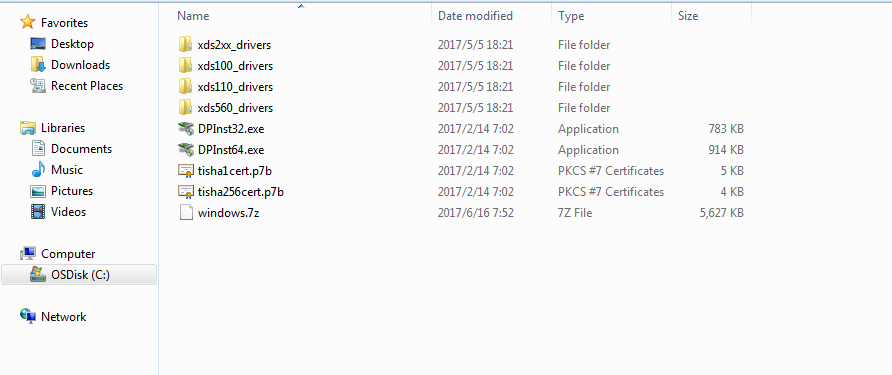
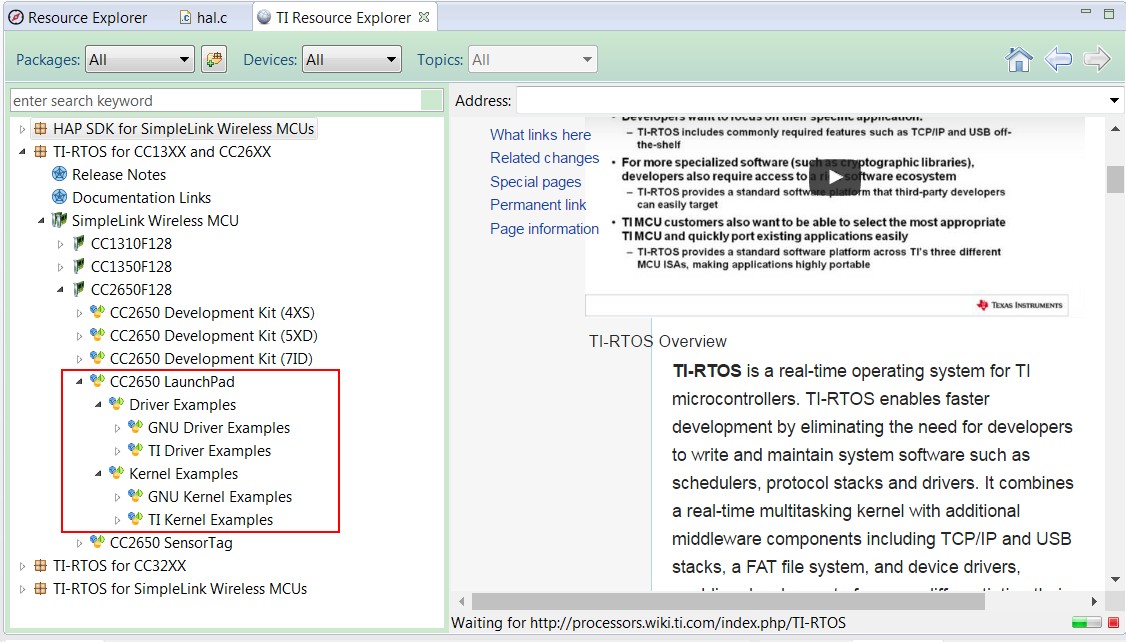
请问一下工程师们 你们有cc2650这个开发板的相关驱动吗?能给个链接吗 谢谢
This thread has been locked.
If you have a related question, please click the "Ask a related question" button in the top right corner. The newly created question will be automatically linked to this question.
下面这个link 也不错
http://dev.ti.com/tirex/#/DevTool/CC2650%20LaunchPad/?link=Development%20Tools%2FKits%20and%20Boards%2FCC2650%20LaunchPad
Description
Develop MCU applications faster with TI-RTOS
TI-RTOS accelerates development schedules by eliminating the need to create basic system software functions from scratch. TI-RTOS scales from a real-time multitasking kernel - TI-RTOS Kernel - to a complete RTOS solution including additional middleware components, device drivers and power management. TI-RTOS and TI's ultra low-power MCUs combine to enable developers to design applications with much longer battery life. By providing essential system software components pre-tested and pre-integrated, TI-RTOS enables developers to focus on differentiating their application.
TI-RTOS builds on existing proven software components to ensure reliability and quality. It augments these with documentation, additional examples and APIs appropriate for multitasking development and integration testing to verify that all components work together. TI-RTOS applications may be developed with multiple Integrated Development Environments (IDEs) or toolchains, including Code Composer Studio™ IDE Desktop, Code Composer Studio IDE Cloud, Energia (an Arduino-compatible software environment), IAR Embedded Workbench IDE and GCC.
To obtain TI-RTOS for Microcontrollers (MCUs)
Licensing - TI-RTOS is provided with full source code and requires no up-front or runtime license fees. The multitasking kernel, TCP/IP networking stack, FAT File System, and all device drivers and examples all use open source BSD-like licensing. This enables developers to easily pass on software to partners or sub-contractors without cumbersome licensing constraints. Unlike the GPL license, the BSD license does not impose requirements for developers to ship their application source code.
TI-RTOS offers the following components:
| TI-RTOS Module | Description |
| TI-RTOS Kernel |
TI-RTOS Kernel (formerly known as SYS/BIOS) provides deterministic preemptive multithreading and synchronization services, memory management, and interrupt handling. |
| TI-RTOS Device Drivers and Board Initialization | TI-RTOS Drivers and Board Initialization provides a set of device driver APIs, such as Ethernet, UART and I2C, that are standard across all devices, as well as initialization code for all supported boards. All driver and board initialization APIs are built on the TivaWare, MWare, CCWare, or MSPWare libraries. |
| TI-RTOSNetworking | TI-RTOS Networking (formerly known as the NDK) provides an IPv4 and IPv6-compliant TCP/IP stack along with associated network applications such as DNS, HTTP, and DHCP. |
| TI-RTOS Wireless Connectivity | TI-RTOS is fully integrated with the wireless connectivity stacks provided with the SimpleLink™ Wireless MCU families, including Wi-Fi, Bluetooth Smart (Bluetooth Low Energy), and ZigBee®. |
| TI-RTOS File System | TI-RTOS File System is a FAT-compatible file system based on the open source Fatfs product. |
| TI-RTOS USB | TI-RTOS USB provides both USB Host and Device stacks, as well as MSC, CDC, and HID class drivers. |
| TI-RTOS Power Manager | The TI-RTOS Power Manager provides pre-implemented, ultra-low power modes and can automatically determine the optimal low-power mode when the CPU becomes idle. TI-RTOS drivers are power-aware and communicate with the Power Manager to ensure peripherals are powered-down when not in use. See our Power Management whitepaper for more details. |
| TI-RTOS Instrumentation | TI-RTOS Instrumentation allows developers to include debug instrumentation in their application that enables run-time behavior, including context-switching, to be displayed by system-level analysis tools. |
Customers who require additional functionality to complement that provided by TI-RTOS can license system software modules from TI-RTOS Ecosystem partners:
| Company | Products |
| HCC Embedded |
SNMP, Failsafe and Flash File Systems |
| wolfSSL |
SSL, TLS, DTLS, cipher libraries |
| Simma Software | CAN stacks |
TI-RTOS Kernel is a deterministic, preemptive, multitasking kernel that enables developers to create sophisticated applications without compromising real-time deadlines. The kernel services are summarized in the table below:
| Kernel Service | Description |
| Cache | Cache configuration and management |
| Clock | Time-triggered functions |
| Diags | User-configurable tracing including asserts for parameter and state checking |
| Error | Define, raise, and check error-handlers |
| Event |
Wait on any combination of multiple RTOS or custom events |
| GateMutex | Binary mutex with priority inheritance |
| HeapBuf | Fast, deterministic fixed-size buffer pools |
| HeapMem | Variable-sized dynamic heaps |
| HeapMultiBuf |
Variable-sized, deterministic dynamic heaps based on multiple buffer pools |
| Hardware Interrupts (HWI) |
Interface from hardware interrupts to the RTOS |
| Log |
Low-overhead logging and print statements |
| Mailbox | Synchronized data exchange between tasks |
| Memory |
Memory allocation interface |
| Semaphores |
Counting semaphores |
| Software Interrupts (SWI) | Lightweight preemptible threads that use the program stack but cannot yield |
| System |
General system functions such as abort, exit, and system printf |
| Task | Independent threads of execution that can yield the processor |
| Timer | Interface to hardware timers |
| Timestamp |
32- and 64-bit timestamping services |
For TI devices designed for use in IoT endpoint applications where power consumption is a key consideration, such as the SimpleLink™ CC3200 and CC2600 and MSP432™ MCU, TI-RTOS offers power management features that enable developers to easily leverage underlying hardware capabilities in the silicon.
See our Power Management whitepaper for more details.
In conjunction with Code Composer Studio (CCS), TI-RTOS Kernel provides several tools to aid debugging and optimization of multithreaded applications. The Run-time Object Viewer (ROV) enables a developer to check the status of OS objects such as tasks, mailboxes, and semaphores, including whether a task is ready, running or blocked; which tasks are blocked on an IPC; and whether tasks have exceeded their stack limits. ROV is integrated into both the CCS and IAR Embedded Workbench IDEs. CCS also includes a tool called RTOS Analyzer that captures behavior in real-time and can display the thread execution and switching sequence, thread and system CPU load, OS events, and user-defined log information.
TI-RTOS Networking - formerly known as the Network Developer Kit (NDK) - combines a dual mode IPv4/IPv6 stack with some network applications. TI-RTOS Networking support is available for both Ethernet-enabled MCU, MPUs, and DSPs. TI-RTOS Networking includes:
In addition, third-party add-ons are available for SNMP and TSL/SSL support. TI-RTOS offers Wi-Fi support through a driver for the SimpleLink CC3100. This driver is pre-integrated with the SPI driver for devices such as Tiva C and MSP432™ MCUs, enabling Wi-Fi capability to be added to these devices right out-of-the-box. TI-RTOS for the CC3200 fully supports the built-in Wi-Fi capability on that device.