
This thread has been locked.

If you have a related question, please click the "Ask a related question" button in the top right corner. The newly created question will be automatically linked to this question.

RE: OPA37: Ultra-Low Noise “N”-Stage Parallel Amplifier

Other Parts Discussed in Thread: OPA210

Thank you Links, very helpful reply.

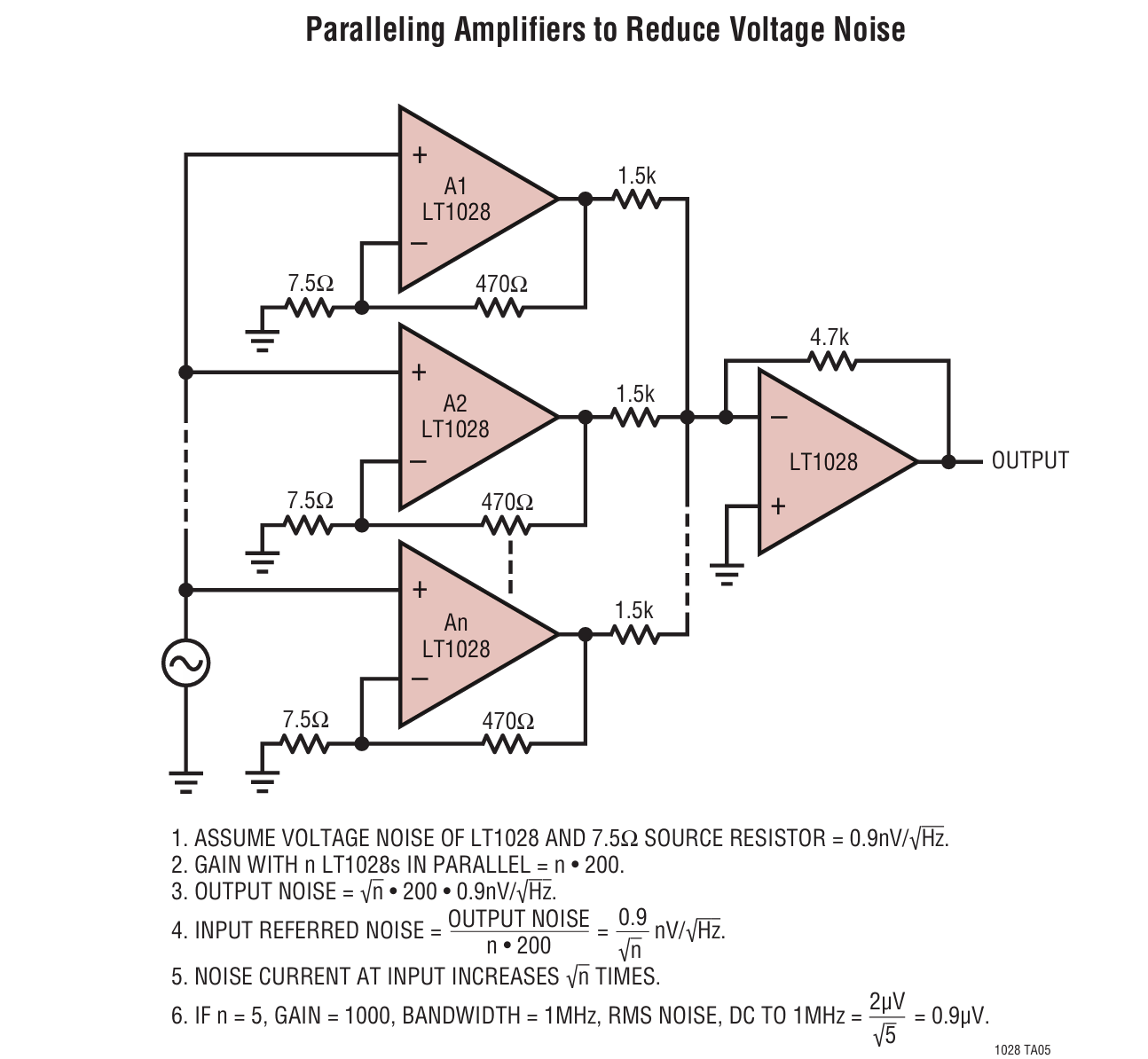
I found this circuit by chance, I also found a similar circuit built by LT1028. I want to test these two circuits. 

Besides, what's the power supply for this circuit? LDO, Li-ion battery, DC power supply or others? When I test this circuit, what should I pay attention to?

I'm looking forward to your reply, Thanks.
  • Hello,

    We cannot open the picture, could you send again.

    Thanks,

    Links

  • A similar circuit built by LT1028. When testing the "N" stage parallel amplifier, I know that the input should be connect to ground. But how do I set up power supply? Any other things to pay attention to when testing? Thanks.

  • The picture cannot be zoomed in,

  • I agree it is an interesting circuit.  I have seen internal circuits that have used this parallel technique to create an ultra-low noise buffer circuit.  The biggest problem is handing the gain; with the gain so high, usually people will also want to AC couple the circuit to make noise measurements.  Then depending on your low-frequency target, the ESR of the capacitor will be very important.

    You are right about the power supply, as well; any noise on the power supply will couple in through the PSRR of the amplifiers.  This is input-referred, so PSRR of 100 dB reduces to 60 dB after the amplifier is configured in 40 dB of gain.  I would recommend using batteries for lowest noise performance.

    What are you using this circuit for?  I would recommend a lower-noise amplifier like OPA210 if you don't need the full bandwidth mentioned above, this will achieve lower noise along with lower input bias current performance.