Part Number: TLV9062
Hi TI Experts,
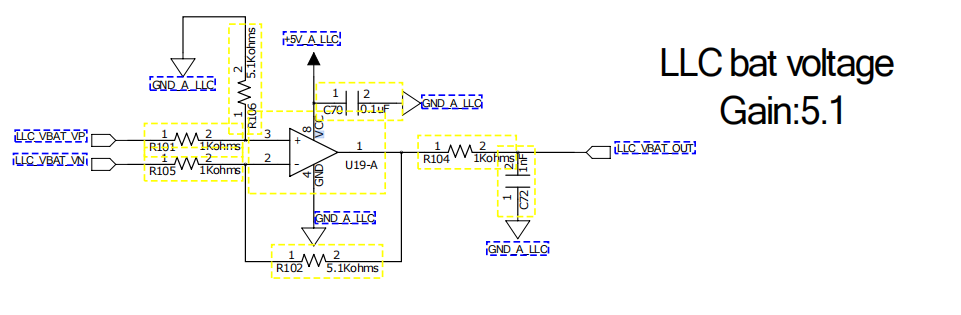
I'm using the TLV9062 to build a difference amplifier with a designed gain of 5.1 V/V.
Setup:
-
V+: 5V
-
V-: GND (Single Supply)
-
Topology: Standard 4-resistor difference amplifier.
-
Input Signal: 1kHz Sine wave.
Issue Description:
During testing, I noticed that the gain spikes significantly when the input signal approaches the negative rail (GND).
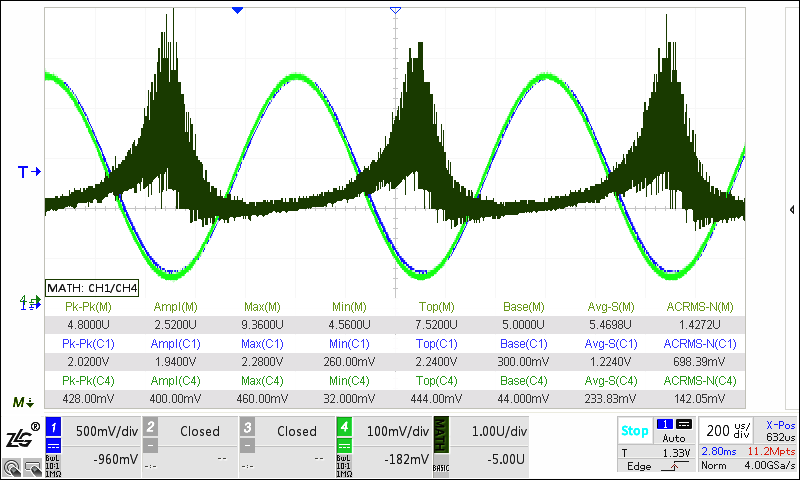
Measurement Screenshot Observation:
-
CH4 (Green): Input signal from function generator.
-
CH1 (Blue): Output of the TLV9062.
-
Math Trace (Dark Green): Calculated Gain (CH1 / CH4).
As shown in the attached waveform (screenshot attached), at the valley of the sine wave (approx 40mV input), the measured gain jumps to around 9 V/V, even though the design target is 5.1 V/V.
Question:
I know TLV9062 is a RRIO device, but is there a specific mechanism causing this gain increase so close to the GND rail?
Is this related to:
-
Transconductance (Gm) degradation near the rail?
-
Common-Mode Voltage limitations or phase reversal?
-
Output stage saturation causing loop gain collapse?
Any insights into the internal behavior causing this specific "gain increase" near the negative rail would be greatly appreciated.
Thanks!