
This thread has been locked.

If you have a related question, please click the "Ask a related question" button in the top right corner. The newly created question will be automatically linked to this question.

[参考译文] EK-TM4C1294XL:UART3针对定制板接收到 UDMA 问题

Guru**** 2562960 points
Other Parts Discussed in Thread: EK-TM4C1294XL, MSP430FR2355

请注意,本文内容源自机器翻译,可能存在语法或其它翻译错误,仅供参考。如需获取准确内容,请参阅链接中的英语原文或自行翻译。

https://e2e.ti.com/support/microcontrollers/arm-based-microcontrollers-group/arm-based-microcontrollers/f/arm-based-microcontrollers-forum/1005755/ek-tm4c1294xl-uart3-receive-with-udma-issue-for-customised-boards

器件型号:EK-TM4C1294XL
主题中讨论的其他器件: MSP430FR2355

大家好、团队、
我们正在研究 UART3接收和 UDMA、其中 EK-TM4C1294XL (Launchpad)作为主器件、MSP430FR2355作为小器件(从 TM4C 接收数据包并发送到 TM4C)。 因此、我已经为 UDMA 接收通道配置了 UART3。此外、我们还在主从设备之间对 Tx 和 Rx 使用 RS485、但每当我在 UDMA 接收步骤处保留断点时、数据都会逐字节获取。 但在自由运行时、没有数据到达我的内部缓冲区。 为什么会发生这种情况、与之前一样、在使用 TM4C (Launchpad)和 MSP430FR2355 (Launchpad)使用 UART0时、我也遇到了这种问题。 但与 UART3目前使用的配置类型相同。 UART3至 UART0是否有任何更改在设计中添加了 RS485? 请帮助我解决问题。 我在 uDMA 中面临着很多问题。 能不能有人告诉我为什么会这样发生?任何帮助都是非常感激的。

 void Init_UART3_UDMA()
{
 // Enable the uDMA controller at the system level.  Enable it to continue
    // to run while the processor is in sleep.
    //
    ROM_SysCtlPeripheralEnable(SYSCTL_PERIPH_UDMA);
    ROM_SysCtlPeripheralSleepEnable(SYSCTL_PERIPH_UDMA);

    //
    // Enable the uDMA controller error interrupt.  This interrupt will occur
    // if there is a bus error during a transfer.
    //
    ROM_IntEnable(INT_UDMAERR);

    //
    // Enable the uDMA controller.
    //
    ROM_uDMAEnable();

    //
    // Point at the control table to use for channel control structures.
    //
    ROM_uDMAControlBaseSet(pui8ControlTable);
    
    
    //
    // Enable the GPIO Peripheral used by the UART.
    //
    SysCtlPeripheralEnable(SYSCTL_PERIPH_GPIOA);

    //
    // Enable UART0.
    //
    SysCtlPeripheralEnable(SYSCTL_PERIPH_UART3);

    //
    // Enable processor interrupts.
    //
    IntMasterEnable();

    //
    // Configure GPIO Pins for UART mode.
    //
    GPIOPinConfigure(GPIO_PA4_U3RX);
    GPIOPinConfigure(GPIO_PA5_U3TX);
    GPIOPinTypeUART(GPIO_PORTA_BASE, GPIO_PIN_4 | GPIO_PIN_5);

    //
    // Initialize the UART for console I/O.
    //
    //UARTStdioConfig(3, 1000000, g_ui32SysClock);
    UARTConfigSetExpClk(UART3_BASE, g_ui32SysClock, 1000000,
                        (UART_CONFIG_WLEN_8 | UART_CONFIG_STOP_ONE |
                        UART_CONFIG_PAR_NONE));

    // UART9BitAddrSend(UART0_BASE, 0x00);
    //  UART9BitEnable(UART0_BASE);

    UARTFIFOEnable(UART3_BASE);

    UARTFIFOLevelSet(UART3_BASE, UART_FIFO_TX4_8, UART_FIFO_RX4_8);

    //
    // Enable the UART for operation, and enable the uDMA interface for both TX
    // and RX channels.
    //
    // MAP_UARTEnable(UART0_BASE);
    MAP_UARTDMAEnable(UART3_BASE, UART_DMA_RX | UART_DMA_TX);

   // HWREG(UART3_BASE + UART_O_CTL) |= UART_CTL_LBE;

    //
    // Put the attributes in a known state for the uDMA UART1RX channel.  These
    // should already be disabled by default.
    //
    MAP_uDMAChannelAttributeDisable(UDMA_CH16_UART3RX,
    UDMA_ATTR_ALTSELECT | UDMA_ATTR_USEBURST |
    UDMA_ATTR_HIGH_PRIORITY |
    UDMA_ATTR_REQMASK);

    //
    // Configure the control parameters for the primary control structure for
    // the UART RX channel.  The primary contol structure is used for the "A"
    // part of the ping-pong receive.  The transfer data size is 8 bits, the
    // source address does not increment since it will be reading from a
    // register.  The destination address increment is byte 8-bit bytes.  The
    // arbitration size is set to 4 to match the RX FIFO trigger threshold.
    // The uDMA controller will use a 4 byte burst transfer if possible.  This
    // will be somewhat more effecient that single byte transfers.
    //
    MAP_uDMAChannelControlSet(UDMA_CH16_UART3RX | UDMA_PRI_SELECT,
    UDMA_SIZE_16 | UDMA_SRC_INC_NONE | UDMA_DST_INC_16);

    //
    // Configure the control parameters for the alternate control structure for
    // the UART RX channel.  The alternate contol structure is used for the "B"
    // part of the ping-pong receive.  The configuration is identical to the
    // primary/A control structure.
    //
    MAP_uDMAChannelControlSet(UDMA_CH16_UART3RX | UDMA_ALT_SELECT,
    UDMA_SIZE_16 | UDMA_SRC_INC_NONE | UDMA_DST_INC_16);

    MAP_uDMAChannelEnable(UDMA_CH16_UART3RX);
//    ROM_uDMAChannelRequest(UDMA_CH16_UART3RX);
    MAP_uDMAChannelEnable(UDMA_CH17_UART3TX);

    //
    // Enable the UART DMA TX/RX interrupts.
    //
    MAP_UARTIntEnable(UART3_BASE, UART_INT_DMARX | UART_INT_DMATX);

    MAP_UARTEnable(UART3_BASE);
    //
    // Enable the UART interrupt.
    //
    //IntEnable(INT_UART0);
    MAP_UARTIntEnable(UART3_BASE, UART_INT_RX | UART_INT_RT);
}

void uDMA_Receive()
{
//
// Get the interrupt status.
//
    ui32Status1 = MAP_UARTIntStatus(UART3_BASE, true);

//
// Clear the asserted interrupts.
//
    MAP_UARTIntClear(UART3_BASE, ui32Status1);

//
// Check the DMA control table to see if the Basic "gu8Array" transfer is
// complete.  The "gu8Array" transfer uses receive buffer "gu8Array", and
// the primary control structure.
//
    ui32Mode = ROM_uDMAChannelModeGet(
            UDMA_CH16_UART3RX | UDMA_PRI_SELECT);

//
// If the primary control structure indicates stop, that means the "gu8Array"
// receive buffer is done.
//
    if (ui32Mode == UDMA_MODE_STOP)
    {

        ROM_uDMAChannelTransferSet(
                UDMA_CH16_UART3RX | UDMA_PRI_SELECT,
                UDMA_MODE_BASIC,
                (void*) (UART3_BASE + (uint16_t) (UART_O_DR & 0xFFFF)),
                gu8Array, sizeof(gu8Array));

        ROM_uDMAChannelEnable(UDMA_CH16_UART3RX);
        ROM_uDMAChannelRequest(UDMA_CH16_UART3RX);
      
    }
}
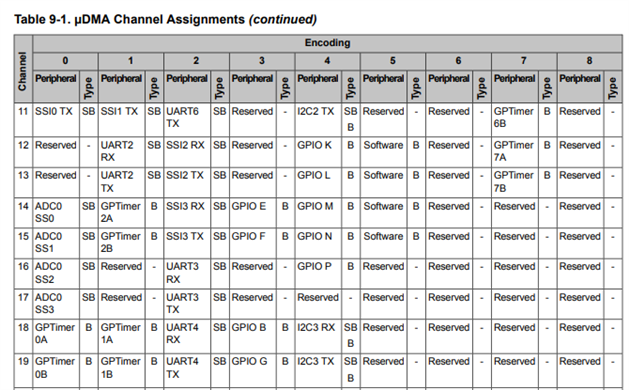
 

如上图所示、UART3和通道16、17位于外设2

上图 UART0和通道8、9作为外设0。

与 UART0相比,使用 UDMA 接收 UART3的配置是否出错,或者是否可以使用相同的配置;使用 UDMA 接收 UART0? 请参阅代码并指导我正确使用 uDMA 接收数据。

  • 请注意,本文内容源自机器翻译,可能存在语法或其它翻译错误,仅供参考。如需获取准确内容,请参阅链接中的英语原文或自行翻译。

    UART0 UDMA 和 UART3 UDMA 之间的一个区别是 UDMA 通道8是 UART0 RX 的默认通道、但 UDMA 通道16不是 UART3 RX 的默认通道。 因此、您必须包括对 uDMAChannekAssign (UDMA_CH16_UART3RX)的调用;

  • 请注意,本文内容源自机器翻译,可能存在语法或其它翻译错误,仅供参考。如需获取准确内容,请参阅链接中的英语原文或自行翻译。

    感谢您的回复 Bob、

    良好信息、我在配置中包含了"uDMAChannekAssign (UDMA_CH16_UART3RX);"、但没有变化。 如果这是唯一的问题、则需要获取数据、但没有数据进入我的内部缓冲区。 我还缺少什么吗?

    void Init_UDMA()
    {
        //
        // Enable the uDMA controller at the system level.  Enable it to continue
        // to run while the processor is in sleep.
        //
        ROM_SysCtlPeripheralEnable(SYSCTL_PERIPH_UDMA);
        ROM_SysCtlPeripheralSleepEnable(SYSCTL_PERIPH_UDMA);
    
        //
        // Enable the uDMA controller error interrupt.  This interrupt will occur
        // if there is a bus error during a transfer.
        //
        ROM_IntEnable(INT_UDMAERR);
    
        //
        // Enable the uDMA controller.
        //
        ROM_uDMAEnable();
    
        //
        // Point at the control table to use for channel control structures.
        //
        ROM_uDMAControlBaseSet(pui8ControlTable);
    
        //
        // Enable the GPIO Peripheral used by the UART.
        //
        SysCtlPeripheralEnable(SYSCTL_PERIPH_GPIOA);
    
        //
        // Enable UART0.
        //
        SysCtlPeripheralEnable(SYSCTL_PERIPH_UART3);
    
        //
        // Enable processor interrupts.
        //
        IntMasterEnable();
    
        //
        // Configure GPIO Pins for UART mode.
        //
        GPIOPinConfigure(GPIO_PA4_U3RX);
        GPIOPinConfigure(GPIO_PA5_U3TX);
        GPIOPinTypeUART(GPIO_PORTA_BASE, GPIO_PIN_4 | GPIO_PIN_5);
    
        //
        // Initialize the UART for console I/O.
        //
        //UARTStdioConfig(3, 1000000, g_ui32SysClock);
        UARTConfigSetExpClk(UART3_BASE, g_ui32SysClock, 1000000,
                            (UART_CONFIG_WLEN_8 | UART_CONFIG_STOP_ONE |
                            UART_CONFIG_PAR_NONE));
    
        // UART9BitAddrSend(UART0_BASE, 0x00);
        //  UART9BitEnable(UART0_BASE);
    
        UARTFIFOEnable(UART3_BASE);
    
        UARTFIFOLevelSet(UART3_BASE, UART_FIFO_TX4_8, UART_FIFO_RX4_8);
    
        //
        // Enable the UART for operation, and enable the uDMA interface for both TX
        // and RX channels.
        //
        // MAP_UARTEnable(UART0_BASE);
        MAP_UARTDMAEnable(UART3_BASE, UART_DMA_RX | UART_DMA_TX);
    
        //HWREG(UART3_BASE + UART_O_CTL) |= UART_CTL_LBE;
    
        MAP_uDMAChannelAssign(UDMA_CH16_UART3RX);
        
        //
        // Put the attributes in a known state for the uDMA UART1RX channel.  These
        // should already be disabled by default.
        //
        MAP_uDMAChannelAttributeDisable(UDMA_CH16_UART3RX,
        UDMA_ATTR_ALTSELECT | UDMA_ATTR_USEBURST |
        UDMA_ATTR_HIGH_PRIORITY |
        UDMA_ATTR_REQMASK);
    
        //
        // Configure the control parameters for the primary control structure for
        // the UART RX channel.  The primary contol structure is used for the "A"
        // part of the ping-pong receive.  The transfer data size is 8 bits, the
        // source address does not increment since it will be reading from a
        // register.  The destination address increment is byte 8-bit bytes.  The
        // arbitration size is set to 4 to match the RX FIFO trigger threshold.
        // The uDMA controller will use a 4 byte burst transfer if possible.  This
        // will be somewhat more effecient that single byte transfers.
        //
        MAP_uDMAChannelControlSet(UDMA_CH16_UART3RX | UDMA_PRI_SELECT,
        UDMA_SIZE_16 | UDMA_SRC_INC_NONE | UDMA_DST_INC_16);
    
    
        MAP_uDMAChannelEnable(UDMA_CH16_UART3RX);
        MAP_uDMAChannelEnable(UDMA_CH17_UART3TX);
    
        //
        // Enable the UART DMA TX/RX interrupts.
        //
        MAP_UARTIntEnable(UART3_BASE, UART_INT_DMARX | UART_INT_DMATX);
    
        MAP_UARTEnable(UART3_BASE);
        
        //
        // Enable the UART interrupt.
        //
        MAP_UARTIntEnable(UART3_BASE, UART_INT_RX | UART_INT_RT);
    }
    
    void uDMA_Receive()
    {
    
            ROM_uDMAChannelTransferSet(
                    UDMA_CH16_UART3RX | UDMA_PRI_SELECT,
                    UDMA_MODE_BASIC,
                    (void*) (UART3_BASE + (uint16_t) (UART_O_DR & 0xFFFF)),
                    gu8Array, sizeof(gu8Array));
    
           // ROM_uDMAChannelEnable(UDMA_CH16_UART3RX);
           // ROM_uDMAChannelRequest(UDMA_CH16_UART3RX);
        
    }

  • 请注意,本文内容源自机器翻译,可能存在语法或其它翻译错误,仅供参考。如需获取准确内容,请参阅链接中的英语原文或自行翻译。

    您是否已验证 UART3是否正在使用简单的轮询例程? 如果您有、则将整个项目导出到.zip 文件并将其附加到此线程。 然后、我将查看它。

  • 请注意,本文内容源自机器翻译,可能存在语法或其它翻译错误,仅供参考。如需获取准确内容,请参阅链接中的英语原文或自行翻译。

    是 Bob、

    我已经尝试过这种方法、在此过程中、当我在函数处保留/使用断点时、我还会接收字节 替换为内部缓冲器(gu8Array)中的新字节我在下面的函数处添加了一个断点

    " ROM_uDMAChannelTransferSet
    UDMA_CH16_UART3RX | UDMA_PRI_SELECT、
    UDMA_MODE_BASIC、
    (void*)(UART3_base +(uint16_t)(UART_O_DR 和0xFFFF)、
    gu8Array、sizeof (gu8Array);"

    需要更清楚地了解内部发生的情况。 任何帮助都是非常感谢的。

  • 请注意,本文内容源自机器翻译,可能存在语法或其它翻译错误,仅供参考。如需获取准确内容,请参阅链接中的英语原文或自行翻译。

    请将项目导出到.zip 文件并附加该文件。

  • 请注意,本文内容源自机器翻译,可能存在语法或其它翻译错误,仅供参考。如需获取准确内容,请参阅链接中的英语原文或自行翻译。

    好的、Bob、

    e2e.ti.com/.../Code-File.zip

    请检查并更新我 Bob。 任何帮助解决这一问题都是非常感谢的。 在此过程中、我们使用 RS485与 MSP430FR2355定制板进行通信。

  • 请注意,本文内容源自机器翻译,可能存在语法或其它翻译错误,仅供参考。如需获取准确内容,请参阅链接中的英语原文或自行翻译。

    您提供的代码中存在几个问题。 我只总结一下我必须进行的修改、因为我没有您的硬件。

    由于我没有一个器件会响应您发送的数据包、因此我使用了环回模式。 main.c 中的第231行启用环回模式。  我还将要接收的字节数更改为  

      sizeof(gu8Array) >> 1u

    因为每次传输都传输两个字节。

    e2e.ti.com/.../BC_5F00_Initial_5F00_Dummy2.zip