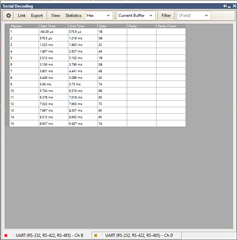
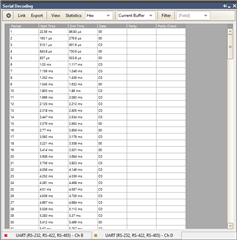
我有 一个 SN65HVD1477连接到 TI Tiva 微控制器、似乎无法从该微控制器接收数据。 正在正确地从 Tiva 微控制器传输 UART、探测 SN65HVD1477的 D 和 R 引脚可发现正在正确地从 MCU 传输数据、
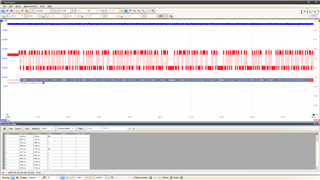
e2e.ti.com/.../Tiva-UART-Data.csv
DTech USB 2.0至 RS485适配器正在接收数据、

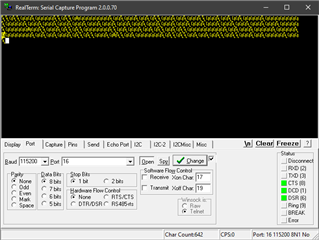
COM 适配器中的数据是一组回车、
是否有人遇到过此问题?
谢谢、
Allan
This thread has been locked.
If you have a related question, please click the "Ask a related question" button in the top right corner. The newly created question will be automatically linked to this question.
我有 一个 SN65HVD1477连接到 TI Tiva 微控制器、似乎无法从该微控制器接收数据。 正在正确地从 Tiva 微控制器传输 UART、探测 SN65HVD1477的 D 和 R 引脚可发现正在正确地从 MCU 传输数据、
e2e.ti.com/.../Tiva-UART-Data.csv
DTech USB 2.0至 RS485适配器正在接收数据、

COM 适配器中的数据是一组回车、
是否有人遇到过此问题?
谢谢、
Allan
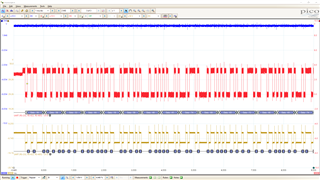
由于某种原因、从项目中删除此代码会影响 A0和 A1上 UART 的 BUAD 速率、
//============== SSI ==============
//
// The SSI0 peripheral must be enabled for use.
//
//SysCtlPeripheralEnable(SYSCTL_PERIPH_SSI1);
//SysCtlPeripheralEnable(SYSCTL_PERIPH_GPIOB);
//SysCtlPeripheralEnable(SYSCTL_PERIPH_GPIOE);
//
// Configure the pin muxing for SSI0 functions on port A2, A3, A4, and A5.
// This step is not necessary if your part does not support pin muxing.
// TODO: change this to select the port/pin you are using.
//
//GPIOPinConfigure(GPIO_PE4_SSI1XDAT0);
//GPIOPinConfigure(GPIO_PE5_SSI1XDAT1);
//GPIOPinConfigure(GPIO_PB5_SSI1CLK);
//
// Configure the GPIO settings for the SSI pins. This function also gives
// control of these pins to the SSI hardware.
//
//GPIOPinTypeSSI(GPIO_PORTE_BASE, GPIO_PIN_5 | GPIO_PIN_4);
//GPIOPinTypeSSI(GPIO_PORTB_BASE, GPIO_PIN_5);
//
// Configure and enable the SSI port for SPI master mode. Use SSI0,
// system clock supply, idle clock level low and active low clock in
// freescale SPI mode, master mode, 1MHz SSI frequency, and 8-bit data.
// For SPI mode, you can set the polarity of the SSI clock when the SSI
// unit is idle. You can also configure what clock edge you want to
// capture data on. Please reference the datasheet for more information on
// the different SPI modes.
//
// uint32_t ui32SysClock = SysCtlClockFreqSet((SYSCTL_XTAL_25MHZ |
// SYSCTL_OSC_MAIN |
// SYSCTL_USE_OSC), 25000000);
// SSIConfigSetExpClk(SSI1_BASE, ui32SysClock, SSI_FRF_MOTO_MODE_0,
// SSI_MODE_MASTER, 1000000, 8);
//
// Enable the SSI1 module.
//
//SSIEnable(SSI1_BASE);
//Chip select pin.
// ROM_GPIOPinTypeGPIOOutput(GPIO_PORTL_BASE, GPIO_PIN_0);
// MAP_GPIOPadConfigSet(GPIO_PORTL_BASE, GPIO_PIN_0, GPIO_STRENGTH_12MA,
// GPIO_PIN_TYPE_STD);