


Part Number: TMS320F28379D
Other Parts Discussed in Thread: C2000WARE
DSP作为从机,利用DMA传输的MISO延迟了四个字节,利用逻辑分析仪抓取的波形如下图
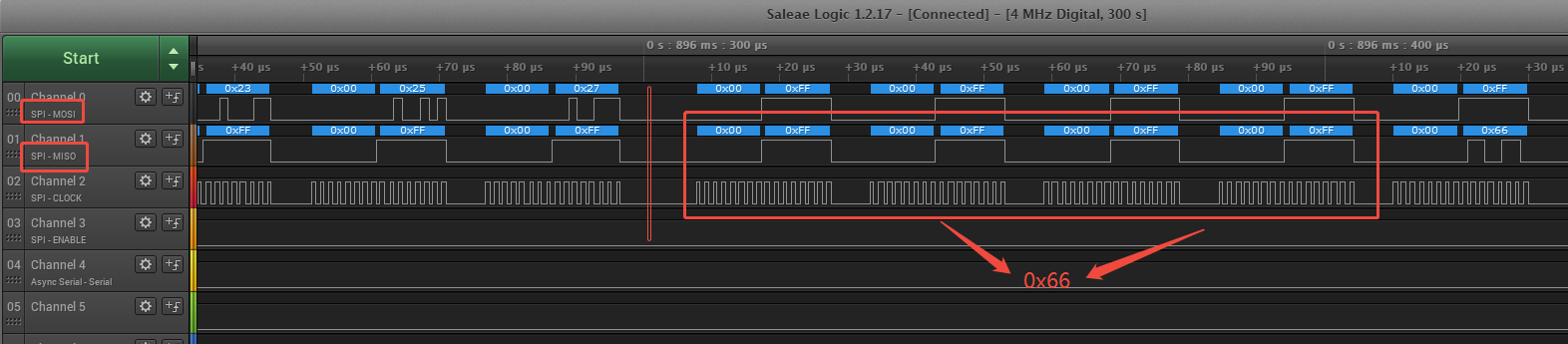
main.c的测试程序如下
//
// Included Files
//
#include "driverlib.h"
#include "device.h"
#include "board.h"
#include <string.h>

#define SPI_FRAME_LEN   20
// volatile uint16_t spi_rx_cnt = 0;
// #pragma DATA_SECTION(rData, "ramgs0");
// static uint16_t rData[SPI_FRAME_LEN];
// const void *rdataPtr = (void*)rData;

// #pragma DATA_SECTION(tData, "ramgs0");
// static uint16_t tData[SPI_FRAME_LEN];
// const void *tdataPtr = (void*)tData;

//===========================================

#pragma DATA_SECTION(rPing, "ramgs0");
#pragma DATA_SECTION(rPong, "ramgs0");
uint16_t rPing[SPI_FRAME_LEN];
uint16_t rPong[SPI_FRAME_LEN];

#pragma DATA_SECTION(tPing, "ramgs0");
#pragma DATA_SECTION(tPong, "ramgs0");
uint16_t tPing[SPI_FRAME_LEN];
uint16_t tPong[SPI_FRAME_LEN];


typedef struct {
    uint16_t *rxBuf;
    uint16_t *txBuf;
} SPI_Buffer;

SPI_Buffer bufPing = {rPing, tPing};
SPI_Buffer bufPong = {rPong, tPong};


SPI_Buffer *dmaBuf = &bufPing;   // DMA正在用
SPI_Buffer *cpuBuf = &bufPong;   // CPU正在处理

const void *rdataPtr;
const void *tdataPtr;

void SPI_initBuffers(void)
{
    rdataPtr = dmaBuf->rxBuf;
    tdataPtr = dmaBuf->txBuf;
}

// const void *rdataPtr = dmaBuf->rxBuf;
// const void *tdataPtr = dmaBuf->txBuf;


typedef enum {
    SPI_IDLE = 0,
    SPI_RX_DONE,
    SPI_PROCESSING,
    SPI_TX_READY
} SPI_State;

volatile SPI_State spiState = SPI_IDLE;
//===========================================


void process_frame(uint16_t *rx, uint16_t *tx)
{
    int i;
    for(i = 0; i < SPI_FRAME_LEN; i++)
    {
        tx[i] = rx[i];   // 示例:简单回传
    }
}

        // switch(spiState)
        // {
        //     case SPI_RX_DONE:
        //     {
        //         spiState = SPI_PROCESSING;

        //         // 处理上一帧数据
        //         process_frame(cpuBuf->rxBuf, cpuBuf->txBuf);
        //         // DMA_startChannel(DMA_CH2_BASE);
        //         spiState = SPI_TX_READY;
        //         break;
        //     }

        //     case SPI_TX_READY:
        //     {
        //         // 等待下一帧自动发送
        //         spiState = SPI_IDLE;
        //         break;
        //     }

        //     default:
        //         break;
        // }


//
// Main
//
void main(void)
{

    //
    // Initialize device clock and peripherals
    //
    Device_init();

    //
    // Disable pin locks and enable internal pullups.
    //
    Device_initGPIO();

    //
    // Initialize PIE and clear PIE registers. Disables CPU interrupts.
    //
    Interrupt_initModule();

    //
    // Initialize the PIE vector table with pointers to the shell Interrupt
    // Service Routines (ISR).
    //
    Interrupt_initVectorTable();

    //
    // Board initialization
    //

    memset((void*)tPing, 0xFF, sizeof(tPing));
    memset((void*)tPong, 0x66, sizeof(tPong));

    SPI_initBuffers();

    Board_init();

    SysCtl_selectSecController(SYSCTL_SEC_CONTROLLER_DMA, SYSCTL_SEC_CONTROLLER_DMA);

    // SysCtl_selectSecMaster(0, SYSCTL_SEC_MASTER_DMA);

    //
    // Enable Global Interrupt (INTM) and realtime interrupt (DBGM)
    //
    EINT;
    ERTM;

    //
    // Loop forever. Suspend or place breakpoints to observe the buffers.
    //
    while(1)
    {
        DEVICE_DELAY_US(100);

    }
}

volatile float32_t dma_rx_time = 0;


__attribute__((ramfunc))
__interrupt void INT_mySPI0_RX_DMA_ISR(void)
{
    Interrupt_clearACKGroup(INT_mySPI0_RX_DMA_INTERRUPT_ACK_GROUP);
    DMA_stopChannel(DMA_CH2_BASE);
    // 交换缓冲区(Ping-Pong切换)
    SPI_Buffer *tmp = dmaBuf;
    dmaBuf = cpuBuf;
    cpuBuf = tmp;

    //更新DMA地址
    rdataPtr = (void *)(dmaBuf->rxBuf);
    tdataPtr = (void *)(dmaBuf->txBuf);
    DMA_configAddresses(mySPI0_RX_DMA_BASE, rdataPtr, mySPI0_RX_DMA_ADDRESS);
    DMA_configAddresses(mySPI0_TX_DMA_BASE, mySPI0_TX_DMA_ADDRESS, tdataPtr);

    DMA_startChannel(DMA_CH2_BASE);

    // 标记接收完成
    spiState = SPI_RX_DONE;


}


__interrupt void INT_mySPI0_TX_DMA_ISR(void)
{
    Interrupt_clearACKGroup(INT_mySPI0_TX_DMA_INTERRUPT_ACK_GROUP);

}


__interrupt void INT_mySPI0_RX_ISR(void)
{
    //
    // Clear interrupt flag and issue ACK
    //
    // uint16_t data = SPI_readDataNonBlocking(mySPI0_BASE);
    // rData[spi_rx_cnt++] = data;
    SPI_clearInterruptStatus(mySPI0_BASE, SPI_INT_RXFF);
    Interrupt_clearACKGroup(INT_mySPI0_RX_INTERRUPT_ACK_GROUP);

}

__interrupt void INT_mySPI0_TX_ISR(void)
{
    SPI_clearInterruptStatus(mySPI0_BASE, INT_mySPI0_TX);
    Interrupt_clearACKGroup(INT_mySPI0_TX_INTERRUPT_ACK_GROUP);
}
DMA配置如下:
/*
 * Copyright (c) 2020 Texas Instruments Incorporated - http://www.ti.com
 * All rights reserved.
 *
 * Redistribution and use in source and binary forms, with or without
 * modification, are permitted provided that the following conditions
 * are met:
 *
 * *  Redistributions of source code must retain the above copyright
 *    notice, this list of conditions and the following disclaimer.
 *
 * *  Redistributions in binary form must reproduce the above copyright
 *    notice, this list of conditions and the following disclaimer in the
 *    documentation and/or other materials provided with the distribution.
 *
 * *  Neither the name of Texas Instruments Incorporated nor the names of
 *    its contributors may be used to endorse or promote products derived
 *    from this software without specific prior written permission.
 *
 * THIS SOFTWARE IS PROVIDED BY THE COPYRIGHT HOLDERS AND CONTRIBUTORS "AS IS"
 * AND ANY EXPRESS OR IMPLIED WARRANTIES, INCLUDING, BUT NOT LIMITED TO,
 * THE IMPLIED WARRANTIES OF MERCHANTABILITY AND FITNESS FOR A PARTICULAR
 * PURPOSE ARE DISCLAIMED. IN NO EVENT SHALL THE COPYRIGHT OWNER OR
 * CONTRIBUTORS BE LIABLE FOR ANY DIRECT, INDIRECT, INCIDENTAL, SPECIAL,
 * EXEMPLARY, OR CONSEQUENTIAL DAMAGES (INCLUDING, BUT NOT LIMITED TO,
 * PROCUREMENT OF SUBSTITUTE GOODS OR SERVICES; LOSS OF USE, DATA, OR PROFITS;
 * OR BUSINESS INTERRUPTION) HOWEVER CAUSED AND ON ANY THEORY OF LIABILITY,
 * WHETHER IN CONTRACT, STRICT LIABILITY, OR TORT (INCLUDING NEGLIGENCE OR
 * OTHERWISE) ARISING IN ANY WAY OUT OF THE USE OF THIS SOFTWARE,
 * EVEN IF ADVISED OF THE POSSIBILITY OF SUCH DAMAGE.
 *
 */

#include "board.h"

//*****************************************************************************
//
// Board Configurations
// Initializes the rest of the modules.
// Call this function in your application if you wish to do all module
// initialization.
// If you wish to not use some of the initializations, instead of the
// Board_init use the individual Module_inits
//
//*****************************************************************************
void Board_init()
{
	EALLOW;

	PinMux_init();
	CPUTIMER_init();
	DMA_init();
	SPI_init();
	INTERRUPT_init();

	EDIS;
}

//*****************************************************************************
//
// PINMUX Configurations
//
//*****************************************************************************
void PinMux_init()
{
	//
	// PinMux for modules assigned to CPU1
	//

	//
	// SPIB -> mySPI0 Pinmux
	//
	GPIO_setPinConfig(mySPI0_SPIPICO_PIN_CONFIG);
	GPIO_setPadConfig(mySPI0_SPIPICO_GPIO, GPIO_PIN_TYPE_STD);
	GPIO_setQualificationMode(mySPI0_SPIPICO_GPIO, GPIO_QUAL_ASYNC);

	GPIO_setPinConfig(mySPI0_SPIPOCI_PIN_CONFIG);
	GPIO_setPadConfig(mySPI0_SPIPOCI_GPIO, GPIO_PIN_TYPE_STD);
	GPIO_setQualificationMode(mySPI0_SPIPOCI_GPIO, GPIO_QUAL_ASYNC);

	GPIO_setPinConfig(mySPI0_SPICLK_PIN_CONFIG);
	GPIO_setPadConfig(mySPI0_SPICLK_GPIO, GPIO_PIN_TYPE_STD);
	GPIO_setQualificationMode(mySPI0_SPICLK_GPIO, GPIO_QUAL_ASYNC);

	GPIO_setPinConfig(mySPI0_SPIPTE_PIN_CONFIG);
	GPIO_setPadConfig(mySPI0_SPIPTE_GPIO, GPIO_PIN_TYPE_STD);
	GPIO_setQualificationMode(mySPI0_SPIPTE_GPIO, GPIO_QUAL_ASYNC);


}

//*****************************************************************************
//
// CPUTIMER Configurations
//
//*****************************************************************************
void CPUTIMER_init(){
	myCPUTIMER0_init();
}

void myCPUTIMER0_init(){
	CPUTimer_setEmulationMode(myCPUTIMER0_BASE, CPUTIMER_EMULATIONMODE_STOPAFTERNEXTDECREMENT);
	CPUTimer_setPreScaler(myCPUTIMER0_BASE, 0U);
	CPUTimer_setPeriod(myCPUTIMER0_BASE, 4294967295U);
	CPUTimer_disableInterrupt(myCPUTIMER0_BASE);
	CPUTimer_stopTimer(myCPUTIMER0_BASE);

	CPUTimer_reloadTimerCounter(myCPUTIMER0_BASE);
	CPUTimer_startTimer(myCPUTIMER0_BASE);
}

//*****************************************************************************
//
// DMA Configurations
//
//*****************************************************************************
void DMA_init(){
    DMA_initController();
	mySPI0_RX_DMA_init();
	mySPI0_TX_DMA_init();
}

void mySPI0_RX_DMA_init(){
    DMA_setEmulationMode(DMA_EMULATION_STOP);
    DMA_configAddresses(mySPI0_RX_DMA_BASE, rdataPtr, mySPI0_RX_DMA_ADDRESS);
    DMA_configBurst(mySPI0_RX_DMA_BASE, 1U, 0, 1);
    DMA_configTransfer(mySPI0_RX_DMA_BASE, 20U, 0, 1);
    DMA_configWrap(mySPI0_RX_DMA_BASE, 65535U, 0, 65535U, 0);
    DMA_configMode(mySPI0_RX_DMA_BASE, mySPI0_RX_DMA_TRIGGER, DMA_CFG_ONESHOT_DISABLE | DMA_CFG_CONTINUOUS_ENABLE | DMA_CFG_SIZE_16BIT);
    DMA_setInterruptMode(mySPI0_RX_DMA_BASE, DMA_INT_AT_END);
    DMA_enableInterrupt(mySPI0_RX_DMA_BASE);
    DMA_disableOverrunInterrupt(mySPI0_RX_DMA_BASE);
    DMA_enableTrigger(mySPI0_RX_DMA_BASE);
    DMA_startChannel(mySPI0_RX_DMA_BASE);
}
void mySPI0_TX_DMA_init(){
    DMA_setEmulationMode(DMA_EMULATION_STOP);
    DMA_configAddresses(mySPI0_TX_DMA_BASE, mySPI0_TX_DMA_ADDRESS, tdataPtr);
    DMA_configBurst(mySPI0_TX_DMA_BASE, 1U, 1, 0);
    DMA_configTransfer(mySPI0_TX_DMA_BASE, 20U, 1, 0);
    DMA_configWrap(mySPI0_TX_DMA_BASE, 65535U, 0, 65535U, 0);
    DMA_configMode(mySPI0_TX_DMA_BASE, mySPI0_TX_DMA_TRIGGER, DMA_CFG_ONESHOT_DISABLE | DMA_CFG_CONTINUOUS_ENABLE | DMA_CFG_SIZE_16BIT);
    DMA_setInterruptMode(mySPI0_TX_DMA_BASE, DMA_INT_AT_END);
    DMA_enableInterrupt(mySPI0_TX_DMA_BASE);
    DMA_disableOverrunInterrupt(mySPI0_TX_DMA_BASE);
    DMA_enableTrigger(mySPI0_TX_DMA_BASE);
    DMA_startChannel(mySPI0_TX_DMA_BASE);
}

//*****************************************************************************
//
// INTERRUPT Configurations
//
//*****************************************************************************
void INTERRUPT_init(){

	// Interrupt Settings for INT_mySPI0_RX
	// ISR need to be defined for the registered interrupts
	Interrupt_register(INT_mySPI0_RX, &INT_mySPI0_RX_ISR);
	Interrupt_enable(INT_mySPI0_RX);

	// Interrupt Settings for INT_mySPI0_TX
	// ISR need to be defined for the registered interrupts
	Interrupt_register(INT_mySPI0_TX, &INT_mySPI0_TX_ISR);
	Interrupt_enable(INT_mySPI0_TX);

	// Interrupt Settings for INT_mySPI0_RX_DMA
	// ISR need to be defined for the registered interrupts
	Interrupt_register(INT_mySPI0_RX_DMA, &INT_mySPI0_RX_DMA_ISR);
	Interrupt_enable(INT_mySPI0_RX_DMA);

	// Interrupt Settings for INT_mySPI0_TX_DMA
	// ISR need to be defined for the registered interrupts
	Interrupt_register(INT_mySPI0_TX_DMA, &INT_mySPI0_TX_DMA_ISR);
	Interrupt_enable(INT_mySPI0_TX_DMA);
}
//*****************************************************************************
//
// SPI Configurations
//
//*****************************************************************************
void SPI_init(){
	mySPI0_init();
}

void mySPI0_init(){
	SPI_disableModule(mySPI0_BASE);
	SPI_setConfig(mySPI0_BASE, DEVICE_LSPCLK_FREQ, SPI_PROT_POL1PHA0,
				  SPI_MODE_PERIPHERAL, mySPI0_BITRATE, mySPI0_DATAWIDTH);
	SPI_setPTESignalPolarity(mySPI0_BASE, SPI_PTE_ACTIVE_LOW);
	SPI_enableFIFO(mySPI0_BASE);
	SPI_setFIFOInterruptLevel(mySPI0_BASE, SPI_FIFO_TXEMPTY, SPI_FIFO_RX1);
	SPI_clearInterruptStatus(mySPI0_BASE, SPI_INT_RXFF | SPI_INT_TXFF);
	SPI_enableInterrupt(mySPI0_BASE, SPI_INT_RXFF | SPI_INT_TXFF);
	SPI_disableLoopback(mySPI0_BASE);
	SPI_setEmulationMode(mySPI0_BASE, SPI_EMULATION_STOP_AFTER_TRANSMIT);
	SPI_enableModule(mySPI0_BASE);
}
