If you have a related question, please click the "Ask a related question" button in the top right corner. The newly created question will be automatically linked to this question.
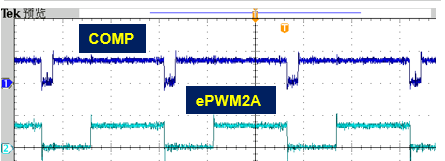
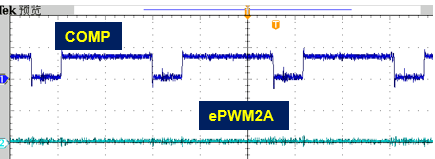
The DCAEVT1/2 and DCBEVT1/2 events can be filtered via event filtering logic to remove noise by optionally blanking events for a certain period of time. This is useful for cases where the analog comparator outputs may be selected to trigger DCAEVT1/2 and DCBEVT1/2 events, and the blanking logic is used to filter out potential noise on the signal prior to tripping the PWM outputs or generating an interrupt or ADC start-of-conversion. The event filtering can also capture the TBCTR value of the trip event. The diagram below shows the details of the event filtering logic.
If the blanking logic is enabled, one of the digital compare events – DCAEVT1, DCAEVT2, DCBEVT1, DCBEVT2 – is selected for filtering. The blanking window, which filters out all event occurrences on the signal while it is active, will be aligned to either a CTR = PRD pulse or a CTR = 0 pulse (configured by the DCFCTL[PULSESEL] bits). An offset value in TBCLK counts is programmed into the DCFOFFSET register, which determines at what point after the CTR = PRD or CTR = 0 pulse the blanking window starts. The duration of the blanking window, in number of TBCLK counts after the offset counter expires, is written to the DCFWINDOW register by the application. During the blanking window, all events are ignored. Before and after the blanking window ends, events can generate soc, sync, interrupt, and force signals as before. The diagram below illustrates several timing conditions for the offset and blanking window within an ePWM period. Notice that if the blanking window crosses the CTR = 0 or CTR = PRD boundary, the next window still starts at the same offset value after the CTR = 0 or CTR = PRD pulse.