


Part Number: TMS320F28388D
我用测试C28核和CLA并行处理时(进行同样的代码),发现软件采用CLA_forceTasks(CLA1_BASE,CLA_TASKFLAG_1)启动TASK1时,并没有立即进入CLA_tas(),延时了1us才进入task。
__interrupt void Cla1Task1 ( void )
{
    //
    //Local Variables
    //
   // num = 0;
    GPIO_writePin(78,1);
//    GpioDataRegs.GPBSET.bit.GPIO33 = 1;
    int xTblIdx; //integer valued Table index
    float A0,A1,A2; //Table coefficients
    float *entry;
    float result;
    int i;
    //
    //Preprocessing
    //
    //__mdebugstop();
    xTblIdx = fVal * TABLE_SIZE_M_1; //convert table index to u16-bits
    xTblIdx = xTblIdx * 3; //Table is ordered as 3 32-bit coefficients, the
                           //index points to these triplets, hence the *3*sizeof(float)
//    entry = &CLAasinTable[xTblIdx];
//    A0 = *entry++;
//    A1 = *entry++;
//    A2 = *entry;
//    result = A0 + fVal*(A1 + A2*fVal);
//
//    //
//    //Post processing
//    //
//    if(fVal < 0)
//    {
//        result = - result;
//    }
    xTblIdx = xTblIdx * 3333;
    xTblIdx = xTblIdx * 3234 + xTblIdx * 367 ;
    fResult = xTblIdx;
//    GpioDataRegs.GPBCLEAR.bit.GPIO33 = 1;
    GPIO_writePin(78,0);
}
void main(void)
{
//
// Intialize device clock and peripherals
//
Device_init();
//
// Initialize GPIO and configure the GPIO pin as a push-pull output
//
GPIO_setPadConfig(78, GPIO_PIN_TYPE_STD);
GPIO_setPinConfig(GPIO_78_GPIO78);
GPIO_setDirectionMode(78, GPIO_DIR_MODE_OUT);
GPIO_setMasterCore(78, GPIO_CORE_CPU1_CLA1);
GPIO_setDirectionMode(80, GPIO_DIR_MODE_OUT);
GPIO_setPinConfig(80);
//
// Disable pin locks and enable internal pullups.
//
//Device_initGPIO(); //skipped for this example
//
// Initialize PIE and clear PIE registers. Disables CPU interrupts
//
Interrupt_initModule();
//
// Initialize the PIE vector table with pointers to the shell Interrupt
// Service Routines (ISR).
//
Interrupt_initVectorTable();
//
// Configure the CLA memory spaces first followed by
// the CLA task vectors
//
CLA_configClaMemory();
CLA_initCpu1Cla1();
//
// Enable Global Interrupt (INTM) and realtime interrupt (DBGM)
//
EINT;
ERTM;
//
// Run the test
//
//CLA_runTest();
for(;;)
{
int xTblIdx1; //integer valued Table index
float result1;
int i;
GPIO_writePin(80,1);
CLA_forceTasks(CLA1_BASE,CLA_TASKFLAG_1);
xTblIdx1 = fVal * TABLE_SIZE_M_1; //convert table index to u16-bits
xTblIdx1 = xTblIdx1 * 3; //Table is ordered as 3 32-bit coefficients, the
//index points to these triplets, hence the *3*sizeof(float)
xTblIdx1 = xTblIdx1 * 3333;
xTblIdx1 = xTblIdx1 * 3234 + xTblIdx1 * 367 ;
fResult = xTblIdx1;
GPIO_writePin(80,0);
DEVICE_DELAY_US(50);
}
}
测试发现GPIO78引脚都是再GPIO80拉高后1us才被拉高,而且主函数执行时间才750ns,而CLA执行了4.2us,
蓝色为CPIO80,红色为GPIO78.
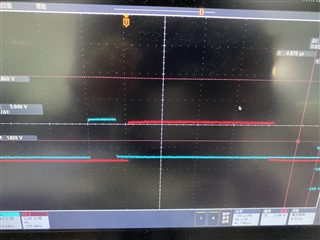
按我的理解,CLA跟CPU应该是并行处理,触发AICK1,进入TASK1执行代码,CPU继续继续z主程序代码,然后等待task完成,但实测并没有得到这个结果。

