您好,正在用ti的MSP-EXP430FR2311。需要实现程序中某些参数的掉电存储。在driverlib users guide和产品users guide 都没找到相关的内容。不知道是否有对flash进行读写操作的例程或者操作说明。在drivelib example也没找到相关例程。
This thread has been locked.
If you have a related question, please click the "Ask a related question" button in the top right corner. The newly created question will be automatically linked to this question.
您好,正在用ti的MSP-EXP430FR2311。需要实现程序中某些参数的掉电存储。在driverlib users guide和产品users guide 都没找到相关的内容。不知道是否有对flash进行读写操作的例程或者操作说明。在drivelib example也没找到相关例程。
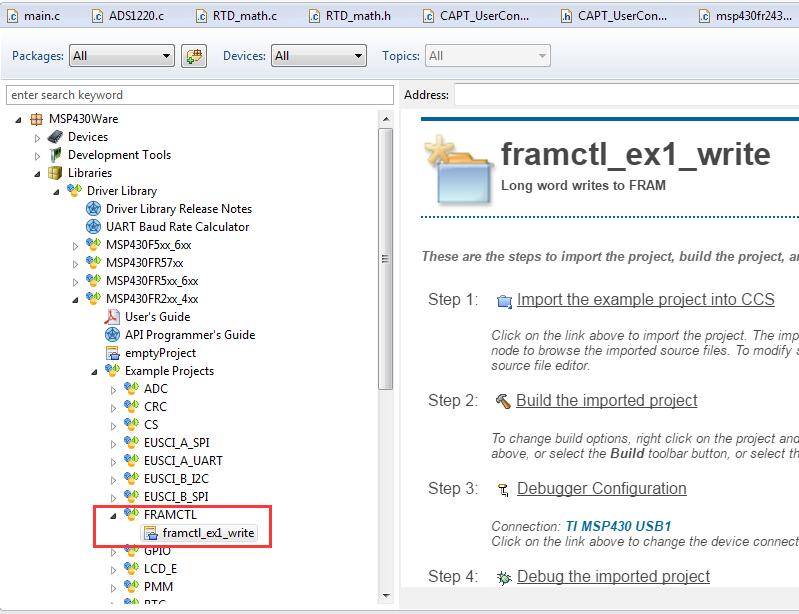
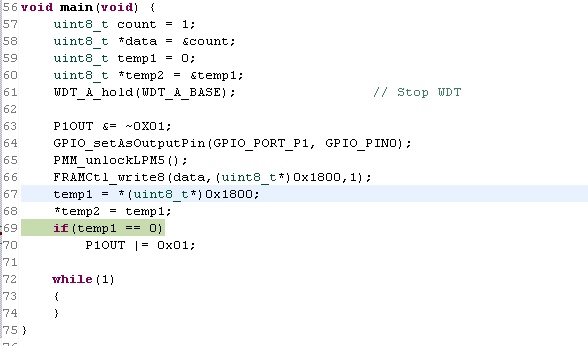
例程里是FR2433,用的0x1800存储地址。
/* --COPYRIGHT--,BSD_EX
* Copyright (c) 2014, Texas Instruments Incorporated
* All rights reserved.
*
* Redistribution and use in source and binary forms, with or without
* modification, are permitted provided that the following conditions
* are met:
*
* * Redistributions of source code must retain the above copyright
* notice, this list of conditions and the following disclaimer.
*
* * Redistributions in binary form must reproduce the above copyright
* notice, this list of conditions and the following disclaimer in the
* documentation and/or other materials provided with the distribution.
*
* * Neither the name of Texas Instruments Incorporated nor the names of
* its contributors may be used to endorse or promote products derived
* from this software without specific prior written permission.
*
* THIS SOFTWARE IS PROVIDED BY THE COPYRIGHT HOLDERS AND CONTRIBUTORS "AS IS"
* AND ANY EXPRESS OR IMPLIED WARRANTIES, INCLUDING, BUT NOT LIMITED TO,
* THE IMPLIED WARRANTIES OF MERCHANTABILITY AND FITNESS FOR A PARTICULAR
* PURPOSE ARE DISCLAIMED. IN NO EVENT SHALL THE COPYRIGHT OWNER OR
* CONTRIBUTORS BE LIABLE FOR ANY DIRECT, INDIRECT, INCIDENTAL, SPECIAL,
* EXEMPLARY, OR CONSEQUENTIAL DAMAGES (INCLUDING, BUT NOT LIMITED TO,
* PROCUREMENT OF SUBSTITUTE GOODS OR SERVICES; LOSS OF USE, DATA, OR PROFITS;
* OR BUSINESS INTERRUPTION) HOWEVER CAUSED AND ON ANY THEORY OF LIABILITY,
* WHETHER IN CONTRACT, STRICT LIABILITY, OR TORT (INCLUDING NEGLIGENCE OR
* OTHERWISE) ARISING IN ANY WAY OUT OF THE USE OF THIS SOFTWARE,
* EVEN IF ADVISED OF THE POSSIBILITY OF SUCH DAMAGE.
*
*******************************************************************************
*
* MSP430 CODE EXAMPLE DISCLAIMER
*
* MSP430 code examples are self-contained low-level programs that typically
* demonstrate a single peripheral function or device feature in a highly
* concise manner. For this the code may rely on the device's power-on default
* register values and settings such as the clock configuration and care must
* be taken when combining code from several examples to avoid potential side
* effects. Also see www.ti.com/grace for a GUI- and www.ti.com/msp430ware
* for an API functional library-approach to peripheral configuration.
*
* --/COPYRIGHT--*/
//******************************************************************************
// MSP430FR243x Demo - Long word writes to FRAM
//
// Description: Use long word write to write to 512 byte blocks of FRAM.
// Toggle LED after every 100 writes.
// NOTE: Running this example for extended periods will impact the FRAM
// endurance.
// ACLK = REFO, MCLK = SMCLK = default DCODIV = ~1MHz
//
// It is recommended to disable interrupt while code is writing to main FRAM,
// because it is dangerous for running the interrupt services routine with
// PFWP disabled.
// This code examples is using DFWP which wouldn't have dangerous. But it is
// recommended to disable interrupt if user is using PFWP.
//
// MSP430FR2433
// ---------------
// /|\| |
// | | |
// --|RST |
// | |
// | P1.0 |---> LED
//
// Ling Zhu
// Texas Instruments Inc.
// Feb 2015
// Built with IAR Embedded Workbench v6.20 & Code Composer Studio v6.0.1
//******************************************************************************
#include <msp430.h>
void FRAMWrite(void);
unsigned char count = 0;
unsigned long *FRAM_write_ptr;
unsigned long data;
#define FRAM_TEST_START 0x1800
int main(void)
{
WDTCTL = WDTPW | WDTHOLD; // Stop watchdog timer
P1OUT &= ~BIT0; // Clear P1.0 output latch for a defined power-on state
P1DIR |= BIT0; // Set P1.0 to output directionOUT
PM5CTL0 &= ~LOCKLPM5; // Disable the GPIO power-on default high-impedance mode
// to activate previously configured port settings
data = 0x11111111; // Initialize dummy data
while(1)
{
data += 0x00010001;
FRAM_write_ptr = (unsigned long *)FRAM_TEST_START;
FRAMWrite();
count++;
if (count > 100)
{
P1OUT ^= 0x01; // Toggle LED to show 512 bytes
count = 0; // have been written
data = 0x11111111;
}
}
}
void FRAMWrite (void)
{
unsigned int i=0;
SYSCFG0 = FRWPPW | PFWP;
for (i = 0; i < 128; i++)
{
*FRAM_write_ptr++ = data;
}
SYSCFG0 = FRWPPW | PFWP | DFWP;
}
写
FRAMWrite_Char((uint8_t *)0x1800, 0xAA);
读
uint8 temp;
temp = *((uint8_t *)0x1800);
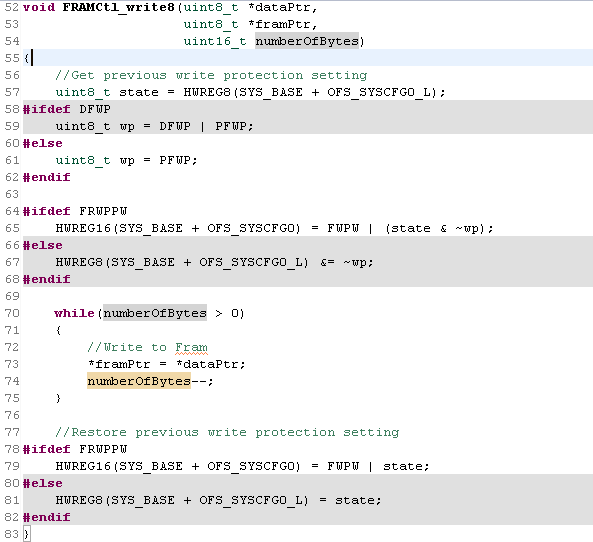
写函数 每个芯片可能有所差异,以下为范例
void FRAMWrite_Char(uint8_t *FRAM_write_ptr, uint8_t data)
{
SYSCFG0 = FRWPPW | PFWP;
*FRAM_write_ptr = data;
SYSCFG0 = FRWPPW | PFWP | DFWP;
}
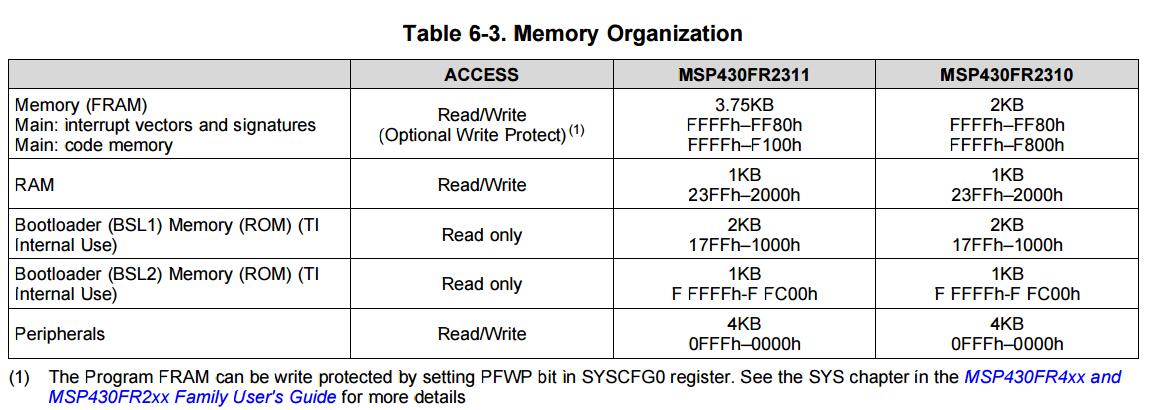
Outman J 说:您好,只能换了个430的样片。那FRAM区域里F100h到FFFFh是代码存储区域,其中FF80h到FFFFh是存储中断向量和标志位的地方,这样的么?
所以不对那部分区域进行操作就不会有问题了对吧? 另外在F100h到FFFFh是代码存储区域,烧写的代码是从高位到低位填还是低位到高位填应该怎么获知?
这样才好确定掉电存储的参数是从F100h开始写入还是从FFFFh开始写入,以避免对代码段存储空间的错误操作。不知这样的理解对否。
感谢您的解答!
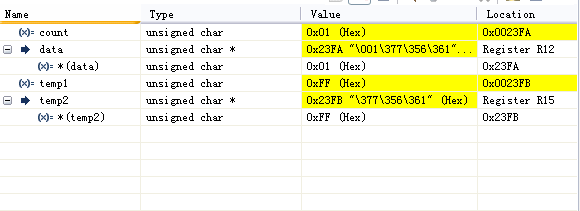
理解正确。烧写的代码是从高位到低位填还是低位到高位填应该怎么获知?可以在debug的时候,看一下memory地址。