Hi TI team:
在使用FR2433的串口通讯时,出现串口1无法收发数据,改变端口配置为串口0 时,收发正常。手册中未查到串口A0和A1有差异,程序使用样的配置A1却无法正常收发。
//串口都配置9600bps,目前串口0可以与串口工具进行收发数据,但是串口1接收数据进不到中断里
//串口1发送数据,串口工具也无法接收,用示波器观察单片机端口没有数据。
请TI 帮忙看看,谢谢。
This thread has been locked.
If you have a related question, please click the "Ask a related question" button in the top right corner. The newly created question will be automatically linked to this question.
Hi TI team:
在使用FR2433的串口通讯时,出现串口1无法收发数据,改变端口配置为串口0 时,收发正常。手册中未查到串口A0和A1有差异,程序使用样的配置A1却无法正常收发。
//串口都配置9600bps,目前串口0可以与串口工具进行收发数据,但是串口1接收数据进不到中断里
//串口1发送数据,串口工具也无法接收,用示波器观察单片机端口没有数据。
请TI 帮忙看看,谢谢。
以上传请查收帮忙看下,谢谢。
void USART0Initialize(void)
{
P1SEL0 |= BIT4+BIT5;
UCA0CTLW0 |= UCSWRST; // Put eUSCI in reset
UCA0CTLW0 |= UCSSEL__SMCLK;
UCA0BR0 = 0x06; // 1000000/16/9600
UCA0BR1 = 0x00;
UCA0MCTLW = UCOS16 | UCBRF_8;
UCA0CTLW0 &= ~UCSWRST; // Initialize eUSCI
UCA0IE |= UCRXIE; // Enable USCI_A0 RX interrupt
}
void USART1Initialize1(void)
{
P2SEL0 |= BIT5+BIT6;
UCA1CTLW0 |= UCSWRST; // Put eUSCI in reset
UCA1CTLW0 |= UCSSEL__SMCLK;
UCA1BR0 = 0x06; // 1000000/16/9600
UCA1BR1 = 0x00;
UCA1MCTLW = UCOS16 | UCBRF_8;
UCA1CTLW0 &= ~UCSWRST; // Initialize eUSCI
UCA1IE |= UCRXIE; // Enable USCI_A1 RX interrupt
}
#pragma vector=USCI_A1_VECTOR
__interrupt void USCI_A1_ISR(void)
{
_DINT();
_BIC_SR_IRQ(LPM3_bits);
fnReDatausart1_rx();
}
#pragma vector=USCI_A0_VECTOR
__interrupt void USCI_A0_ISR(void)
{
UCA0IFG &= ~UCRXIFG;
}
//���ڶ�����9600bps,Ŀǰ����0�����봮�ڹ��߽����շ����ݣ����Ǵ���1�������ݽ������ж���
//����1�������ݣ����ڹ���Ҳ�����գ���ʾ�����۲쵥Ƭ���˿�û������
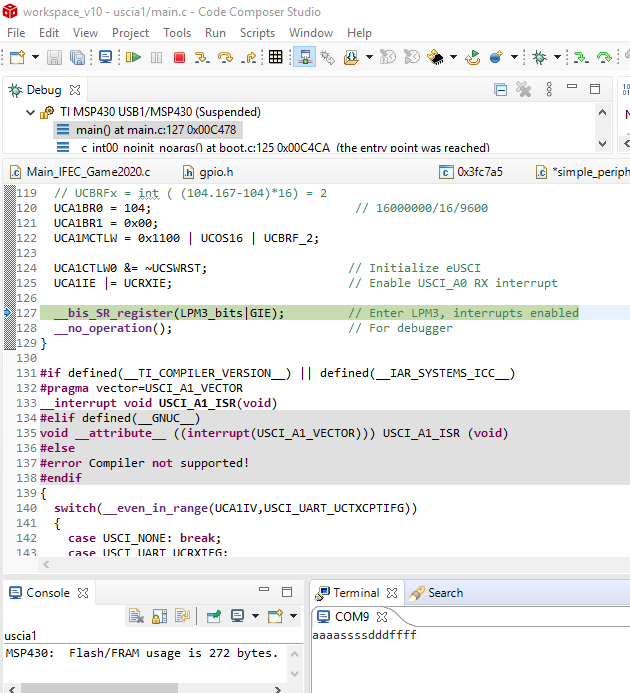
请您使用下面的程序,UART1,测试正常
/* --COPYRIGHT--,BSD_EX
* Copyright (c) 2014, Texas Instruments Incorporated
* All rights reserved.
*
* Redistribution and use in source and binary forms, with or without
* modification, are permitted provided that the following conditions
* are met:
*
* * Redistributions of source code must retain the above copyright
* notice, this list of conditions and the following disclaimer.
*
* * Redistributions in binary form must reproduce the above copyright
* notice, this list of conditions and the following disclaimer in the
* documentation and/or other materials provided with the distribution.
*
* * Neither the name of Texas Instruments Incorporated nor the names of
* its contributors may be used to endorse or promote products derived
* from this software without specific prior written permission.
*
* THIS SOFTWARE IS PROVIDED BY THE COPYRIGHT HOLDERS AND CONTRIBUTORS "AS IS"
* AND ANY EXPRESS OR IMPLIED WARRANTIES, INCLUDING, BUT NOT LIMITED TO,
* THE IMPLIED WARRANTIES OF MERCHANTABILITY AND FITNESS FOR A PARTICULAR
* PURPOSE ARE DISCLAIMED. IN NO EVENT SHALL THE COPYRIGHT OWNER OR
* CONTRIBUTORS BE LIABLE FOR ANY DIRECT, INDIRECT, INCIDENTAL, SPECIAL,
* EXEMPLARY, OR CONSEQUENTIAL DAMAGES (INCLUDING, BUT NOT LIMITED TO,
* PROCUREMENT OF SUBSTITUTE GOODS OR SERVICES; LOSS OF USE, DATA, OR PROFITS;
* OR BUSINESS INTERRUPTION) HOWEVER CAUSED AND ON ANY THEORY OF LIABILITY,
* WHETHER IN CONTRACT, STRICT LIABILITY, OR TORT (INCLUDING NEGLIGENCE OR
* OTHERWISE) ARISING IN ANY WAY OUT OF THE USE OF THIS SOFTWARE,
* EVEN IF ADVISED OF THE POSSIBILITY OF SUCH DAMAGE.
*
*******************************************************************************
*
* MSP430 CODE EXAMPLE DISCLAIMER
*
* MSP430 code examples are self-contained low-level programs that typically
* demonstrate a single peripheral function or device feature in a highly
* concise manner. For this the code may rely on the device's power-on default
* register values and settings such as the clock configuration and care must
* be taken when combining code from several examples to avoid potential side
* effects. Also see www.ti.com/grace for a GUI- and www.ti.com/msp430ware
* for an API functional library-approach to peripheral configuration.
*
* --/COPYRIGHT--*/
//******************************************************************************
// MSP430FR243x Demo - eUSCI_A1 UART echo at 9600 baud using BRCLK = 16MHz
//
// Description: This demo echoes back characters received via a PC serial port.
// SMCLK/ DCO is used as a clock source and the device is put in LPM3
// The auto-clock enable feature is used by the eUSCI and SMCLK is turned off
// when the UART is idle and turned on when a receive edge is detected.
// Note that level shifter hardware is needed to shift between RS232 and MSP
// voltage levels.
//
// The example code shows proper initialization of registers
// and interrupts to receive and transmit data.
// To test code in LPM3, disconnect the debugger.
//
// ACLK = REFO = 32768Hz, MCLK = DCODIV = SMCLK = 16MHz.
//
// MSP430FR2433
// -----------------
// /|\| |
// | | |
// --|RST |
// | |
// | |
// | P2.6/UCA1TXD|----> PC (echo)
// | P2.5/UCA1RXD|<---- PC
// | |
//
// Ling Zhu
// Texas Instruments Inc.
// Nov 2019
// Built with IAR Embedded Workbench v7.10 & Code Composer Studio v7.3
//******************************************************************************
#include <msp430.h>
void Init_GPIO();
int main(void)
{
WDTCTL = WDTPW | WDTHOLD; // Stop watchdog timer
// Configure GPIO
Init_GPIO();
PM5CTL0 &= ~LOCKLPM5; // Disable the GPIO power-on default high-impedance mode
// to activate 1previously configured port settings
// Configure one FRAM waitstate as required by the device datasheet for MCLK
// operation beyond 8MHz _before_ configuring the clock system.
FRCTL0 = FRCTLPW | NWAITS_1;
__bis_SR_register(SCG0); // disable FLL
CSCTL3 |= SELREF__REFOCLK; // Set REFO as FLL reference source
CSCTL0 = 0; // clear DCO and MOD registers
CSCTL1 &= ~(DCORSEL_7); // Clear DCO frequency select bits first
CSCTL1 |= DCORSEL_5; // Set DCO = 16MHz
CSCTL2 = FLLD_0 + 487; // DCOCLKDIV = 16MHz
__delay_cycles(3);
__bic_SR_register(SCG0); // enable FLL
while(CSCTL7 & (FLLUNLOCK0 | FLLUNLOCK1)); // FLL locked
CSCTL4 = SELMS__DCOCLKDIV | SELA__REFOCLK; // set default REFO(~32768Hz) as ACLK source, ACLK = 32768Hz
// default DCOCLKDIV as MCLK and SMCLK source
// Configure UART pins
P2SEL0 |= BIT5 | BIT6; // set 2-UART pin as second function
// Configure UART
UCA1CTLW0 |= UCSWRST;
UCA1CTLW0 |= UCSSEL__SMCLK;
// Baud Rate calculation
// 16000000/(16*9600) = 104.167
// Fractional portion = 0.167
// User's Guide Table 14-4: UCBRSx = 0x11
// UCBRFx = int ( (104.167-104)*16) = 2
UCA1BR0 = 104; // 16000000/16/9600
UCA1BR1 = 0x00;
UCA1MCTLW = 0x1100 | UCOS16 | UCBRF_2;
UCA1CTLW0 &= ~UCSWRST; // Initialize eUSCI
UCA1IE |= UCRXIE; // Enable USCI_A0 RX interrupt
__bis_SR_register(LPM3_bits|GIE); // Enter LPM3, interrupts enabled
__no_operation(); // For debugger
}
#if defined(__TI_COMPILER_VERSION__) || defined(__IAR_SYSTEMS_ICC__)
#pragma vector=USCI_A1_VECTOR
__interrupt void USCI_A1_ISR(void)
#elif defined(__GNUC__)
void __attribute__ ((interrupt(USCI_A1_VECTOR))) USCI_A1_ISR (void)
#else
#error Compiler not supported!
#endif
{
switch(__even_in_range(UCA1IV,USCI_UART_UCTXCPTIFG))
{
case USCI_NONE: break;
case USCI_UART_UCRXIFG:
while(!(UCA1IFG&UCTXIFG));
UCA1TXBUF = UCA1RXBUF;
__no_operation();
break;
case USCI_UART_UCTXIFG: break;
case USCI_UART_UCSTTIFG: break;
case USCI_UART_UCTXCPTIFG: break;
default: break;
}
}
void Init_GPIO()
{
P1DIR = 0xFF; P2DIR = 0xFF; P3DIR = 0xFF;
P1REN = 0xFF; P2REN = 0xFF; P3REN = 0xFF;
P1OUT = 0x00; P2OUT = 0x00; P3OUT = 0x00;
}