Part Number: MSP430FR2433
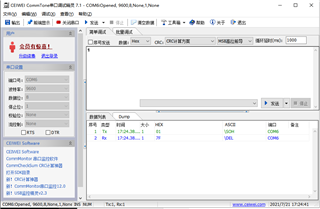
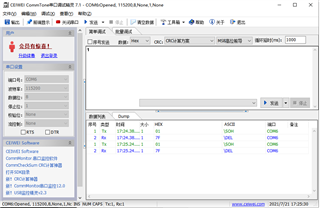
为什么我串口助手不管在何种波特率下输入01回来都是7F而且我改变代码让他一直输出01但是还是要先接收后输出7F,代码的改变不能改变功能,我把发送放在主函数里面while(1)里一直发送功能没有变还是要先发送再接受数据与截图一样。
/* --COPYRIGHT--,BSD_EX
 * Copyright (c) 2014, Texas Instruments Incorporated
 * All rights reserved.
 *
 * Redistribution and use in source and binary forms, with or without
 * modification, are permitted provided that the following conditions
 * are met:
 *
 * *  Redistributions of source code must retain the above copyright
 *    notice, this list of conditions and the following disclaimer.
 *
 * *  Redistributions in binary form must reproduce the above copyright
 *    notice, this list of conditions and the following disclaimer in the
 *    documentation and/or other materials provided with the distribution.
 *
 * *  Neither the name of Texas Instruments Incorporated nor the names of
 *    its contributors may be used to endorse or promote products derived
 *    from this software without specific prior written permission.
 *
 * THIS SOFTWARE IS PROVIDED BY THE COPYRIGHT HOLDERS AND CONTRIBUTORS "AS IS"
 * AND ANY EXPRESS OR IMPLIED WARRANTIES, INCLUDING, BUT NOT LIMITED TO,
 * THE IMPLIED WARRANTIES OF MERCHANTABILITY AND FITNESS FOR A PARTICULAR
 * PURPOSE ARE DISCLAIMED. IN NO EVENT SHALL THE COPYRIGHT OWNER OR
 * CONTRIBUTORS BE LIABLE FOR ANY DIRECT, INDIRECT, INCIDENTAL, SPECIAL,
 * EXEMPLARY, OR CONSEQUENTIAL DAMAGES (INCLUDING, BUT NOT LIMITED TO,
 * PROCUREMENT OF SUBSTITUTE GOODS OR SERVICES; LOSS OF USE, DATA, OR PROFITS;
 * OR BUSINESS INTERRUPTION) HOWEVER CAUSED AND ON ANY THEORY OF LIABILITY,
 * WHETHER IN CONTRACT, STRICT LIABILITY, OR TORT (INCLUDING NEGLIGENCE OR
 * OTHERWISE) ARISING IN ANY WAY OUT OF THE USE OF THIS SOFTWARE,
 * EVEN IF ADVISED OF THE POSSIBILITY OF SUCH DAMAGE.
 *
 *******************************************************************************
 *
 *                       MSP430 CODE EXAMPLE DISCLAIMER
 *
 * MSP430 code examples are self-contained low-level programs that typically
 * demonstrate a single peripheral function or device feature in a highly
 * concise manner. For this the code may rely on the device's power-on default
 * register values and settings such as the clock configuration and care must
 * be taken when combining code from several examples to avoid potential side
 * effects. Also see www.ti.com/grace for a GUI- and www.ti.com/msp430ware
 * for an API functional library-approach to peripheral configuration.
 *
 * --/COPYRIGHT--*/
//******************************************************************************
//   MSP430FR243x Demo - eUSCI_A0 UART echo at 9600 baud using BRCLK = 8MHz
//
//  Description: This demo echoes back characters received via a PC serial port.
//  SMCLK/ DCO is used as a clock source and the device is put in LPM3
//  The auto-clock enable feature is used by the eUSCI and SMCLK is turned off
//  when the UART is idle and turned on when a receive edge is detected.
//  Note that level shifter hardware is needed to shift between RS232 and MSP
//  voltage levels.
//
//  The example code shows proper initialization of registers
//  and interrupts to receive and transmit data.
//  To test code in LPM3, disconnect the debugger.
//
//  ACLK = REFO = 32768Hz, MCLK = DCODIV = SMCLK = 8MHz.
//
//                MSP430FR2433
//             -----------------
//         /|\|                 |
//          | |                 |
//          --|RST              |
//            |                 |
//            |                 |
//            |     P1.4/UCA0TXD|----> PC (echo)
//            |     P1.5/UCA0RXD|<---- PC
//            |                 |
//
//   Ling Zhu
//   Texas Instruments Inc.
//   Jan 2018
//   Built with IAR Embedded Workbench v7.10 & Code Composer Studio v7.3
//******************************************************************************

#include <msp430.h>
void Software_Trim();                       // Software Trim to get the best DCOFTRIM value
#define MCLK_FREQ_MHZ 8                     // MCLK = 8MHz

void Init_GPIO();

int main(void)
{
  WDTCTL = WDTPW | WDTHOLD;                // Stop watchdog timer

  // Configure GPIO
  Init_GPIO();
  PM5CTL0 &= ~LOCKLPM5;                    // Disable the GPIO power-on default high-impedance mode
                                           // to activate 1previously configured port settings

  __bis_SR_register(SCG0);                 // disable FLL
  CSCTL3 |= SELREF__REFOCLK;               // Set REFO as FLL reference source
  CSCTL1 = DCOFTRIMEN | DCOFTRIM0 | DCOFTRIM1 | DCORSEL_3;// DCOFTRIM=3, DCO Range = 8MHz
  CSCTL2 = FLLD_0 + 243;                   // DCODIV = 8MHz
  __delay_cycles(3);
  __bic_SR_register(SCG0);                 // enable FLL
  Software_Trim();                         // Software Trim to get the best DCOFTRIM value

  CSCTL4 = SELMS__DCOCLKDIV | SELA__REFOCLK; // set default REFO(~32768Hz) as ACLK source, ACLK = 32768Hz
                                           // default DCODIV as MCLK and SMCLK source

  // Configure UART pins
  P1SEL0 |= BIT4 | BIT5;                    // set 2-UART pin as second function

  // Configure UART
  UCA0CTLW0 |= UCSWRST;
  UCA0CTLW0 |= UCSSEL__SMCLK;

  // Baud Rate calculation
  // 8000000/(16*9600) = 52.083
  // Fractional portion = 0.083
  // User's Guide Table 14-4: UCBRSx = 0x49
  // UCBRFx = int ( (52.083-52)*16) = 1
  UCA0BR0 = 52;                             // 8000000/16/9600
  UCA0BR1 = 0x00;
  UCA0MCTLW = 0x4900 | UCOS16 | UCBRF_1;

  UCA0CTLW0 &= ~UCSWRST;                    // Initialize eUSCI
  UCA0IE |= UCRXIE;                         // Enable USCI_A0 RX interrupt

  __bis_SR_register(LPM3_bits|GIE);         // Enter LPM3, interrupts enabled
  __no_operation();                         // For debugger
}

#if defined(__TI_COMPILER_VERSION__) || defined(__IAR_SYSTEMS_ICC__)
#pragma vector=USCI_A0_VECTOR
__interrupt void USCI_A0_ISR(void)
#elif defined(__GNUC__)
void __attribute__ ((interrupt(USCI_A0_VECTOR))) USCI_A0_ISR (void)
#else
#error Compiler not supported!
#endif
{
  switch(__even_in_range(UCA0IV,USCI_UART_UCTXCPTIFG))
  {
    case USCI_NONE: break;
    case USCI_UART_UCRXIFG:
      while(!(UCA0IFG&UCTXIFG));
      UCA0TXBUF = UCA0RXBUF;
      __no_operation();
      break;
    case USCI_UART_UCTXIFG: break;
    case USCI_UART_UCSTTIFG: break;
    case USCI_UART_UCTXCPTIFG: break;
    default: break;
  }
}

void Init_GPIO()
{
    P1DIR = 0xFF; P2DIR = 0xFF; P3DIR = 0xFF;
    P1REN = 0xFF; P2REN = 0xFF; P3REN = 0xFF;
    P1OUT = 0x00; P2OUT = 0x00; P3OUT = 0x00;
}

void Software_Trim()
{
    unsigned int oldDcoTap = 0xffff;
    unsigned int newDcoTap = 0xffff;
    unsigned int newDcoDelta = 0xffff;
    unsigned int bestDcoDelta = 0xffff;
    unsigned int csCtl0Copy = 0;
    unsigned int csCtl1Copy = 0;
    unsigned int csCtl0Read = 0;
    unsigned int csCtl1Read = 0;
    unsigned int dcoFreqTrim = 3;
    unsigned char endLoop = 0;

    do
    {
        CSCTL0 = 0x100;                         // DCO Tap = 256
        do
        {
            CSCTL7 &= ~DCOFFG;                  // Clear DCO fault flag
        }while (CSCTL7 & DCOFFG);               // Test DCO fault flag

        __delay_cycles((unsigned int)3000 * MCLK_FREQ_MHZ);// Wait FLL lock status (FLLUNLOCK) to be stable
                                                           // Suggest to wait 24 cycles of divided FLL reference clock
        while((CSCTL7 & (FLLUNLOCK0 | FLLUNLOCK1)) && ((CSCTL7 & DCOFFG) == 0));

        csCtl0Read = CSCTL0;                   // Read CSCTL0
        csCtl1Read = CSCTL1;                   // Read CSCTL1

        oldDcoTap = newDcoTap;                 // Record DCOTAP value of last time
        newDcoTap = csCtl0Read & 0x01ff;       // Get DCOTAP value of this time
        dcoFreqTrim = (csCtl1Read & 0x0070)>>4;// Get DCOFTRIM value

        if(newDcoTap < 256)                    // DCOTAP < 256
        {
            newDcoDelta = 256 - newDcoTap;     // Delta value between DCPTAP and 256
            if((oldDcoTap != 0xffff) && (oldDcoTap >= 256)) // DCOTAP cross 256
                endLoop = 1;                   // Stop while loop
            else
            {
                dcoFreqTrim--;
                CSCTL1 = (csCtl1Read & (~(DCOFTRIM0+DCOFTRIM1+DCOFTRIM2))) | (dcoFreqTrim<<4);
            }
        }
        else                                   // DCOTAP >= 256
        {
            newDcoDelta = newDcoTap - 256;     // Delta value between DCPTAP and 256
            if(oldDcoTap < 256)                // DCOTAP cross 256
                endLoop = 1;                   // Stop while loop
            else
            {
                dcoFreqTrim++;
                CSCTL1 = (csCtl1Read & (~(DCOFTRIM0+DCOFTRIM1+DCOFTRIM2))) | (dcoFreqTrim<<4);
            }
        }

        if(newDcoDelta < bestDcoDelta)         // Record DCOTAP closest to 256
        {
            csCtl0Copy = csCtl0Read;
            csCtl1Copy = csCtl1Read;
            bestDcoDelta = newDcoDelta;
        }

    }while(endLoop == 0);                      // Poll until endLoop == 1

    CSCTL0 = csCtl0Copy;                       // Reload locked DCOTAP
    CSCTL1 = csCtl1Copy;                       // Reload locked DCOFTRIM
    while(CSCTL7 & (FLLUNLOCK0 | FLLUNLOCK1)); // Poll until FLL is locked
}