


大家好,我最近入手了一款TIVA系列TM4C123GH6PMI的launchpad,在使用I2C数据的时候遇到了一个问题,困扰了我数周,实在无法解决,希望得到大家的帮助。
我用该launchpad和一款tca6416 IO拓展芯片进行通信,该芯片的读需要先发送一个写信号,具体时序如下。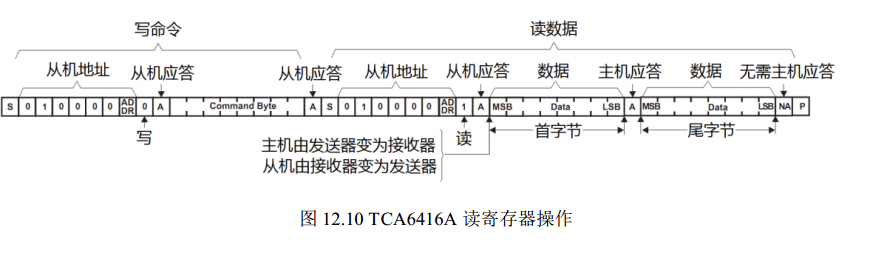
我的关于此芯片的代码如下
//中断服务程序,I2C通信在此服务程序中进行
void IntGPIOc(void)
{


	GPIOIntDisable(GPIO_PORTC_BASE, GPIO_PIN_7);

	GPIOIntClear(GPIO_PORTC_BASE,GPIO_PIN_7);

	delay_ms(100);

	if(GPIOPinRead(GPIO_PORTC_BASE,GPIO_PIN_7)==0)
	{
		    PCIntFlag=~PCIntFlag;
		    I2CMasterSlaveAddrSet(I2C0_BASE, SLAVE_ADDRESS, false);
			I2CMasterDataPut(I2C0_BASE, CommandByte);
		    //I2CMasterControl(I2C0_BASE, I2C_MASTER_CMD_SINGLE_RECEIVE);
		    while(I2CMasterBusBusy(I2C0_BASE))
		    {

		    }

		    I2CMasterSlaveAddrSet(I2C0_BASE, SLAVE_ADDRESS+1, true);
		    I2CMasterControl(I2C0_BASE, I2C_MASTER_CMD_SINGLE_RECEIVE);
		    data=I2CMasterDataGet(I2C0_BASE);
		    UARTprintf("Hello world!%d\n",data);
	}


    GPIOIntEnable(GPIO_PORTC_BASE, GPIO_PIN_7);

	//lcd_ShowChar_5x8(1,1,1,1,data);

}
//主函数代码
int
main(void)
{
	 //   uint32_t ui32DataTx;
	 // Set the clocking to run directly from the crystal.
	    SysCtlClockSet(SYSCTL_SYSDIV_4 | SYSCTL_USE_PLL | SYSCTL_XTAL_16MHZ |
	                   SYSCTL_OSC_MAIN);

	    ConfigureUART();
	    IntEnable(INT_GPIOC);
	    SysCtlPeripheralEnable(SYSCTL_PERIPH_GPIOC);
	    GPIOPinTypeGPIOInput(GPIO_PORTC_BASE, GPIO_PIN_7);
        //IntMasterEnable();
	    GPIOPadConfigSet(GPIO_PORTC_BASE,GPIO_PIN_7,GPIO_STRENGTH_2MA,GPIO_PIN_TYPE_STD_WPU);
	    GPIOIntTypeSet(GPIO_PORTC_BASE, GPIO_PIN_7, GPIO_BOTH_EDGES);
	    GPIOIntEnable(GPIO_PORTC_BASE, GPIO_PIN_7);

	    SysCtlPeripheralEnable(SYSCTL_PERIPH_I2C0);
	    SysCtlPeripheralEnable(SYSCTL_PERIPH_GPIOB);

	    GPIOPinConfigure(GPIO_PB2_I2C0SCL);
	    GPIOPinConfigure(GPIO_PB3_I2C0SDA);

	    GPIOPinTypeI2CSCL(GPIO_PORTB_BASE, GPIO_PIN_2);
	    GPIOPinTypeI2C(GPIO_PORTB_BASE, GPIO_PIN_3);

	    //HWREG(I2C0_BASE + I2C_O_MCR) |= 0x01;
	    //IntEnable(INT_I2C0);
	    //I2CSlaveIntEnableEx(I2C0_BASE, I2C_SLAVE_INT_DATA);

	        //
	        // Enable and initialize the I2C0 master module.  Use the system clock for
	        // the I2C0 module.  The last parameter sets the I2C data transfer rate.
	        // If false the data rate is set to 100kbps and if true the data rate will
	        // be set to 400kbps.  For this example we will use a data rate of 100kbps.
	        //
	    I2CMasterInitExpClk(I2C0_BASE, SysCtlClockGet(), false);

	    I2CMasterEnable(I2C0_BASE);
	        //
	        // Enable the I2C0 slave module.
	        //
	    //I2CSlaveEnable(I2C0_BASE);

	        //
	        // Set the slave address to SLAVE_ADDRESS.  In loopback mode, it's an
	        // arbitrary 7-bit number (set in a macro above) that is sent to the
	        // I2CMasterSlaveAddrSet function.
	        //
	    //I2CSlaveInit(I2C0_BASE, SLAVE_ADDRESS);

	        //
	        // Tell the master module what address it will place on the bus when
	        // communicating with the slave.  Set the address to SLAVE_ADDRESS
	        // (as set in the slave module).  The receive parameter is set to false
	        // which indicates the I2C Master is initiating a writes to the slave.  If
	        // true, that would indicate that the I2C Master is initiating reads from
	        // the slave.
	        //
//	    I2CMasterSlaveAddrSet(I2C0_BASE, SLAVE_ADDRESS, false);

	        //
	        // Set up the serial console to use for displaying messages.  This is just
	        // for this example program and is not needed for proper I2C operation.
	        //
	    //InitConsole();

	        //
	        // Enable interrupts to the processor.
	        //
	           IntMasterEnable();
while(1)
{

}
}
我调试了好久,但并不理解tca6416 restart的条件以及在该开发板上的函数, 希望得到大家的帮助,谢谢!!
