Michael Sun大哥:
这么些天天麻烦你帮忙解决问题,我自己都不好意思了,但估计最近一个月都还会问你许多我不懂的问题,
在问问题前,首先对你帮我结局的问题表示深深的感谢!!!
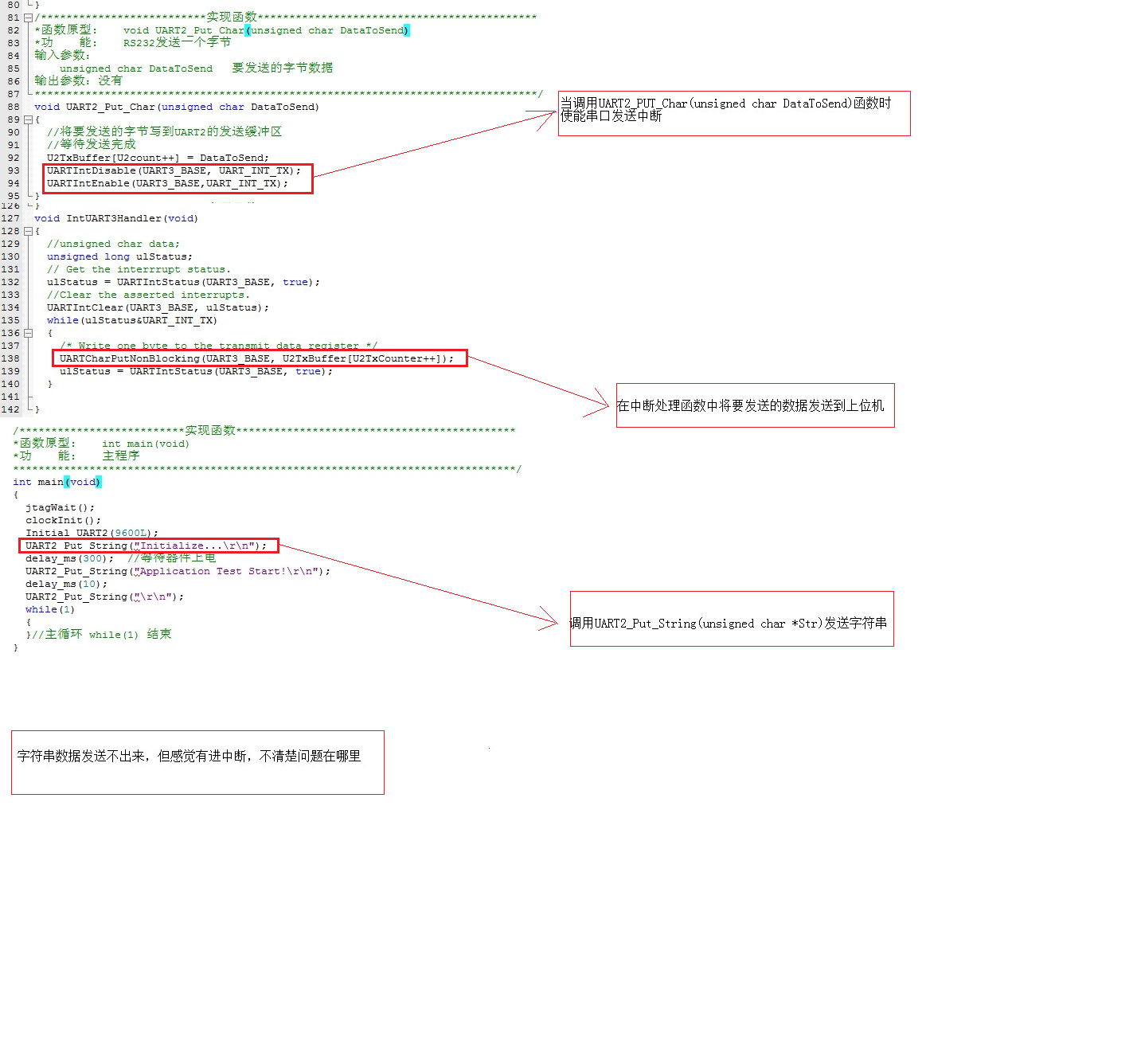
继昨天调试串口接收终端回环发送之后,我几天调试发送终端,把数据发送放在了中断服务函数中,但调试
中发现,所需要发送的字符串始终无法发送到终端,但感觉中断入服务函数了。还有昨天的回环接受实验,
发现发送到中断的数据会有错位,比如我在终端发送123给TM4C129,第一次按发送,返回的是12,第二
This thread has been locked.
If you have a related question, please click the "Ask a related question" button in the top right corner. The newly created question will be automatically linked to this question.
Michael Sun大哥:
这么些天天麻烦你帮忙解决问题,我自己都不好意思了,但估计最近一个月都还会问你许多我不懂的问题,
在问问题前,首先对你帮我结局的问题表示深深的感谢!!!
继昨天调试串口接收终端回环发送之后,我几天调试发送终端,把数据发送放在了中断服务函数中,但调试
中发现,所需要发送的字符串始终无法发送到终端,但感觉中断入服务函数了。还有昨天的回环接受实验,
发现发送到中断的数据会有错位,比如我在终端发送123给TM4C129,第一次按发送,返回的是12,第二
Share 一个uart串口发送数据的代码给你。串口中断服务程序再收到一个任意字节时,会置位UartTxIntEnFlag标志。主循环检测到这个标志后,会打开串口发送中断,把UartTxBuf中的数据发出去。
你的应用程序可以根据这个流程进行对应修改。这个代码我自己改的,可以用的。
#include <stdint.h>
#include <stdbool.h>
#include "inc/hw_ints.h"
#include "inc/hw_memmap.h"
#include "driverlib/debug.h"
#include "driverlib/fpu.h"
#include "driverlib/gpio.h"
#include "driverlib/interrupt.h"
#include "driverlib/pin_map.h"
#include "driverlib/rom.h"
#include "driverlib/sysctl.h"
#include "driverlib/uart.h"
uint8_t UartRxDatFlag = false;
uint8_t UartTxIntEnFlag = false;
uint8_t UartTxBuf[10] = {0x30,0x31,0x32,0x33,0x34,0x35,0x36,0x37,0x38,0x39};
uint16_t UartTxLen = 10;
uint16_t UartTxIndex = 0;
//*****************************************************************************
//
//! \addtogroup example_list
//! <h1>UART Echo (uart_echo)</h1>
//!
//! This example application utilizes the UART to echo text. The first UART
//! (connected to the USB debug virtual serial port on the evaluation board)
//! will be configured in 115,200 baud, 8-n-1 mode. All characters received on
//! the UART are transmitted back to the UART.
//
//*****************************************************************************
//*****************************************************************************
//
// The error routine that is called if the driver library encounters an error.
//
//*****************************************************************************
#ifdef DEBUG
void
__error__(char *pcFilename, uint32_t ui32Line)
{
}
#endif
//*****************************************************************************
//
// The UART interrupt handler.
//
//*****************************************************************************
void
UARTIntHandler(void)
{
uint32_t ui32Status;
//uint32_t val;
//
// Get the interrrupt status.
//
ui32Status = ROM_UARTIntStatus(UART0_BASE, true);
//
// Clear the asserted interrupts.
//
ROM_UARTIntClear(UART0_BASE, ui32Status);
if((ui32Status == UART_INT_RX) || (ui32Status == UART_INT_RT))
{
//
// Loop while there are characters in the receive FIFO.
//
while(ROM_UARTCharsAvail(UART0_BASE))
{
//
// Read the next character from the UART and write it back to the UART.
//
//ROM_UARTCharPutNonBlocking(UART0_BASE, ROM_UARTCharGetNonBlocking(UART0_BASE));
ROM_UARTCharGetNonBlocking(UART0_BASE);
UartTxIntEnFlag = true;
//
// Blink the LED to show a character transfer is occuring.
//
GPIOPinWrite(GPIO_PORTF_BASE, GPIO_PIN_2, GPIO_PIN_2);
//
// Delay for 1 millisecond. Each SysCtlDelay is about 3 clocks.
//
SysCtlDelay(SysCtlClockGet() / (1000 * 3));
//
// Turn off the LED
//
GPIOPinWrite(GPIO_PORTF_BASE, GPIO_PIN_2, 0);
}
}
else if(ui32Status == UART_INT_TX)
{
if(UartTxIndex < UartTxLen)
{
ROM_UARTCharPut(UART0_BASE, UartTxBuf[UartTxIndex ++]);
if(UartTxIndex >= UartTxLen)
{
UartTxIndex = 0;
ROM_UARTIntDisable(UART0_BASE, UART_INT_TX);
}
}
}
}
//*****************************************************************************
//
// Send a string to the UART.
//
//*****************************************************************************
void
UARTSend(const uint8_t *pui8Buffer, uint32_t ui32Count)
{
//
// Loop while there are more characters to send.
//
while(ui32Count--)
{
//
// Write the next character to the UART.
//
ROM_UARTCharPutNonBlocking(UART0_BASE, *pui8Buffer++);
while(ROM_UARTBusy(UART0_BASE));
}
}
//*****************************************************************************
//
// This example demonstrates how to send a string of data to the UART.
//
//*****************************************************************************
int
main(void)
{
//
// Enable lazy stacking for interrupt handlers. This allows floating-point
// instructions to be used within interrupt handlers, but at the expense of
// extra stack usage.
//
ROM_FPUEnable();
ROM_FPULazyStackingEnable();
//
// Set the clocking to run directly from the crystal.
//
ROM_SysCtlClockSet(SYSCTL_SYSDIV_1 | SYSCTL_USE_OSC | SYSCTL_OSC_MAIN |
SYSCTL_XTAL_16MHZ);
//
// Enable the GPIO port that is used for the on-board LED.
//
ROM_SysCtlPeripheralEnable(SYSCTL_PERIPH_GPIOF);
//
// Enable the GPIO pins for the LED (PF2).
//
ROM_GPIOPinTypeGPIOOutput(GPIO_PORTF_BASE, GPIO_PIN_2);
//
// Enable the peripherals used by this example.
//
ROM_SysCtlPeripheralEnable(SYSCTL_PERIPH_UART0);
ROM_SysCtlPeripheralEnable(SYSCTL_PERIPH_GPIOA);
//
// Enable processor interrupts.
//
ROM_IntMasterEnable();
//
// Set GPIO A0 and A1 as UART pins.
//
GPIOPinConfigure(GPIO_PA0_U0RX);
GPIOPinConfigure(GPIO_PA1_U0TX);
ROM_GPIOPinTypeUART(GPIO_PORTA_BASE, GPIO_PIN_0 | GPIO_PIN_1);
//
// Configure the UART for 115,200, 8-N-1 operation.
//
ROM_UARTConfigSetExpClk(UART0_BASE, ROM_SysCtlClockGet(), 115200,
(UART_CONFIG_WLEN_8 | UART_CONFIG_STOP_ONE |
UART_CONFIG_PAR_NONE));
ROM_UARTFIFODisable(UART0_BASE);
//
// Enable the UART interrupt.
//
ROM_IntEnable(INT_UART0);
ROM_UARTIntEnable(UART0_BASE, UART_INT_RX | UART_INT_RT);
//
// Prompt for text to be entered.
//
UARTSend((uint8_t *)"\033[2JEnter text: ", 16);
//
// Loop forever echoing data through the UART.
//
while(1)
{
if(UartTxIntEnFlag == true)
{
UartTxIntEnFlag = false;
ROM_UARTIntEnable(UART0_BASE, UART_INT_TX);
}
}
}
也可以实现的。
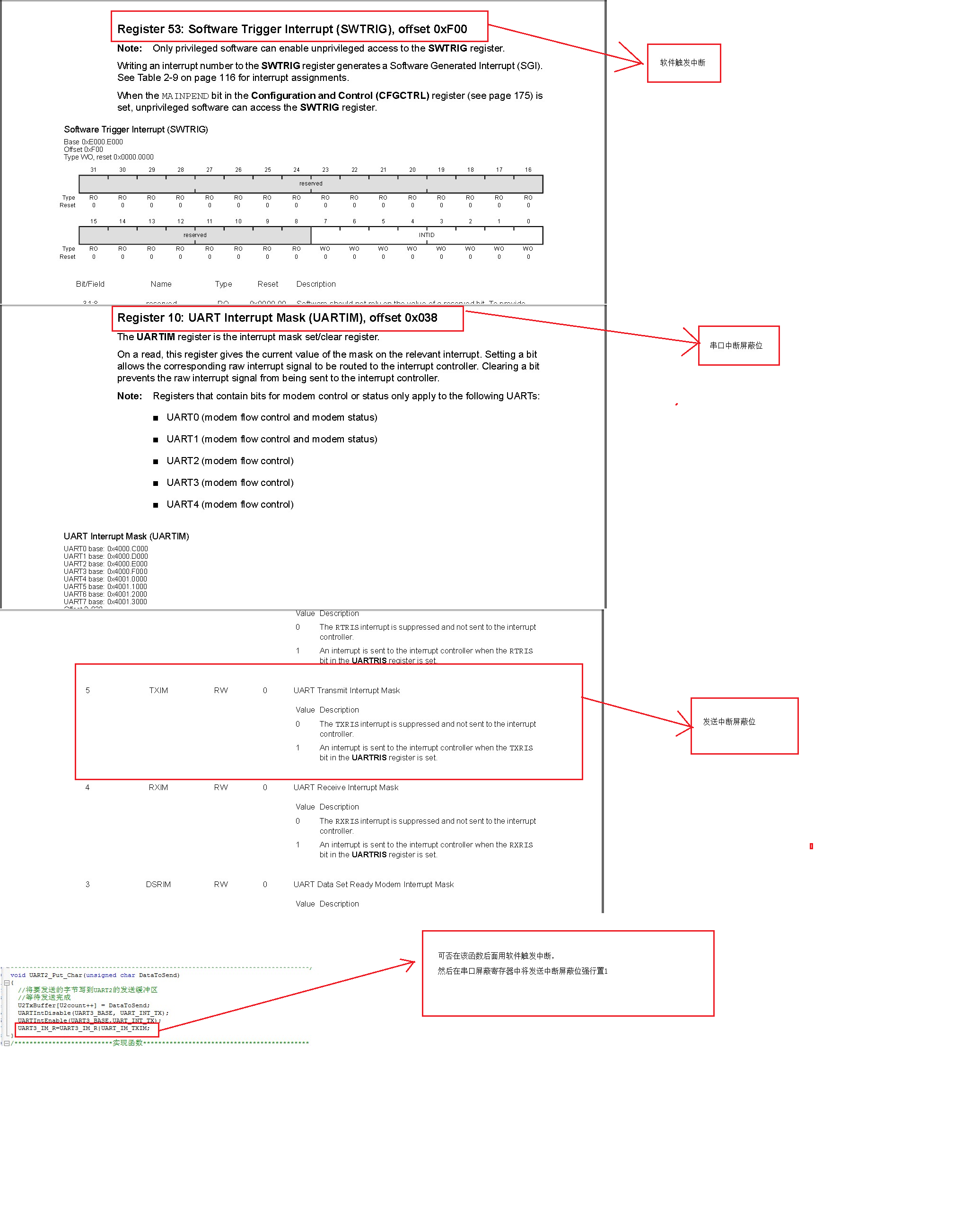
串口中断的机制是,使能UART_INT_TX中断时由于发送数据寄存器为空,就会立即进入中断服务程序。然后在中断服务程序中把数据写进去就发出去了。
最后一个数据发送完毕后还会进中断,这时候判断数据发完了,就把中断关了就行了。