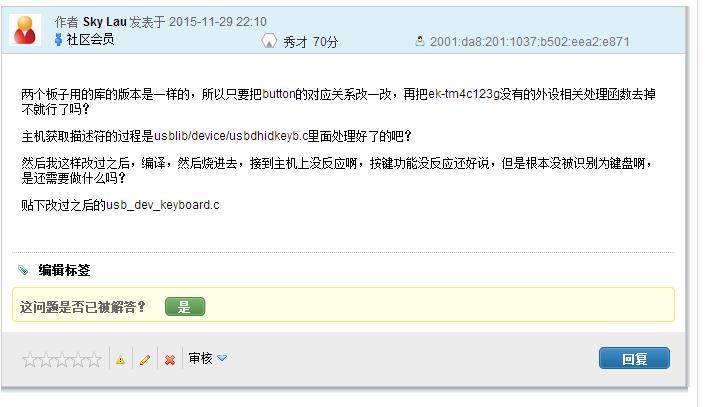
如题。
本人纯新手,需要将EK-TM4C123GXL模拟成usb_keyboard,哪位大神有例程吗>_<
在ek-lm系列里有这个例程,移植起来麻烦吗?求解~
This thread has been locked.
If you have a related question, please click the "Ask a related question" button in the top right corner. The newly created question will be automatically linked to this question.
如题。
本人纯新手,需要将EK-TM4C123GXL模拟成usb_keyboard,哪位大神有例程吗>_<
在ek-lm系列里有这个例程,移植起来麻烦吗?求解~

两个板子用的库的版本是一样的,所以只要把button的对应关系改一改,再把ek-tm4c123g没有的外设相关处理函数去掉不就行了吗?
主机获取描述符的过程是usblib/device/usbdhidkeyb.c里面处理好了的吧?
然后我这样改过之后,编译,然后烧进去,接到主机上没反应啊,按键功能没反应还好说,但是根本没被识别为键盘啊,是还需要做什么吗?
贴下改过之后的usb_dev_keyboard.c
#include <stdbool.h>
#include <stdint.h>
#include "inc/hw_memmap.h"
#include "inc/hw_types.h"
#include "inc/hw_gpio.h"
#include "inc/hw_sysctl.h"
#include "driverlib/debug.h"
#include "driverlib/fpu.h"
#include "driverlib/gpio.h"
#include "driverlib/pin_map.h"
#include "driverlib/rom.h"
#include "driverlib/sysctl.h"
#include "driverlib/systick.h"
#include "grlib/grlib.h"
#include "grlib/widget.h"
#include "usblib/usblib.h"
#include "usblib/usbhid.h"
#include "usblib/device/usbdevice.h"
#include "usblib/device/usbdhid.h"
#include "usblib/device/usbdhidkeyb.h"
#include "drivers/buttons.h"
#include "usb_keyb_structs.h"

//*****************************************************************************
//
//! <h1>USB HID Keyboard Device (usb_dev_keyboard)</h1>
//!
//! This example application turns the evaluation board into a USB keyboard
//! supporting the Human Interface Device class.  When the push button is
//! pressed, a sequence of key presses is simulated to type a string.  Care
//! should be taken to ensure that the active window can safely receive the
//! text; enter is not pressed at any point so no actions are attempted by the
//! host if a terminal window is used (for example).  The status LED is used to
//! indicate the current Caps Lock state and is updated in response to any
//! other keyboard attached to the same USB host system.
//!
//! The device implemented by this application also supports USB remote wakeup
//! allowing it to request the host to reactivate a suspended bus.  If the bus
//! is suspended (as indicated on the application display), pressing the
//! push button will request a remote wakeup assuming the host has not
//! specifically disabled such requests.
//
//*****************************************************************************

//*****************************************************************************
//
// The system tick timer period.
//
//*****************************************************************************
#define SYSTICKS_PER_SECOND     100

//*****************************************************************************
//
// A mapping from the ASCII value received from the UART to the corresponding
// USB HID usage code.
//
//*****************************************************************************
static const int8_t g_ppi8KeyUsageCodes[][2] =
{
    { 0, HID_KEYB_USAGE_SPACE },                       //   0x20
    { HID_KEYB_LEFT_SHIFT, HID_KEYB_USAGE_1 },         // ! 0x21
    { HID_KEYB_LEFT_SHIFT, HID_KEYB_USAGE_FQUOTE },    // " 0x22
    { HID_KEYB_LEFT_SHIFT, HID_KEYB_USAGE_3 },         // # 0x23
    { HID_KEYB_LEFT_SHIFT, HID_KEYB_USAGE_4 },         // $ 0x24
    { HID_KEYB_LEFT_SHIFT, HID_KEYB_USAGE_5 },         // % 0x25
    { HID_KEYB_LEFT_SHIFT, HID_KEYB_USAGE_7 },         // & 0x26
    { 0, HID_KEYB_USAGE_FQUOTE },                      // ' 0x27
    { HID_KEYB_LEFT_SHIFT, HID_KEYB_USAGE_9 },         // ( 0x28
    { HID_KEYB_LEFT_SHIFT, HID_KEYB_USAGE_0 },         // ) 0x29
    { HID_KEYB_LEFT_SHIFT, HID_KEYB_USAGE_8 },         // * 0x2a
    { HID_KEYB_LEFT_SHIFT, HID_KEYB_USAGE_EQUAL },     // + 0x2b
    { 0, HID_KEYB_USAGE_COMMA },                       // , 0x2c
    { 0, HID_KEYB_USAGE_MINUS },                       // - 0x2d
    { 0, HID_KEYB_USAGE_PERIOD },                      // . 0x2e
    { 0, HID_KEYB_USAGE_FSLASH },                      // / 0x2f
    { 0, HID_KEYB_USAGE_0 },                           // 0 0x30
    { 0, HID_KEYB_USAGE_1 },                           // 1 0x31
    { 0, HID_KEYB_USAGE_2 },                           // 2 0x32
    { 0, HID_KEYB_USAGE_3 },                           // 3 0x33
    { 0, HID_KEYB_USAGE_4 },                           // 4 0x34
    { 0, HID_KEYB_USAGE_5 },                           // 5 0x35
    { 0, HID_KEYB_USAGE_6 },                           // 6 0x36
    { 0, HID_KEYB_USAGE_7 },                           // 7 0x37
    { 0, HID_KEYB_USAGE_8 },                           // 8 0x38
    { 0, HID_KEYB_USAGE_9 },                           // 9 0x39
    { HID_KEYB_LEFT_SHIFT, HID_KEYB_USAGE_SEMICOLON }, // : 0x3a
    { 0, HID_KEYB_USAGE_SEMICOLON },                   // ; 0x3b
    { HID_KEYB_LEFT_SHIFT, HID_KEYB_USAGE_COMMA },     // < 0x3c
    { 0, HID_KEYB_USAGE_EQUAL },                       // = 0x3d
    { HID_KEYB_LEFT_SHIFT, HID_KEYB_USAGE_PERIOD },    // > 0x3e
    { HID_KEYB_LEFT_SHIFT, HID_KEYB_USAGE_FSLASH },    // ? 0x3f
    { HID_KEYB_LEFT_SHIFT, HID_KEYB_USAGE_2 },         // @ 0x40
    { HID_KEYB_LEFT_SHIFT, HID_KEYB_USAGE_A },         // A 0x41
    { HID_KEYB_LEFT_SHIFT, HID_KEYB_USAGE_B },         // B 0x42
    { HID_KEYB_LEFT_SHIFT, HID_KEYB_USAGE_C },         // C 0x43
    { HID_KEYB_LEFT_SHIFT, HID_KEYB_USAGE_D },         // D 0x44
    { HID_KEYB_LEFT_SHIFT, HID_KEYB_USAGE_E },         // E 0x45
    { HID_KEYB_LEFT_SHIFT, HID_KEYB_USAGE_F },         // F 0x46
    { HID_KEYB_LEFT_SHIFT, HID_KEYB_USAGE_G },         // G 0x47
    { HID_KEYB_LEFT_SHIFT, HID_KEYB_USAGE_H },         // H 0x48
    { HID_KEYB_LEFT_SHIFT, HID_KEYB_USAGE_I },         // I 0x49
    { HID_KEYB_LEFT_SHIFT, HID_KEYB_USAGE_J },         // J 0x4a
    { HID_KEYB_LEFT_SHIFT, HID_KEYB_USAGE_K },         // K 0x4b
    { HID_KEYB_LEFT_SHIFT, HID_KEYB_USAGE_L },         // L 0x4c
    { HID_KEYB_LEFT_SHIFT, HID_KEYB_USAGE_M },         // M 0x4d
    { HID_KEYB_LEFT_SHIFT, HID_KEYB_USAGE_N },         // N 0x4e
    { HID_KEYB_LEFT_SHIFT, HID_KEYB_USAGE_O },         // O 0x4f
    { HID_KEYB_LEFT_SHIFT, HID_KEYB_USAGE_P },         // P 0x50
    { HID_KEYB_LEFT_SHIFT, HID_KEYB_USAGE_Q },         // Q 0x51
    { HID_KEYB_LEFT_SHIFT, HID_KEYB_USAGE_R },         // R 0x52
    { HID_KEYB_LEFT_SHIFT, HID_KEYB_USAGE_S },         // S 0x53
    { HID_KEYB_LEFT_SHIFT, HID_KEYB_USAGE_T },         // T 0x54
    { HID_KEYB_LEFT_SHIFT, HID_KEYB_USAGE_U },         // U 0x55
    { HID_KEYB_LEFT_SHIFT, HID_KEYB_USAGE_V },         // V 0x56
    { HID_KEYB_LEFT_SHIFT, HID_KEYB_USAGE_W },         // W 0x57
    { HID_KEYB_LEFT_SHIFT, HID_KEYB_USAGE_X },         // X 0x58
    { HID_KEYB_LEFT_SHIFT, HID_KEYB_USAGE_Y },         // Y 0x59
    { HID_KEYB_LEFT_SHIFT, HID_KEYB_USAGE_Z },         // Z 0x5a
    { 0, HID_KEYB_USAGE_LBRACKET },                    // [ 0x5b
    { 0, HID_KEYB_USAGE_BSLASH },                      // \ 0x5c
    { 0, HID_KEYB_USAGE_RBRACKET },                    // ] 0x5d
    { HID_KEYB_LEFT_SHIFT, HID_KEYB_USAGE_6 },         // ^ 0x5e
    { HID_KEYB_LEFT_SHIFT, HID_KEYB_USAGE_MINUS },     // _ 0x5f
    { 0, HID_KEYB_USAGE_BQUOTE },                      // ` 0x60
    { 0, HID_KEYB_USAGE_A },                           // a 0x61
    { 0, HID_KEYB_USAGE_B },                           // b 0x62
    { 0, HID_KEYB_USAGE_C },                           // c 0x63
    { 0, HID_KEYB_USAGE_D },                           // d 0x64
    { 0, HID_KEYB_USAGE_E },                           // e 0x65
    { 0, HID_KEYB_USAGE_F },                           // f 0x66
    { 0, HID_KEYB_USAGE_G },                           // g 0x67
    { 0, HID_KEYB_USAGE_H },                           // h 0x68
    { 0, HID_KEYB_USAGE_I },                           // i 0x69
    { 0, HID_KEYB_USAGE_J },                           // j 0x6a
    { 0, HID_KEYB_USAGE_K },                           // k 0x6b
    { 0, HID_KEYB_USAGE_L },                           // l 0x6c
    { 0, HID_KEYB_USAGE_M },                           // m 0x6d
    { 0, HID_KEYB_USAGE_N },                           // n 0x6e
    { 0, HID_KEYB_USAGE_O },                           // o 0x6f
    { 0, HID_KEYB_USAGE_P },                           // p 0x70
    { 0, HID_KEYB_USAGE_Q },                           // q 0x71
    { 0, HID_KEYB_USAGE_R },                           // r 0x72
    { 0, HID_KEYB_USAGE_S },                           // s 0x73
    { 0, HID_KEYB_USAGE_T },                           // t 0x74
    { 0, HID_KEYB_USAGE_U },                           // u 0x75
    { 0, HID_KEYB_USAGE_V },                           // v 0x76
    { 0, HID_KEYB_USAGE_W },                           // w 0x77
    { 0, HID_KEYB_USAGE_X },                           // x 0x78
    { 0, HID_KEYB_USAGE_Y },                           // y 0x79
    { 0, HID_KEYB_USAGE_Z },                           // z 0x7a
    { HID_KEYB_LEFT_SHIFT, HID_KEYB_USAGE_LBRACKET },  // { 0x7b
    { HID_KEYB_LEFT_SHIFT, HID_KEYB_USAGE_BSLASH },    // | 0x7c
    { HID_KEYB_LEFT_SHIFT, HID_KEYB_USAGE_RBRACKET },  // } 0x7d
    { HID_KEYB_LEFT_SHIFT, HID_KEYB_USAGE_BQUOTE },    // ~ 0x7e
};

//*****************************************************************************
//
// This global indicates whether or not we are connected to a USB host.
//
//*****************************************************************************
volatile bool g_bConnected = false;

//*****************************************************************************
//
// This global indicates whether or not the USB bus is currently in the suspend
// state.
//
//*****************************************************************************
volatile bool g_bSuspended = false;

//*****************************************************************************
//
// Global system tick counter holds elapsed time since the application started
// expressed in 100ths of a second.
//
//*****************************************************************************
volatile uint32_t g_ui32SysTickCount;

//*****************************************************************************
//
// The number of system ticks to wait for each USB packet to be sent before
// we assume the host has disconnected.  The value 50 equates to half a second.
//
//*****************************************************************************
#define MAX_SEND_DELAY          50

//*****************************************************************************
//
// This global is set to true if the host sends a request to set or clear
// any keyboard LED.
//
//*****************************************************************************
volatile bool g_bDisplayUpdateRequired;

//*****************************************************************************
//
// This enumeration holds the various states that the keyboard can be in during
// normal operation.
//
//*****************************************************************************
volatile enum
{
    //
    // Unconfigured.
    //
    STATE_UNCONFIGURED,

    //
    // No keys to send and not waiting on data.
    //
    STATE_IDLE,

    //
    // Waiting on data to be sent out.
    //
    STATE_SENDING
}
g_eKeyboardState = STATE_UNCONFIGURED;

//*****************************************************************************
//
// The error routine that is called if the driver library encounters an error.
//
//*****************************************************************************
#ifdef DEBUG
void
__error__(char *pcFilename, uint32_t ui32Line)
{
}
#endif

//*****************************************************************************
//
// Handles asynchronous events from the HID keyboard driver.
//
// \param pvCBData is the event callback pointer provided during
// USBDHIDKeyboardInit().  This is a pointer to our keyboard device structure
// (&g_sKeyboardDevice).
// \param ui32Event identifies the event we are being called back for.
// \param ui32MsgData is an event-specific value.
// \param pvMsgData is an event-specific pointer.
//
// This function is called by the HID keyboard driver to inform the application
// of particular asynchronous events related to operation of the keyboard HID
// device.
//
// \return Returns 0 in all cases.
//
//*****************************************************************************
uint32_t
KeyboardHandler(void *pvCBData, uint32_t ui32Event, uint32_t ui32MsgData,
                void *pvMsgData)
{
    switch (ui32Event)
    {
        //
        // The host has connected to us and configured the device.
        //
        case USB_EVENT_CONNECTED:
        {
            g_bConnected = true;
            g_bSuspended = false;
            break;
        }

        //
        // The host has disconnected from us.
        //
        case USB_EVENT_DISCONNECTED:
        {
            g_bConnected = false;
            break;
        }

        //
        // We receive this event every time the host acknowledges transmission
        // of a report. It is used here purely as a way of determining whether
        // the host is still talking to us or not.
        //
        case USB_EVENT_TX_COMPLETE:
        {
            //
            // Enter the idle state since we finished sending something.
            //
            g_eKeyboardState = STATE_IDLE;
            break;
        }

        //
        // This event indicates that the host has suspended the USB bus.
        //
        case USB_EVENT_SUSPEND:
        {
            g_bSuspended = true;
            break;
        }

        //
        // This event signals that the host has resumed signalling on the bus.
        //
        case USB_EVENT_RESUME:
        {
            g_bSuspended = false;
            break;
        }

        //
        // This event indicates that the host has sent us an Output or
        // Feature report and that the report is now in the buffer we provided
        // on the previous USBD_HID_EVENT_GET_REPORT_BUFFER callback.
        //
        case USBD_HID_KEYB_EVENT_SET_LEDS:
        {
            //
            // Set the LED to match the current state of the caps lock LED.
            //
            ROM_GPIOPinWrite(GPIO_PORTG_BASE, GPIO_PIN_2,
                             (ui32MsgData & HID_KEYB_CAPS_LOCK) ? GPIO_PIN_2 :
                             0);

            break;
        }

        //
        // We ignore all other events.
        //
        default:
        {
            break;
        }
    }

    return(0);
}

//***************************************************************************
//
// Wait for a period of time for the state to become idle.
//
// \param ui32TimeoutTick is the number of system ticks to wait before
// declaring a timeout and returning \b false.
//
// This function polls the current keyboard state for ui32TimeoutTicks system
// ticks waiting for it to become idle.  If the state becomes idle, the
// function returns true.  If it ui32TimeoutTicks occur prior to the state
// becoming idle, false is returned to indicate a timeout.
//
// \return Returns \b true on success or \b false on timeout.
//
//***************************************************************************
bool
WaitForSendIdle(uint_fast32_t ui32TimeoutTicks)
{
    uint32_t ui32Start;
    uint32_t ui32Now;
    uint32_t ui32Elapsed;

    ui32Start = g_ui32SysTickCount;
    ui32Elapsed = 0;

    while(ui32Elapsed < ui32TimeoutTicks)
    {
        //
        // Is the keyboard is idle, return immediately.
        //
        if(g_eKeyboardState == STATE_IDLE)
        {
            return(true);
        }

        //
        // Determine how much time has elapsed since we started waiting.  This
        // should be safe across a wrap of g_ui32SysTickCount.
        //
        ui32Now = g_ui32SysTickCount;
        ui32Elapsed = ((ui32Start < ui32Now) ? (ui32Now - ui32Start) :
                     (((uint32_t)0xFFFFFFFF - ui32Start) + ui32Now + 1));
    }

    //
    // If we get here, we timed out so return a bad return code to let the
    // caller know.
    //
    return(false);
}

//*****************************************************************************
//
// Sends a string of characters via the USB HID keyboard interface.
//
//*****************************************************************************
void
SendString(char *pcStr)
{
    uint32_t ui32Char;

    //
    // Loop while there are more characters in the string.
    //
    while(*pcStr)
    {
        //
        // Get the next character from the string.
        //
        ui32Char = *pcStr++;

        //
        // Skip this character if it is a non-printable character.
        //
        if((ui32Char < ' ') || (ui32Char > '~'))
        {
            continue;
        }

        //
        // Convert the character into an index into the keyboard usage code
        // table.
        //
        ui32Char -= ' ';

        //
        // Send the key press message.
        //
        g_eKeyboardState = STATE_SENDING;
        if(USBDHIDKeyboardKeyStateChange((void *)&g_sKeyboardDevice,
                                         g_ppi8KeyUsageCodes[ui32Char][0],
                                         g_ppi8KeyUsageCodes[ui32Char][1],
                                         true) != KEYB_SUCCESS)
        {
            return;
        }

        //
        // Wait until the key press message has been sent.
        //
        if(!WaitForSendIdle(MAX_SEND_DELAY))
        {
            g_bConnected = 0;
            return;
        }

        //
        // Send the key release message.
        //
        g_eKeyboardState = STATE_SENDING;
        if(USBDHIDKeyboardKeyStateChange((void *)&g_sKeyboardDevice,
                                         0, g_ppi8KeyUsageCodes[ui32Char][1],
                                         false) != KEYB_SUCCESS)
        {
            return;
        }

        //
        // Wait until the key release message has been sent.
        //
        if(!WaitForSendIdle(MAX_SEND_DELAY))
        {
            g_bConnected = 0;
            return;
        }
    }
}

//*****************************************************************************
//
// This is the interrupt handler for the SysTick interrupt.  It is used to
// update our local tick count which, in turn, is used to check for transmit
// timeouts.
//
//*****************************************************************************
void
SysTickIntHandler(void)
{
    g_ui32SysTickCount++;
}

//*****************************************************************************
//
// This is the main loop that runs the application.
//
//*****************************************************************************
int
main(void)
{
    uint_fast32_t ui32LastTickCount;

    //
    // Enable lazy stacking for interrupt handlers.  This allows floating-point
    // instructions to be used within interrupt handlers, but at the expense of
    // extra stack usage.
    //
    ROM_FPULazyStackingEnable();

    //
    // Set the clocking to run from the PLL at 50MHz.
    //
    ROM_SysCtlClockSet(SYSCTL_SYSDIV_4 | SYSCTL_USE_PLL | SYSCTL_OSC_MAIN |
                       SYSCTL_XTAL_16MHZ);

    //
    // Enable the GPIO that is used for the on-board LED.
    //
    ROM_SysCtlPeripheralEnable(SYSCTL_PERIPH_GPIOG);
    ROM_GPIOPinTypeGPIOOutput(GPIO_PORTG_BASE, GPIO_PIN_2);
    ROM_GPIOPinWrite(GPIO_PORTG_BASE, GPIO_PIN_2, GPIO_PIN_2);

    //
    // Enable the GPIO peripheral used for USB, and configure the USB
    // pins.
    //
    ROM_SysCtlPeripheralEnable(SYSCTL_PERIPH_GPIOD);
    SysCtlGPIOAHBEnable(SYSCTL_PERIPH_GPIOD);
    ROM_GPIOPinTypeUSBAnalog(GPIO_PORTD_AHB_BASE, GPIO_PIN_4 | GPIO_PIN_5);

    //
    // Initialize the buttons driver
    //
    ButtonsInit();

    //
    // Not configured initially.
    //
    g_bConnected = false;
    g_bSuspended = false;
    //bLastSuspend = false;

    //
    // Initialize the USB stack for device mode.
    //
    USBStackModeSet(0, eUSBModeDevice, 0);

    //
    // Pass our device information to the USB HID device class driver,
    // initialize the USB
    // controller and connect the device to the bus.
    //
    USBDHIDKeyboardInit(0, &g_sKeyboardDevice);

    //
    // Set the system tick to fire 100 times per second.
    //
    ROM_SysTickPeriodSet(ROM_SysCtlClockGet() / SYSTICKS_PER_SECOND);
    ROM_SysTickIntEnable();
    ROM_SysTickEnable();

    //
    // The main loop starts here.  We begin by waiting for a host connection
    // then drop into the main keyboard handling section.  If the host
    // disconnects, we return to the top and wait for a new connection.
    //
    while(1)
    {
        uint8_t ui8Buttons;
        uint8_t ui8ButtonsChanged;

        //
        // Wait here until USB device is connected to a host.
        //
        while(!g_bConnected)
        {
        }

        //
        // Enter the idle state.
        //
        g_eKeyboardState = STATE_IDLE;

        //
        // Keep transferring characters from the UART to the USB host for as
        // long as we are connected to the host.
        //
        while(g_bConnected)
        {
            //
            // Remember the current time.
            //
            ui32LastTickCount = g_ui32SysTickCount;

            //
            // See if the button was just pressed.
            //
            ui8Buttons = ButtonsPoll(&ui8ButtonsChanged, 0);
            if(BUTTON_PRESSED(ALL_BUTTONS, ui8Buttons, ui8ButtonsChanged))
            {
                //
                // If the bus is suspended then resume it.  Otherwise, type
                // some "random" characters.
                //
                if(g_bSuspended)
                {
                    USBDHIDKeyboardRemoteWakeupRequest(
                                                   (void *)&g_sKeyboardDevice);
                }
                else
                {
                    SendString("Make the Switch to TI Microcontrollers!");
                }
            }

            //
            // Wait for at least 1 system tick to have gone by before we poll
            // the buttons again.
            //
            while(g_ui32SysTickCount == ui32LastTickCount)
            {
            }
        }
    }
}
我也看不到了,但是论坛给我发的邮件里有,再贴一遍~
问一下,如果先不在板子上实现任何按键功能,只是想让它被识别为keyboard,需要做哪些功工作?
我是把dk-tm4c123g例程里的button.h/c替换成了ek的,改了一下makefile,然后删掉关于OLED屏的处理函数,因为ek-tm4c123g上没有OLED屏。
#include <stdbool.h>
#include <stdint.h>
#include "inc/hw_memmap.h"
#include "inc/hw_types.h"
#include "inc/hw_gpio.h"
#include "inc/hw_sysctl.h"
#include "driverlib/debug.h"
#include "driverlib/fpu.h"
#include "driverlib/gpio.h"
#include "driverlib/pin_map.h"
#include "driverlib/rom.h"
#include "driverlib/sysctl.h"
#include "driverlib/systick.h"
#include "grlib/grlib.h"
#include "grlib/widget.h"
#include "usblib/usblib.h"
#include "usblib/usbhid.h"
#include "usblib/device/usbdevice.h"
#include "usblib/device/usbdhid.h"
#include "usblib/device/usbdhidkeyb.h"
#include "drivers/buttons.h"
#include "usb_keyb_structs.h"

//*****************************************************************************
//
//! <h1>USB HID Keyboard Device (usb_dev_keyboard)</h1>
//!
//! This example application turns the evaluation board into a USB keyboard
//! supporting the Human Interface Device class.  When the push button is
//! pressed, a sequence of key presses is simulated to type a string.  Care
//! should be taken to ensure that the active window can safely receive the
//! text; enter is not pressed at any point so no actions are attempted by the
//! host if a terminal window is used (for example).  The status LED is used to
//! indicate the current Caps Lock state and is updated in response to any
//! other keyboard attached to the same USB host system.
//!
//! The device implemented by this application also supports USB remote wakeup
//! allowing it to request the host to reactivate a suspended bus.  If the bus
//! is suspended (as indicated on the application display), pressing the
//! push button will request a remote wakeup assuming the host has not
//! specifically disabled such requests.
//
//*****************************************************************************

//*****************************************************************************
//
// The system tick timer period.
//
//*****************************************************************************
#define SYSTICKS_PER_SECOND     100

//*****************************************************************************
//
// A mapping from the ASCII value received from the UART to the corresponding
// USB HID usage code.
//
//*****************************************************************************
static const int8_t g_ppi8KeyUsageCodes[][2] =
{
    { 0, HID_KEYB_USAGE_SPACE },                       //   0x20
    { HID_KEYB_LEFT_SHIFT, HID_KEYB_USAGE_1 },         // ! 0x21
    { HID_KEYB_LEFT_SHIFT, HID_KEYB_USAGE_FQUOTE },    // " 0x22
    { HID_KEYB_LEFT_SHIFT, HID_KEYB_USAGE_3 },         // # 0x23
    { HID_KEYB_LEFT_SHIFT, HID_KEYB_USAGE_4 },         // $ 0x24
    { HID_KEYB_LEFT_SHIFT, HID_KEYB_USAGE_5 },         // % 0x25
    { HID_KEYB_LEFT_SHIFT, HID_KEYB_USAGE_7 },         // & 0x26
    { 0, HID_KEYB_USAGE_FQUOTE },                      // ' 0x27
    { HID_KEYB_LEFT_SHIFT, HID_KEYB_USAGE_9 },         // ( 0x28
    { HID_KEYB_LEFT_SHIFT, HID_KEYB_USAGE_0 },         // ) 0x29
    { HID_KEYB_LEFT_SHIFT, HID_KEYB_USAGE_8 },         // * 0x2a
    { HID_KEYB_LEFT_SHIFT, HID_KEYB_USAGE_EQUAL },     // + 0x2b
    { 0, HID_KEYB_USAGE_COMMA },                       // , 0x2c
    { 0, HID_KEYB_USAGE_MINUS },                       // - 0x2d
    { 0, HID_KEYB_USAGE_PERIOD },                      // . 0x2e
    { 0, HID_KEYB_USAGE_FSLASH },                      // / 0x2f
    { 0, HID_KEYB_USAGE_0 },                           // 0 0x30
    { 0, HID_KEYB_USAGE_1 },                           // 1 0x31
    { 0, HID_KEYB_USAGE_2 },                           // 2 0x32
    { 0, HID_KEYB_USAGE_3 },                           // 3 0x33
    { 0, HID_KEYB_USAGE_4 },                           // 4 0x34
    { 0, HID_KEYB_USAGE_5 },                           // 5 0x35
    { 0, HID_KEYB_USAGE_6 },                           // 6 0x36
    { 0, HID_KEYB_USAGE_7 },                           // 7 0x37
    { 0, HID_KEYB_USAGE_8 },                           // 8 0x38
    { 0, HID_KEYB_USAGE_9 },                           // 9 0x39
    { HID_KEYB_LEFT_SHIFT, HID_KEYB_USAGE_SEMICOLON }, // : 0x3a
    { 0, HID_KEYB_USAGE_SEMICOLON },                   // ; 0x3b
    { HID_KEYB_LEFT_SHIFT, HID_KEYB_USAGE_COMMA },     // < 0x3c
    { 0, HID_KEYB_USAGE_EQUAL },                       // = 0x3d
    { HID_KEYB_LEFT_SHIFT, HID_KEYB_USAGE_PERIOD },    // > 0x3e
    { HID_KEYB_LEFT_SHIFT, HID_KEYB_USAGE_FSLASH },    // ? 0x3f
    { HID_KEYB_LEFT_SHIFT, HID_KEYB_USAGE_2 },         // @ 0x40
    { HID_KEYB_LEFT_SHIFT, HID_KEYB_USAGE_A },         // A 0x41
    { HID_KEYB_LEFT_SHIFT, HID_KEYB_USAGE_B },         // B 0x42
    { HID_KEYB_LEFT_SHIFT, HID_KEYB_USAGE_C },         // C 0x43
    { HID_KEYB_LEFT_SHIFT, HID_KEYB_USAGE_D },         // D 0x44
    { HID_KEYB_LEFT_SHIFT, HID_KEYB_USAGE_E },         // E 0x45
    { HID_KEYB_LEFT_SHIFT, HID_KEYB_USAGE_F },         // F 0x46
    { HID_KEYB_LEFT_SHIFT, HID_KEYB_USAGE_G },         // G 0x47
    { HID_KEYB_LEFT_SHIFT, HID_KEYB_USAGE_H },         // H 0x48
    { HID_KEYB_LEFT_SHIFT, HID_KEYB_USAGE_I },         // I 0x49
    { HID_KEYB_LEFT_SHIFT, HID_KEYB_USAGE_J },         // J 0x4a
    { HID_KEYB_LEFT_SHIFT, HID_KEYB_USAGE_K },         // K 0x4b
    { HID_KEYB_LEFT_SHIFT, HID_KEYB_USAGE_L },         // L 0x4c
    { HID_KEYB_LEFT_SHIFT, HID_KEYB_USAGE_M },         // M 0x4d
    { HID_KEYB_LEFT_SHIFT, HID_KEYB_USAGE_N },         // N 0x4e
    { HID_KEYB_LEFT_SHIFT, HID_KEYB_USAGE_O },         // O 0x4f
    { HID_KEYB_LEFT_SHIFT, HID_KEYB_USAGE_P },         // P 0x50
    { HID_KEYB_LEFT_SHIFT, HID_KEYB_USAGE_Q },         // Q 0x51
    { HID_KEYB_LEFT_SHIFT, HID_KEYB_USAGE_R },         // R 0x52
    { HID_KEYB_LEFT_SHIFT, HID_KEYB_USAGE_S },         // S 0x53
    { HID_KEYB_LEFT_SHIFT, HID_KEYB_USAGE_T },         // T 0x54
    { HID_KEYB_LEFT_SHIFT, HID_KEYB_USAGE_U },         // U 0x55
    { HID_KEYB_LEFT_SHIFT, HID_KEYB_USAGE_V },         // V 0x56
    { HID_KEYB_LEFT_SHIFT, HID_KEYB_USAGE_W },         // W 0x57
    { HID_KEYB_LEFT_SHIFT, HID_KEYB_USAGE_X },         // X 0x58
    { HID_KEYB_LEFT_SHIFT, HID_KEYB_USAGE_Y },         // Y 0x59
    { HID_KEYB_LEFT_SHIFT, HID_KEYB_USAGE_Z },         // Z 0x5a
    { 0, HID_KEYB_USAGE_LBRACKET },                    // [ 0x5b
    { 0, HID_KEYB_USAGE_BSLASH },                      // \ 0x5c
    { 0, HID_KEYB_USAGE_RBRACKET },                    // ] 0x5d
    { HID_KEYB_LEFT_SHIFT, HID_KEYB_USAGE_6 },         // ^ 0x5e
    { HID_KEYB_LEFT_SHIFT, HID_KEYB_USAGE_MINUS },     // _ 0x5f
    { 0, HID_KEYB_USAGE_BQUOTE },                      // ` 0x60
    { 0, HID_KEYB_USAGE_A },                           // a 0x61
    { 0, HID_KEYB_USAGE_B },                           // b 0x62
    { 0, HID_KEYB_USAGE_C },                           // c 0x63
    { 0, HID_KEYB_USAGE_D },                           // d 0x64
    { 0, HID_KEYB_USAGE_E },                           // e 0x65
    { 0, HID_KEYB_USAGE_F },                           // f 0x66
    { 0, HID_KEYB_USAGE_G },                           // g 0x67
    { 0, HID_KEYB_USAGE_H },                           // h 0x68
    { 0, HID_KEYB_USAGE_I },                           // i 0x69
    { 0, HID_KEYB_USAGE_J },                           // j 0x6a
    { 0, HID_KEYB_USAGE_K },                           // k 0x6b
    { 0, HID_KEYB_USAGE_L },                           // l 0x6c
    { 0, HID_KEYB_USAGE_M },                           // m 0x6d
    { 0, HID_KEYB_USAGE_N },                           // n 0x6e
    { 0, HID_KEYB_USAGE_O },                           // o 0x6f
    { 0, HID_KEYB_USAGE_P },                           // p 0x70
    { 0, HID_KEYB_USAGE_Q },                           // q 0x71
    { 0, HID_KEYB_USAGE_R },                           // r 0x72
    { 0, HID_KEYB_USAGE_S },                           // s 0x73
    { 0, HID_KEYB_USAGE_T },                           // t 0x74
    { 0, HID_KEYB_USAGE_U },                           // u 0x75
    { 0, HID_KEYB_USAGE_V },                           // v 0x76
    { 0, HID_KEYB_USAGE_W },                           // w 0x77
    { 0, HID_KEYB_USAGE_X },                           // x 0x78
    { 0, HID_KEYB_USAGE_Y },                           // y 0x79
    { 0, HID_KEYB_USAGE_Z },                           // z 0x7a
    { HID_KEYB_LEFT_SHIFT, HID_KEYB_USAGE_LBRACKET },  // { 0x7b
    { HID_KEYB_LEFT_SHIFT, HID_KEYB_USAGE_BSLASH },    // | 0x7c
    { HID_KEYB_LEFT_SHIFT, HID_KEYB_USAGE_RBRACKET },  // } 0x7d
    { HID_KEYB_LEFT_SHIFT, HID_KEYB_USAGE_BQUOTE },    // ~ 0x7e
};

//*****************************************************************************
//
// This global indicates whether or not we are connected to a USB host.
//
//*****************************************************************************
volatile bool g_bConnected = false;

//*****************************************************************************
//
// This global indicates whether or not the USB bus is currently in the suspend
// state.
//
//*****************************************************************************
volatile bool g_bSuspended = false;

//*****************************************************************************
//
// Global system tick counter holds elapsed time since the application started
// expressed in 100ths of a second.
//
//*****************************************************************************
volatile uint32_t g_ui32SysTickCount;

//*****************************************************************************
//
// The number of system ticks to wait for each USB packet to be sent before
// we assume the host has disconnected.  The value 50 equates to half a second.
//
//*****************************************************************************
#define MAX_SEND_DELAY          50

//*****************************************************************************
//
// This global is set to true if the host sends a request to set or clear
// any keyboard LED.
//
//*****************************************************************************
volatile bool g_bDisplayUpdateRequired;

//*****************************************************************************
//
// This enumeration holds the various states that the keyboard can be in during
// normal operation.
//
//*****************************************************************************
volatile enum
{
    //
    // Unconfigured.
    //
    STATE_UNCONFIGURED,

    //
    // No keys to send and not waiting on data.
    //
    STATE_IDLE,

    //
    // Waiting on data to be sent out.
    //
    STATE_SENDING
}
g_eKeyboardState = STATE_UNCONFIGURED;

//*****************************************************************************
//
// The error routine that is called if the driver library encounters an error.
//
//*****************************************************************************
#ifdef DEBUG
void
__error__(char *pcFilename, uint32_t ui32Line)
{
}
#endif

//*****************************************************************************
//
// Handles asynchronous events from the HID keyboard driver.
//
// \param pvCBData is the event callback pointer provided during
// USBDHIDKeyboardInit().  This is a pointer to our keyboard device structure
// (&g_sKeyboardDevice).
// \param ui32Event identifies the event we are being called back for.
// \param ui32MsgData is an event-specific value.
// \param pvMsgData is an event-specific pointer.
//
// This function is called by the HID keyboard driver to inform the application
// of particular asynchronous events related to operation of the keyboard HID
// device.
//
// \return Returns 0 in all cases.
//
//*****************************************************************************
uint32_t
KeyboardHandler(void *pvCBData, uint32_t ui32Event, uint32_t ui32MsgData,
                void *pvMsgData)
{
    switch (ui32Event)
    {
        //
        // The host has connected to us and configured the device.
        //
        case USB_EVENT_CONNECTED:
        {
            g_bConnected = true;
            g_bSuspended = false;
            break;
        }

        //
        // The host has disconnected from us.
        //
        case USB_EVENT_DISCONNECTED:
        {
            g_bConnected = false;
            break;
        }

        //
        // We receive this event every time the host acknowledges transmission
        // of a report. It is used here purely as a way of determining whether
        // the host is still talking to us or not.
        //
        case USB_EVENT_TX_COMPLETE:
        {
            //
            // Enter the idle state since we finished sending something.
            //
            g_eKeyboardState = STATE_IDLE;
            break;
        }

        //
        // This event indicates that the host has suspended the USB bus.
        //
        case USB_EVENT_SUSPEND:
        {
            g_bSuspended = true;
            break;
        }

        //
        // This event signals that the host has resumed signalling on the bus.
        //
        case USB_EVENT_RESUME:
        {
            g_bSuspended = false;
            break;
        }

        //
        // This event indicates that the host has sent us an Output or
        // Feature report and that the report is now in the buffer we provided
        // on the previous USBD_HID_EVENT_GET_REPORT_BUFFER callback.
        //
        case USBD_HID_KEYB_EVENT_SET_LEDS:
        {
            //
            // Set the LED to match the current state of the caps lock LED.
            //
            ROM_GPIOPinWrite(GPIO_PORTG_BASE, GPIO_PIN_2,
                             (ui32MsgData & HID_KEYB_CAPS_LOCK) ? GPIO_PIN_2 :
                             0);

            break;
        }

        //
        // We ignore all other events.
        //
        default:
        {
            break;
        }
    }

    return(0);
}

//***************************************************************************
//
// Wait for a period of time for the state to become idle.
//
// \param ui32TimeoutTick is the number of system ticks to wait before
// declaring a timeout and returning \b false.
//
// This function polls the current keyboard state for ui32TimeoutTicks system
// ticks waiting for it to become idle.  If the state becomes idle, the
// function returns true.  If it ui32TimeoutTicks occur prior to the state
// becoming idle, false is returned to indicate a timeout.
//
// \return Returns \b true on success or \b false on timeout.
//
//***************************************************************************
bool
WaitForSendIdle(uint_fast32_t ui32TimeoutTicks)
{
    uint32_t ui32Start;
    uint32_t ui32Now;
    uint32_t ui32Elapsed;

    ui32Start = g_ui32SysTickCount;
    ui32Elapsed = 0;

    while(ui32Elapsed < ui32TimeoutTicks)
    {
        //
        // Is the keyboard is idle, return immediately.
        //
        if(g_eKeyboardState == STATE_IDLE)
        {
            return(true);
        }

        //
        // Determine how much time has elapsed since we started waiting.  This
        // should be safe across a wrap of g_ui32SysTickCount.
        //
        ui32Now = g_ui32SysTickCount;
        ui32Elapsed = ((ui32Start < ui32Now) ? (ui32Now - ui32Start) :
                     (((uint32_t)0xFFFFFFFF - ui32Start) + ui32Now + 1));
    }

    //
    // If we get here, we timed out so return a bad return code to let the
    // caller know.
    //
    return(false);
}

//*****************************************************************************
//
// Sends a string of characters via the USB HID keyboard interface.
//
//*****************************************************************************
void
SendString(char *pcStr)
{
    uint32_t ui32Char;

    //
    // Loop while there are more characters in the string.
    //
    while(*pcStr)
    {
        //
        // Get the next character from the string.
        //
        ui32Char = *pcStr++;

        //
        // Skip this character if it is a non-printable character.
        //
        if((ui32Char < ' ') || (ui32Char > '~'))
        {
            continue;
        }

        //
        // Convert the character into an index into the keyboard usage code
        // table.
        //
        ui32Char -= ' ';

        //
        // Send the key press message.
        //
        g_eKeyboardState = STATE_SENDING;
        if(USBDHIDKeyboardKeyStateChange((void *)&g_sKeyboardDevice,
                                         g_ppi8KeyUsageCodes[ui32Char][0],
                                         g_ppi8KeyUsageCodes[ui32Char][1],
                                         true) != KEYB_SUCCESS)
        {
            return;
        }

        //
        // Wait until the key press message has been sent.
        //
        if(!WaitForSendIdle(MAX_SEND_DELAY))
        {
            g_bConnected = 0;
            return;
        }

        //
        // Send the key release message.
        //
        g_eKeyboardState = STATE_SENDING;
        if(USBDHIDKeyboardKeyStateChange((void *)&g_sKeyboardDevice,
                                         0, g_ppi8KeyUsageCodes[ui32Char][1],
                                         false) != KEYB_SUCCESS)
        {
            return;
        }

        //
        // Wait until the key release message has been sent.
        //
        if(!WaitForSendIdle(MAX_SEND_DELAY))
        {
            g_bConnected = 0;
            return;
        }
    }
}

//*****************************************************************************
//
// This is the interrupt handler for the SysTick interrupt.  It is used to
// update our local tick count which, in turn, is used to check for transmit
// timeouts.
//
//*****************************************************************************
void
SysTickIntHandler(void)
{
    g_ui32SysTickCount++;
}

//*****************************************************************************
//
// This is the main loop that runs the application.
//
//*****************************************************************************
int
main(void)
{
    uint_fast32_t ui32LastTickCount;

    //
    // Enable lazy stacking for interrupt handlers.  This allows floating-point
    // instructions to be used within interrupt handlers, but at the expense of
    // extra stack usage.
    //
    ROM_FPULazyStackingEnable();

    //
    // Set the clocking to run from the PLL at 50MHz.
    //
    ROM_SysCtlClockSet(SYSCTL_SYSDIV_4 | SYSCTL_USE_PLL | SYSCTL_OSC_MAIN |
                       SYSCTL_XTAL_16MHZ);

    //
    // Enable the GPIO that is used for the on-board LED.
    //
    ROM_SysCtlPeripheralEnable(SYSCTL_PERIPH_GPIOG);
    ROM_GPIOPinTypeGPIOOutput(GPIO_PORTG_BASE, GPIO_PIN_2);
    ROM_GPIOPinWrite(GPIO_PORTG_BASE, GPIO_PIN_2, GPIO_PIN_2);

    //
    // Enable the GPIO peripheral used for USB, and configure the USB
    // pins.
    //
    ROM_SysCtlPeripheralEnable(SYSCTL_PERIPH_GPIOD);
    SysCtlGPIOAHBEnable(SYSCTL_PERIPH_GPIOD);
    ROM_GPIOPinTypeUSBAnalog(GPIO_PORTD_AHB_BASE, GPIO_PIN_4 | GPIO_PIN_5);

    //
    // Initialize the buttons driver
    //
    ButtonsInit();

    //
    // Not configured initially.
    //
    g_bConnected = false;
    g_bSuspended = false;
    //bLastSuspend = false;

    //
    // Initialize the USB stack for device mode.
    //
    USBStackModeSet(0, eUSBModeDevice, 0);

    //
    // Pass our device information to the USB HID device class driver,
    // initialize the USB
    // controller and connect the device to the bus.
    //
    USBDHIDKeyboardInit(0, &g_sKeyboardDevice);

    //
    // Set the system tick to fire 100 times per second.
    //
    ROM_SysTickPeriodSet(ROM_SysCtlClockGet() / SYSTICKS_PER_SECOND);
    ROM_SysTickIntEnable();
    ROM_SysTickEnable();

    //
    // The main loop starts here.  We begin by waiting for a host connection
    // then drop into the main keyboard handling section.  If the host
    // disconnects, we return to the top and wait for a new connection.
    //
    while(1)
    {
        uint8_t ui8Buttons;
        uint8_t ui8ButtonsChanged;

        //
        // Wait here until USB device is connected to a host.
        //
        while(!g_bConnected)
        {
        }

        //
        // Enter the idle state.
        //
        g_eKeyboardState = STATE_IDLE;

        //
        // Keep transferring characters from the UART to the USB host for as
        // long as we are connected to the host.
        //
        while(g_bConnected)
        {
            //
            // Remember the current time.
            //
            ui32LastTickCount = g_ui32SysTickCount;

            //
            // See if the button was just pressed.
            //
            ui8Buttons = ButtonsPoll(&ui8ButtonsChanged, 0);
            if(BUTTON_PRESSED(ALL_BUTTONS, ui8Buttons, ui8ButtonsChanged))
            {        //这里的第一个参数原来是“SELECT_BUTTON”,但是ek上没有这个按键,
			         //所以我改成了“ALL_BUTTONS”,不知道什么影响。。
                //
                // If the bus is suspended then resume it.  Otherwise, type
                // some "random" characters.
                //
                if(g_bSuspended)
                {
                    USBDHIDKeyboardRemoteWakeupRequest(
                                                   (void *)&g_sKeyboardDevice);
                }
                else
                {
                    SendString("Make the Switch to TI Microcontrollers!");
                }
            }

            //
            // Wait for at least 1 system tick to have gone by before we poll
            // the buttons again.
            //
            while(g_ui32SysTickCount == ui32LastTickCount)
            {
            }
        }
    }
}