Part Number: TMUXHS4412
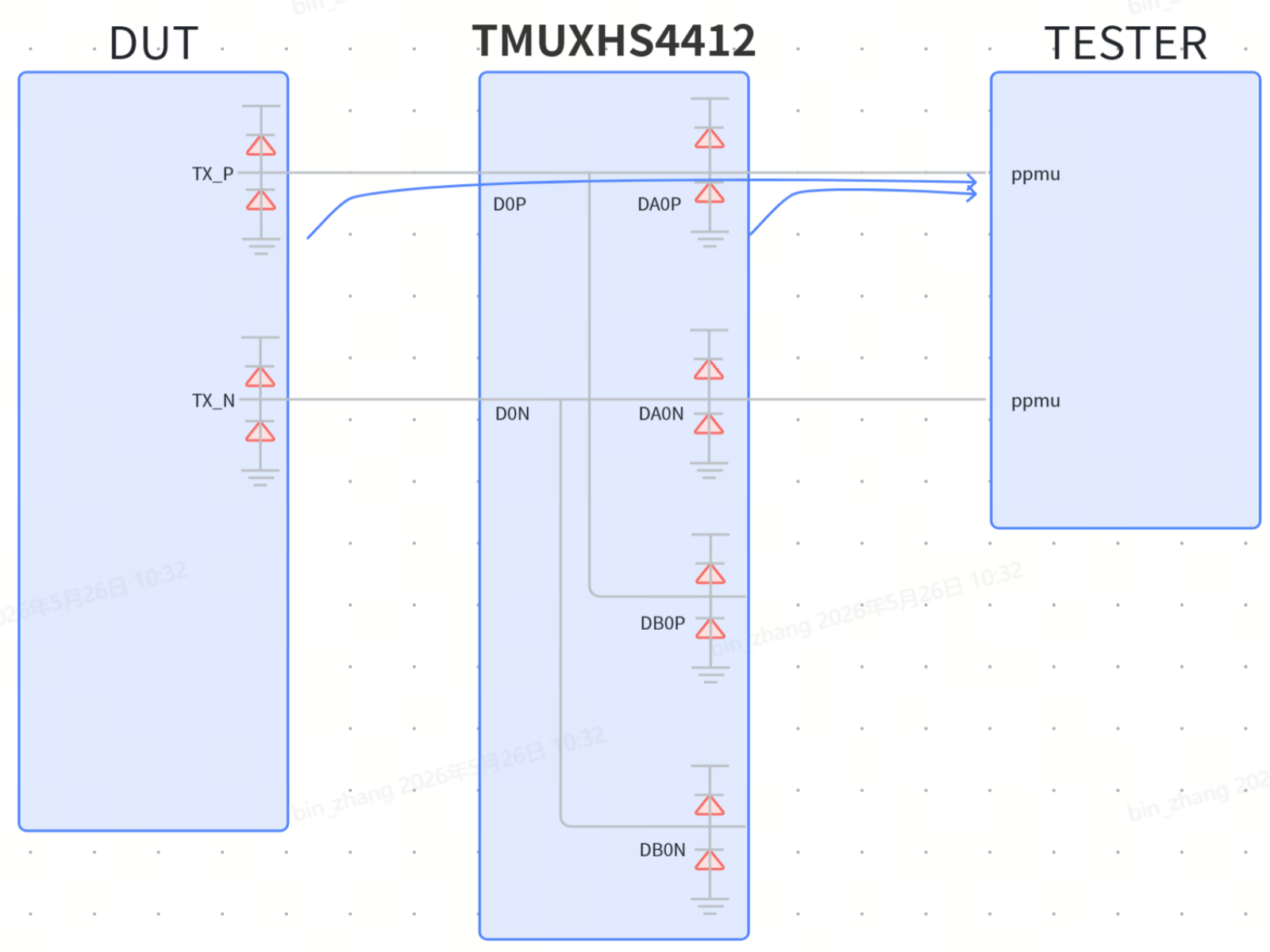
We are using TMUXHS4412 in an ATE loopback test for MIPI interfaces. The configuration is: ATE Tester ↔ TMUXHS4412 ↔ DUT.
We have a critical concern regarding the open-short (OS) / continuity test.
Background & Concern:
Our analysis suggests that the TMUXHS4412 has internal ESD diodes on its high-speed differential I/O pins. While these are vital for device protection, we are concerned they will create a parallel current path that directly corrupts our DUT's OS test measurement.
The Core Problem (False PASS Risk):
The OS test works by injecting a small DC test current (e.g., 0.2 mA) to forward-bias the DUT's internal ESD protection diode and measure the resulting voltage drop (e.g., ~0.6 V).
If the DUT's own ESD diode is open-circuited (a fail condition), the current would normally have no path, resulting in a voltage measurement near 0V and a correct FAIL verdict.
However, with the TMUXHS4412 in the path, we fear the ATE current will be shunted through the TMUXHS4412's internal diode. Consequently, the ATE would still measure a normal forward voltage drop, incorrectly reporting the DUT as PASS (a false PASS) even though its ESD diode is faulty.
Request for Clarification:
-
Could you please confirm the exact ESD protection structure on the high-speed I/O pins (e.g., is there a diode from I/O to GND)?
-
In a scenario where the DUT's internal diode is open, could the TMUXHS4412's own ESD structure create this misleading current path, leading to a false PASS on the ATE OS test?
-
Is AC-coupling the only reliable solution to isolate this DC path, and if we apply it, what is the correct biasing scheme for the TMUXHS4412 to ensure it stays within its valid operating conditions (CMV 0V to 1.8V)?
We look forward to your guidance on this critical issue.