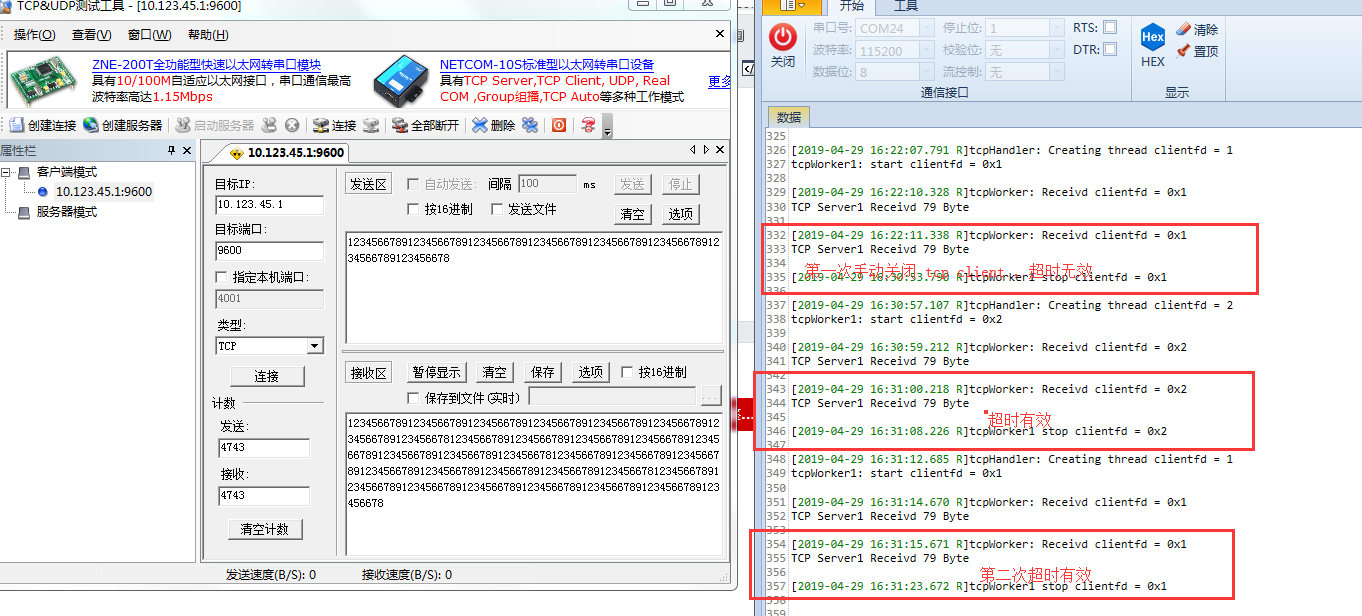
在AP模式设置为 TCP server,使用了TCP socket 超时设置,当socket server与第一个TCP client 建立连接后,进行socket通信,client 不发数据,socket不会超时,当第二个client接入就会超时,或者将第一个 tcp client关闭,再次连接创建为client ID 0x01的socket就会出现超时 ,
void BsdTcpServer1(uint32_t arg0)
{
void *thread = NULL;
int status;
int clientfd;
int server;
struct sockaddr_in localAddr;
struct sockaddr_in clientAddr;
int optval;
int optlen = sizeof(optval);
socklen_t addrlen = sizeof(clientAddr);
struct SlTimeval_t TimeVal;
UART_PRINT("TCP Server1 example started\n");
// UART_PRINT("Creating TCP socket\n\r");
server = socket(AF_INET, SOCK_STREAM, 0);
if (server == -1) {
UART_PRINT("tcpHandler1: socket failed\n");
goto shutdown;
}
memset(&localAddr, 0, sizeof(localAddr));
localAddr.sin_family = AF_INET;
localAddr.sin_addr.s_addr = htonl(INADDR_ANY);
localAddr.sin_port = htons(arg0);
//localAddr.sin_port = htons(arg0+1);
status = bind(server, (struct sockaddr *)&localAddr, sizeof(localAddr));
if (status == -1) {
UART_PRINT("tcpHandler: bind failed\n");
goto shutdown;
}
status = listen(server, NUMTCPWORKERS);
if (status == -1) {
UART_PRINT("tcpHandler: listen failed\n");
goto shutdown;
}
optval = 1;
status = setsockopt(server, SOL_SOCKET, SO_KEEPALIVE, &optval, optlen);
// status =sl_SetSockOpt(server,SL_SOL_SOCKET,SL_SO_NONBLOCKING,(_u8*)&optval,optlen);
// status = setsockopt(server, SOL_SOCKET, SO_KEEPALIVE, &optval, optlen);
if (status == -1) {
UART_PRINT("tcpHandler: setsockopt failed\n");
goto shutdown;
}
TimeVal.tv_sec = 7; // Seconds
TimeVal.tv_usec = 0; // Microseconds. 10000 microseconds resolution
// setting socket option to enable receive timeout
status = sl_SetSockOpt(server, SL_SOL_SOCKET, SL_SO_RCVTIMEO,
(_u8 *)&TimeVal, sizeof(TimeVal));
if(status < 0)
{
UART_PRINT("[line:%d, error:%d] %s\n\r", __LINE__, status,
SL_SOCKET_ERROR);
//sl_Close(server);
// return(-1);
}
while ((clientfd =
accept(server, (struct sockaddr *)&clientAddr, &addrlen)) != -1)
{
UART_PRINT(
"tcpHandler: Creating thread clientfd = %x\n", clientfd);
// TimeVal.tv_sec = 7; // Seconds
// TimeVal.tv_usec = 0; // Microseconds. 10000 microseconds resolution
//
// // setting socket option to enable receive timeout
// status = sl_SetSockOpt(server, SL_SOL_SOCKET, SL_SO_RCVTIMEO,
// (_u8 *)&TimeVal, sizeof(TimeVal));
// if(status < 0)
// {
// UART_PRINT("[line:%d, error:%d] %s\n\r", __LINE__, status,
// SL_SOCKET_ERROR);
// //sl_Close(server);
// // return(-1);
// }
thread = TaskCreate(tcpServerWorker1, NULL, 3, 2048, (uintptr_t)clientfd,
0, 0);
#if 1
// tcpServerWorker1(clientfd,0);
// sleep(1);
#endif
if (!thread) {
UART_PRINT(
"tcpHandler1: Error - Failed to create new thread.\n");
close(clientfd);
}
/* addrlen is a value-result param, must reset for next accept call */
addrlen = sizeof(clientAddr);
}
UART_PRINT("tcpHandler1: accept failed.\n");
shutdown:
if (server != -1) {
close(server);
}
pthread_exit(0);
}
void tcpServerWorker1(uint32_t arg0, uint32_t arg1)
{
int clientfd = (int)arg0;
int bytesRcvd;
int bytesSent;
char buffer[TCPPACKETSIZE];
UART_PRINT("tcpWorker1: start clientfd = 0x%x\n",
clientfd);
while ((bytesRcvd = recv(clientfd, buffer, TCPPACKETSIZE, 0)) > 0)
{
UART_PRINT("tcpWorker: Receivd clientfd = 0x%x\n",
clientfd);
UART_PRINT("TCP Server1 Receivd %d Byte \n",
bytesRcvd);
sleep(1);
bytesSent = send(clientfd, buffer, bytesRcvd, 0);
if (bytesSent < 0 || bytesSent != bytesRcvd)
{
UART_PRINT("send failed.\n");
break;
}
}
UART_PRINT("tcpWorker1 stop clientfd = 0x%x\n", clientfd);
close(clientfd);
pthread_detach ( pthread_self ( ) );
pthread_exit(0);
}