pcm1865的i2s协议2单通道已经实现,pcm1865实现4通道是不是就不能用i2s协议了,必须要pcm实现?如果要需要pcm协议来实现,那么在i2s的基础上如何修改。
pcm协议的资料太少,还希望能提点一二。
This thread has been locked.
If you have a related question, please click the "Ask a related question" button in the top right corner. The newly created question will be automatically linked to this question.
pcm1865的i2s协议2单通道已经实现,pcm1865实现4通道是不是就不能用i2s协议了,必须要pcm实现?如果要需要pcm协议来实现,那么在i2s的基础上如何修改。
pcm协议的资料太少,还希望能提点一二。
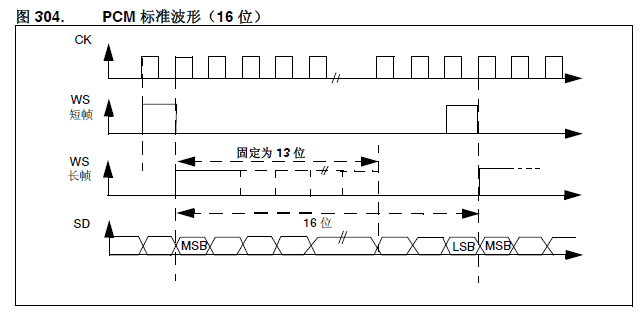
PCM格式的数据格式是怎么样的,在datasheet里找不到有关时序的说明。
关于I2S和PCM:
I2S is a common 4 wire DAI used in HiFi, STB and portable devices. The Tx and
Rx lines are used for audio transmission, whilst the bit clock (BCLK) and
left/right clock (LRC) synchronise the link. I2S is flexible in that either the
controller or CODEC can drive (master) the BCLK and LRC clock lines. Bit clock
usually varies depending on the sample rate and the master system clock
(SYSCLK). LRCLK is the same as the sample rate. A few devices support separate
ADC and DAC LRCLKs, this allows for simultaneous capture and playback at
different sample rates.
I2S has several different operating modes:-
I2S - MSB is transmitted on the falling edge of the first BCLK after LRC
transition.
Left Justified - MSB is transmitted on transition of LRC.
Right Justified - MSB is transmitted sample size BCLKs before LRC
transition.
PCM
===
PCM is another 4 wire interface, very similar to I2S, which can support a more
flexible protocol. It has bit clock (BCLK) and sync (SYNC) lines that are used
to synchronise the link whilst the Tx and Rx lines are used to transmit and
receive the audio data. Bit clock usually varies depending on sample rate
whilst sync runs at the sample rate. PCM also supports Time Division
Multiplexing (TDM) in that several devices can use the bus simultaneously (this
is sometimes referred to as network mode).
Common PCM operating modes:-
Mode A - MSB is transmitted on falling edge of first BCLK after FRAME/SYNC.
Mode B - MSB is transmitted on rising edge of FRAME/SYNC.