
Other Parts Discussed in Thread: CC2642R, SYSCONFIG
器件型号: CC2642R
主题: SysConfig 中讨论的其他器件
它可能关心的对象、
TI 是否会在 TI 工厂校准 CC2642R 的 Tx 功率?
如果不是、CC2642R 是否需要在开发人员侧进行 Tx 功率校准?
就在这种情况下、“校准“是指提高 Tx 功率精度。
此致、
山口
This thread has been locked.
If you have a related question, please click the "Ask a related question" button in the top right corner. The newly created question will be automatically linked to this question.
Other Parts Discussed in Thread: CC2642R, SYSCONFIG
器件型号: CC2642R
主题: SysConfig 中讨论的其他器件
它可能关心的对象、
TI 是否会在 TI 工厂校准 CC2642R 的 Tx 功率?
如果不是、CC2642R 是否需要在开发人员侧进行 Tx 功率校准?
就在这种情况下、“校准“是指提高 Tx 功率精度。
此致、
山口
尊敬的山口:
请参阅 SWRA640 的第 10 节 PA 表。 默认 PA 表基于 TI LaunchPad、可能需要进一步调整以适应定制硬件设计。 它还需要 从固件映像中更改 ti_radio_config.c/h、固件映像通常由 SysConfig 生成、但 在使用 SmartRF Studio 7 确定 PA 表的目标值后需要进行编辑。
此致、
Ryan
亲爱的瑞安 — 桑:
请让我确认我的理解是否正确。
根据您的回复、CC2642R 的校准是通过更改 PA 表来完成的、对吗?
此外、CC2642R 具有默认的 PA 表、并在 TI 的电路板上对默认值进行了调整、对吧?
此外、您能告诉我默认的输出功率吗? 由于默认 输出功率为 5dBm、
我认为我不需要通过 SmartRF Studio 更改输出功率设置。
此致、
山口
您的理解是正确的。 以下是 SimpleLink F2 SDK 的 TI 示例工程内部由 SysConfig 生成的 ti_parace_config.c 文件的示例。
// *********************************************************************************
// RF Frontend configuration
// *********************************************************************************
// RF design based on: LP_CC2652R7
// TX Power tables
// The RF_TxPowerTable_DEFAULT_PA_ENTRY and RF_TxPowerTable_HIGH_PA_ENTRY macros are defined in RF.h.
// The following arguments are required:
// RF_TxPowerTable_DEFAULT_PA_ENTRY(bias, gain, boost, coefficient)
// RF_TxPowerTable_HIGH_PA_ENTRY(bias, ibboost, boost, coefficient, ldoTrim)
// See the Technical Reference Manual for further details about the "txPower" Command field.
// The PA settings require the CCFG_FORCE_VDDR_HH = 0 unless stated otherwise.
// 2400 MHz, 5 dBm
RF_TxPowerTable_Entry txPowerTable_2400_pa5[TXPOWERTABLE_2400_PA5_SIZE] =
{
{-20, RF_TxPowerTable_DEFAULT_PA_ENTRY(8, 3, 0, 2) }, // 0x04C8
{-18, RF_TxPowerTable_DEFAULT_PA_ENTRY(10, 3, 0, 3) }, // 0x06CA
{-15, RF_TxPowerTable_DEFAULT_PA_ENTRY(13, 3, 0, 3) }, // 0x06CD
{-12, RF_TxPowerTable_DEFAULT_PA_ENTRY(15, 3, 0, 5) }, // 0x0ACF
{-10, RF_TxPowerTable_DEFAULT_PA_ENTRY(17, 3, 0, 5) }, // 0x0AD1
{-9, RF_TxPowerTable_DEFAULT_PA_ENTRY(19, 3, 0, 6) }, // 0x0CD3
{-6, RF_TxPowerTable_DEFAULT_PA_ENTRY(18, 2, 0, 9) }, // 0x1292
{-5, RF_TxPowerTable_DEFAULT_PA_ENTRY(19, 2, 0, 11) }, // 0x1693
{-3, RF_TxPowerTable_DEFAULT_PA_ENTRY(23, 2, 0, 11) }, // 0x1697
{0, RF_TxPowerTable_DEFAULT_PA_ENTRY(25, 1, 0, 19) }, // 0x2659
{1, RF_TxPowerTable_DEFAULT_PA_ENTRY(28, 1, 0, 22) }, // 0x2C5C
{2, RF_TxPowerTable_DEFAULT_PA_ENTRY(31, 1, 0, 25) }, // 0x325F
{3, RF_TxPowerTable_DEFAULT_PA_ENTRY(36, 1, 0, 29) }, // 0x3A64
{4, RF_TxPowerTable_DEFAULT_PA_ENTRY(23, 0, 0, 29) }, // 0x3A17
{5, RF_TxPowerTable_DEFAULT_PA_ENTRY(31, 0, 0, 56) }, // 0x701F
RF_TxPowerTable_TERMINATION_ENTRY
};
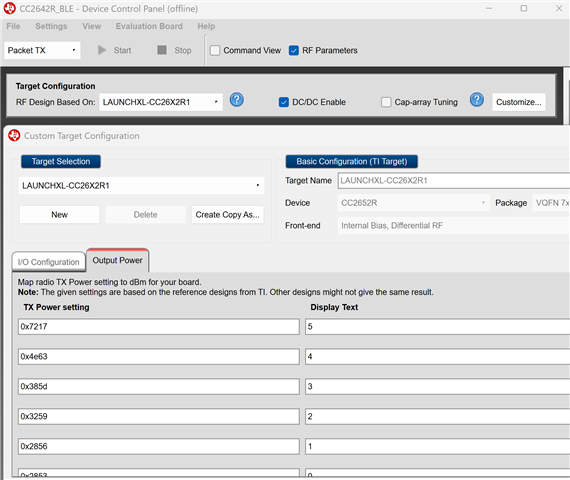
您还可以在 SmartRF Studio 7 的自定义目标配置中找到类似的设置

默认输出功率可根据引用的工程进行选择、通常是在编译时在 SysConfig 中设置的、但通常每个无线电堆栈都包含 API、用于在运行时更改 TX 输出功率。
此致、
Ryan