If you have a related question, please click the "Ask a related question" button in the top right corner. The newly created question will be automatically linked to this question.
// Behavioral model for the Texas Instruments ADS7952 ADC
// Not a cycle-accurate model, but provides basic functionality for simulation.

`timescale 1ns / 1ps

module ADS7952_model (
    inout SDO,
    input CS,
    input SCLK,
    input SDI,

    inout [3:0] GPIO
);

    // Internal state
    reg [15:0] shift_reg;
    reg [ 3:0] bit_count;
    reg        sdo_oe;
    reg [11:0] adc_mem [11:0]; // Memory for 12 channels
    reg [ 3:0] current_channel;
    reg        auto_mode;

    // GPIO registers
    reg [ 3:0] gpio_dir; // 0 = input, 1 = output
    reg [ 3:0] gpio_out;

    // GPIO output enables
    assign GPIO[0] = gpio_dir[0] ? gpio_out[0] : 1'bz;
    assign GPIO[1] = gpio_dir[1] ? gpio_out[1] : 1'bz;
    assign GPIO[2] = gpio_dir[2] ? gpio_out[2] : 1'bz;
    assign GPIO[3] = gpio_dir[3] ? gpio_out[3] : 1'bz;

    // Initialize memory and registers
    integer i;
    initial begin
        for ( i = 0; i < 12; i = i + 1 ) begin
            adc_mem[i]  <= i * 256;
        end
        current_channel <= 0;
        auto_mode       <= 0;
        sdo_oe          <= 1'b0;
        bit_count       <= 0;

        // Default GPIO to input
        gpio_dir        <= 4'b0000;
        gpio_out        <= 4'b0000;
    end

    assign SDO = sdo_oe ? shift_reg[15] : 1'bz;

    always @(negedge CS) begin
        // Start of a new transaction
        bit_count <= 0;
        sdo_oe    <= 1'b1;

        // Load the shift register with the result of the previous conversion
        shift_reg <= { adc_mem[current_channel], 4'b0000 };
    end

    always @(posedge CS) begin
        // End of transaction
        sdo_oe <= 1'b0;

        // Decode the command received on SDI
        case (shift_reg[15:12])
            4'b1000: begin // Manual mode channel select
                auto_mode       <= 0;
                current_channel <= shift_reg[11:8];
            end

            4'b1010: begin // Auto-1 mode
                auto_mode       <= 1;
            end

            4'b0100: begin // GPIO programming
                gpio_dir        <= shift_reg[9:6];
                gpio_out        <= shift_reg[5:2];
            end
            // Other modes are not implemented in this simple model
        endcase

        // In auto mode, increment channel after each conversion
        if (auto_mode) begin
            current_channel     <= (current_channel == 11) ? 0 : current_channel + 1;
        end
    end

    always @(posedge SCLK) begin
        if (!CS) begin
            // Shift data in on SDI and out on SDO
            shift_reg <= { shift_reg[14:0], SDI };
            bit_count <= bit_count + 1;
        end
    end

endmodule
// Behavioral model for the Texas Instruments ADS7952 ADC
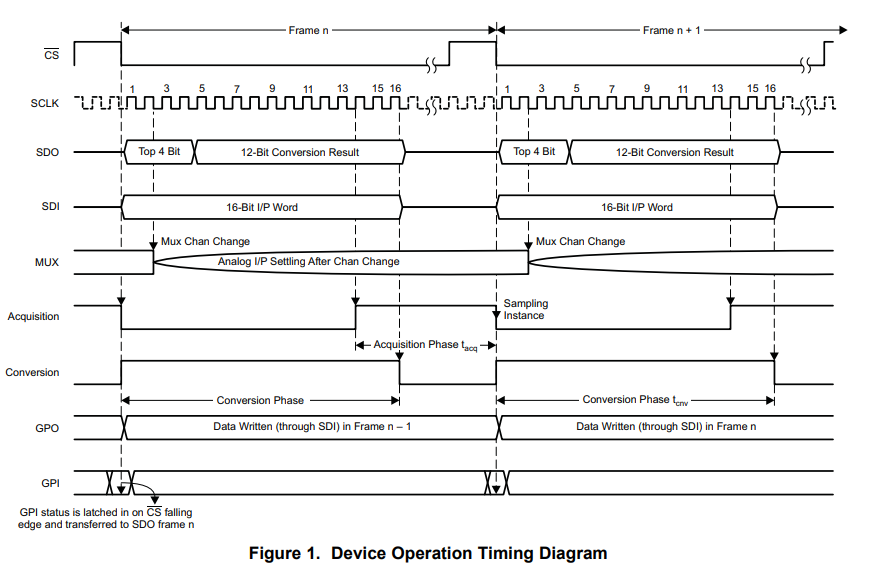
// Modified to better reflect the one-frame delay for manual mode programming as per the datasheet.

`timescale 1ns / 1ps

module ADS7952_model (
    output SDO,
    input  CS,
    input  SCLK,
    input  SDI,

    input [ 3:0] GPIO, // inout
    input [11:0] adc_in[11:0]
);

    // Internal state
    reg [15:0] shift_reg;
    reg [ 3:0] bit_count;
    reg        SDO_out;
    reg        sdo_oe;

    reg [ 3:0] mux_channl_requested;     // in the end of transaction we know what channel to sample after delay
    reg [ 3:0] mux_channl_delay;         // save the requested channel
    reg [ 3:0] mux_channl_ready2send;    // CS pos edg -> move the mux_channl_delay here

    reg        auto_mode;

    // GPIO registers
    reg [ 3:0] gpio_dir; // 0 = input, 1 = output
    reg [ 3:0] gpio_out;

    // GPIO output enables
    assign GPIO[0] = gpio_dir[0] ? gpio_out[0] : 1'bz;
    assign GPIO[1] = gpio_dir[1] ? gpio_out[1] : 1'bz;
    assign GPIO[2] = gpio_dir[2] ? gpio_out[2] : 1'bz;
    assign GPIO[3] = gpio_dir[3] ? gpio_out[3] : 1'bz;

    assign SDO = sdo_oe ? SDO_out : 1'bz;

    // Initialize memory and registers
    integer i;
    initial begin

        auto_mode     <= 0;
        sdo_oe        <= 1'b0;
        shift_reg     <= 16'd0;
        bit_count     <= 0;

        // Default GPIO to input
        gpio_dir      <= 4'b0000; // All inputs
        gpio_out      <= 4'b0000;

        #1;
        mux_channl_requested  <=  4'hB;
        mux_channl_delay      <=  4'hB;
        mux_channl_ready2send <=  4'hB;
    end

    // At the start of a transaction, load the shift register with the result
    // of the *previous* conversion cycle (for the current_channel).
    always @(negedge CS) begin
        // Start of a new transaction
        bit_count        <= 0;
        sdo_oe           <= 1'b1;

        // Load the shift register with the result of the previous conversion
        shift_reg        <= { mux_channl_ready2send, adc_in[ mux_channl_ready2send ] };
        SDO_out          <=   mux_channl_ready2send[3]; // put shift_reg's msb on the output line

        // requested  -> mux delay
        mux_channl_delay <= mux_channl_requested;
    end

    // At the end of a transaction, decode the command that was just received
    // and set up the state for the *next* transaction.
    always @(posedge CS) begin
        // End of transaction
        sdo_oe  <= 1'b0;
        SDO_out <= 1'b1;

        // next ADC step
        // mux delay -> ready
        mux_channl_ready2send     <= mux_channl_delay;

        // Decode the command received on SDI
        case (shift_reg[15:12])
            4'b0001: begin // Manual Mode (DI15-12 = 0001)
                auto_mode         <= 0;
                // DI11 = 1 enables programming of ‘range and GPIO’
                if     (    1'b1  == shift_reg[11  ] ) begin
                    mux_channl_requested <= shift_reg[10:7]; // DI10-7 = binary address of channel
                        //           shift_reg[ 6  ]; // 0 = Vref    1 = 2*Vref
                        //           shift_reg[ 5  ]; // 1 = power down
                        //           shift_reg[ 4  ]; // in next transaction  0 = output samples channel  1 = output GPIO
                    gpio_out             <= shift_reg[ 3:0];
                end
            end

            // Other modes (like Auto-1) would need to be defined based on their DI15-12 patterns
            // If no other patterns are defined, they would fall into a default case.
            default: begin
                // Handle unimplemented or reserved commands
            end
        endcase

        // After decoding, update the current_channel for the next conversion cycle.
//      if (auto_mode) begin
            // In auto mode, channel increments after each conversion.
            // The programmed_channel is ignored.
//          current_channel     <= (current_channel == 11) ? 0 : current_channel + 1;
//      end else begin
            // In manual mode, the next channel to be converted is the one we just programmed.
//          current_channel     <= programmed_channel;
//      end
    end

    always @(posedge SCLK) begin
        if (!CS) begin
            // Shift data in on SDI and out on SDO
            shift_reg <= { shift_reg[14:0], SDI };
            bit_count <= bit_count + 1;
        end
    end
    always @(negedge SCLK) begin
        if (!CS) begin
            if ( sdo_oe ) begin
                SDO_out <= shift_reg[15];

            end else begin
                SDO_out <= 1'b1;
            end;
        end
    end

endmodule