
This thread has been locked.

If you have a related question, please click the "Ask a related question" button in the top right corner. The newly created question will be automatically linked to this question.

TMS320F28388D: UART例程为什么是偶次数触发中断

Part Number: TMS320F28388D


//#############################################################################
//
// FILE:   UART_ex1_echoback.c
//
// TITLE:  UART echoback example.
//
//! \addtogroup driver_example_cm_list
//! <h1>UART Echoback</h1>
//!
//!  This test receives and echo-backs data through the UART0 port.
//!
//!  A terminal such as 'putty' can be used to view the data from
//!  the CM-UART and to send information to the CM-UART. Characters 
//!  received by the CM-UART port are sent back to the host.
//!
//!  \b Running \b the \b Application
//!  Open a COM port with the following settings using a terminal:
//!  -  Find correct COM port
//!  -  Bits per second = 115200
//!  -  Data Bits = 8
//!  -  Parity = None
//!  -  Stop Bits = 1
//!  -  Hardware Control = None
//!
//!  The program will print out a greeting and then ask you to
//!  enter a character which it will echo back to the terminal.
//!
//!  \b Watch \b Variables \n
//!  - None
//!
//! \b External \b Connections \n
//!  Connect the UART0 port to a PC via a transceiver and cable.
//!  - GPIO85 is UART0RX/CMUARTRXA(Connect to Pin3, PC-TX, of serial DB9 cable)
//!  - GPIO84 is UART0TX/CMUARTTXA(Connect to Pin2, PC-RX, of serial DB9 cable)
//! 
//!  \note The pin muxing for the UART0 port needs to be done by the master 
//!  CPU1. The common configuration example provided in the C28x folder can be 
//!  used for making GPIO85 as the UART Rx pin and GPIO84 as the UART Tx pin.
//
//#############################################################################
// $TI Release: F2838x Support Library v3.03.00.00 $
// $Release Date: Sun Oct  4 16:00:36 IST 2020 $
// $Copyright:
// Copyright (C) 2020 Texas Instruments Incorporated - http://www.ti.com/
//
// Redistribution and use in source and binary forms, with or without 
// modification, are permitted provided that the following conditions 
// are met:
// 
//   Redistributions of source code must retain the above copyright 
//   notice, this list of conditions and the following disclaimer.
// 
//   Redistributions in binary form must reproduce the above copyright
//   notice, this list of conditions and the following disclaimer in the 
//   documentation and/or other materials provided with the   
//   distribution.
// 
//   Neither the name of Texas Instruments Incorporated nor the names of
//   its contributors may be used to endorse or promote products derived
//   from this software without specific prior written permission.
// 
// THIS SOFTWARE IS PROVIDED BY THE COPYRIGHT HOLDERS AND CONTRIBUTORS 
// "AS IS" AND ANY EXPRESS OR IMPLIED WARRANTIES, INCLUDING, BUT NOT 
// LIMITED TO, THE IMPLIED WARRANTIES OF MERCHANTABILITY AND FITNESS FOR
// A PARTICULAR PURPOSE ARE DISCLAIMED. IN NO EVENT SHALL THE COPYRIGHT 
// OWNER OR CONTRIBUTORS BE LIABLE FOR ANY DIRECT, INDIRECT, INCIDENTAL, 
// SPECIAL, EXEMPLARY, OR CONSEQUENTIAL DAMAGES (INCLUDING, BUT NOT 
// LIMITED TO, PROCUREMENT OF SUBSTITUTE GOODS OR SERVICES; LOSS OF USE,
// DATA, OR PROFITS; OR BUSINESS INTERRUPTION) HOWEVER CAUSED AND ON ANY
// THEORY OF LIABILITY, WHETHER IN CONTRACT, STRICT LIABILITY, OR TORT 
// (INCLUDING NEGLIGENCE OR OTHERWISE) ARISING IN ANY WAY OUT OF THE USE 
// OF THIS SOFTWARE, EVEN IF ADVISED OF THE POSSIBILITY OF SUCH DAMAGE.
// $
//#############################################################################

//
// Included Files
//
#include <stdint.h>
#include <stdbool.h>

#include "cm.h"

//
// Defines
//
#define NUM_UART_DATA    4

uint16_t count,i,Data[100];
__interrupt void UART_RX_IntHandler(void);

//
// Main
//
void main(void)
{

    //
    // disable WD, enable peripheral clocks.
    //
    CM_init();

    //
    // Configure UART0 for echoback.Set up to transfer data at 115200 baud.
    //                                                        
    UART_setConfig(UART0_BASE,UART_CLK_FREQ , 115200,(UART_CONFIG_WLEN_8 | 
                   UART_CONFIG_STOP_ONE | UART_CONFIG_PAR_NONE));

    // 
    // Put a character to show start of example.  This will display on the
    // terminal.
    //
    UART_writeChar(UART0_BASE, '!');

    //
    // Enable the UART0 interrupt on the processor (NVIC).
    //
    UART_registerInterrupt(INT_UART0,UART_RX_IntHandler);

    //
    // FIFO enable
    //
    UART_enableFIFO(UART0_BASE);

    //
    // FIFO interrupt levels are set to generate an interrupt
    // when the TX FIFO is less than or equal to 7/8 empty and the
    // RX FIFO is greater than or equal to 1/8 full.
    //
    UART_setFIFOLevel(UART0_BASE, UART_FIFO_TX1_8, UART_FIFO_RX1_8);

    //
    // FIFO receive interrupt configuration
    //
    UART_clearInterruptStatus(UART0_BASE,UART_INT_RX | UART_INT_RT);   
    UART_enableInterrupt(UART0_BASE,UART_INT_RX);
    UART_enableLoopback(UART0_BASE);
    //
    // Loop forever echoing data through the UART.
    for(i=0;i<9;i++)
    {
        UART_writeChar(UART0_BASE, i);
    }
    while(1)
    {
    }
}


__interrupt void UART_RX_IntHandler(void)
{
    uint32_t ui32Status;

    //
    // Get the interrupt status.
    //
    ui32Status = UART_getInterruptStatus(UART0_BASE, UART_RAW_INT);

    //
    // Clear the asserted interrupts.
    //
    UART_clearInterruptStatus(UART0_BASE, ui32Status);

    //
    // Loop while there are characters in the receive FIFO.
    //
    while(UART_isDataAvailable(UART0_BASE))
    {
        //
//        // Read the next character from the UART and write it back to the UART.
//        //
//        UART_writeCharNonBlocking(UART0_BASE,
//                                  UART_readCharNonBlocking(UART0_BASE));

        Data[count] = UART_readChar(UART0_BASE);
    }


    count++;
}

//
// End of File
//

  • //#############################################################################
    //
    // FILE:   UART_ex1_echoback.c
    //
    // TITLE:  UART echoback example.
    //
    //! \addtogroup driver_example_cm_list
    //! <h1>UART Echoback</h1>
    //!
    //!  This test receives and echo-backs data through the UART0 port.
    //!
    //!  A terminal such as 'putty' can be used to view the data from
    //!  the CM-UART and to send information to the CM-UART. Characters 
    //!  received by the CM-UART port are sent back to the host.
    //!
    //!  \b Running \b the \b Application
    //!  Open a COM port with the following settings using a terminal:
    //!  -  Find correct COM port
    //!  -  Bits per second = 115200
    //!  -  Data Bits = 8
    //!  -  Parity = None
    //!  -  Stop Bits = 1
    //!  -  Hardware Control = None
    //!
    //!  The program will print out a greeting and then ask you to
    //!  enter a character which it will echo back to the terminal.
    //!
    //!  \b Watch \b Variables \n
    //!  - None
    //!
    //! \b External \b Connections \n
    //!  Connect the UART0 port to a PC via a transceiver and cable.
    //!  - GPIO85 is UART0RX/CMUARTRXA(Connect to Pin3, PC-TX, of serial DB9 cable)
    //!  - GPIO84 is UART0TX/CMUARTTXA(Connect to Pin2, PC-RX, of serial DB9 cable)
    //! 
    //!  \note The pin muxing for the UART0 port needs to be done by the master 
    //!  CPU1. The common configuration example provided in the C28x folder can be 
    //!  used for making GPIO85 as the UART Rx pin and GPIO84 as the UART Tx pin.
    //
    //#############################################################################
    // $TI Release: F2838x Support Library v3.03.00.00 $
    // $Release Date: Sun Oct  4 16:00:36 IST 2020 $
    // $Copyright:
    // Copyright (C) 2020 Texas Instruments Incorporated - http://www.ti.com/
    //
    // Redistribution and use in source and binary forms, with or without 
    // modification, are permitted provided that the following conditions 
    // are met:
    // 
    //   Redistributions of source code must retain the above copyright 
    //   notice, this list of conditions and the following disclaimer.
    // 
    //   Redistributions in binary form must reproduce the above copyright
    //   notice, this list of conditions and the following disclaimer in the 
    //   documentation and/or other materials provided with the   
    //   distribution.
    // 
    //   Neither the name of Texas Instruments Incorporated nor the names of
    //   its contributors may be used to endorse or promote products derived
    //   from this software without specific prior written permission.
    // 
    // THIS SOFTWARE IS PROVIDED BY THE COPYRIGHT HOLDERS AND CONTRIBUTORS 
    // "AS IS" AND ANY EXPRESS OR IMPLIED WARRANTIES, INCLUDING, BUT NOT 
    // LIMITED TO, THE IMPLIED WARRANTIES OF MERCHANTABILITY AND FITNESS FOR
    // A PARTICULAR PURPOSE ARE DISCLAIMED. IN NO EVENT SHALL THE COPYRIGHT 
    // OWNER OR CONTRIBUTORS BE LIABLE FOR ANY DIRECT, INDIRECT, INCIDENTAL, 
    // SPECIAL, EXEMPLARY, OR CONSEQUENTIAL DAMAGES (INCLUDING, BUT NOT 
    // LIMITED TO, PROCUREMENT OF SUBSTITUTE GOODS OR SERVICES; LOSS OF USE,
    // DATA, OR PROFITS; OR BUSINESS INTERRUPTION) HOWEVER CAUSED AND ON ANY
    // THEORY OF LIABILITY, WHETHER IN CONTRACT, STRICT LIABILITY, OR TORT 
    // (INCLUDING NEGLIGENCE OR OTHERWISE) ARISING IN ANY WAY OUT OF THE USE 
    // OF THIS SOFTWARE, EVEN IF ADVISED OF THE POSSIBILITY OF SUCH DAMAGE.
    // $
    //#############################################################################
    
    //
    // Included Files
    //
    #include <stdint.h>
    #include <stdbool.h>
    
    #include "cm.h"
    
    //
    // Defines
    //
    #define NUM_UART_DATA    4
    
    uint16_t count,i,Data[100];
    __interrupt void UART_RX_IntHandler(void);
    
    //
    // Main
    //
    void main(void)
    {
    
        //
        // disable WD, enable peripheral clocks.
        //
        CM_init();
    
        //
        // Configure UART0 for echoback.Set up to transfer data at 115200 baud.
        //                                                        
        UART_setConfig(UART0_BASE,UART_CLK_FREQ , 115200,(UART_CONFIG_WLEN_8 | 
                       UART_CONFIG_STOP_ONE | UART_CONFIG_PAR_NONE));
    
        // 
        // Put a character to show start of example.  This will display on the
        // terminal.
        //
      //  UART_writeChar(UART0_BASE, '!');
    
        //
        // Enable the UART0 interrupt on the processor (NVIC).
        //
        UART_registerInterrupt(INT_UART0,UART_RX_IntHandler);
    
        //
        // FIFO enable
        //
        UART_enableFIFO(UART0_BASE);
    
        //
        // FIFO interrupt levels are set to generate an interrupt
        // when the TX FIFO is less than or equal to 7/8 empty and the
        // RX FIFO is greater than or equal to 1/8 full.
        //
        UART_setFIFOLevel(UART0_BASE, UART_FIFO_TX1_8, UART_FIFO_RX1_8);
    
        //
        // FIFO receive interrupt configuration
        //
        UART_clearInterruptStatus(UART0_BASE,UART_INT_RX | UART_INT_RT);   
        UART_enableInterrupt(UART0_BASE,UART_INT_RX);
        UART_enableLoopback(UART0_BASE);
        //
        // Loop forever echoing data through the UART.
        for(i=0;i<9;i++)
        {
            UART_writeChar(UART0_BASE, i);
        }
        while(1)
        {
        }
    }
    
    
    __interrupt void UART_RX_IntHandler(void)
    {
        uint32_t ui32Status;
    
        //
        // Get the interrupt status.
        //
        ui32Status = UART_getInterruptStatus(UART0_BASE, UART_RAW_INT);
    
        //
        // Clear the asserted interrupts.
        //
        UART_clearInterruptStatus(UART0_BASE, ui32Status);
    
        //
        // Loop while there are characters in the receive FIFO.
        //
    //    while(UART_isDataAvailable(UART0_BASE))
    //    {
            //
    //        // Read the next character from the UART and write it back to the UART.
    //        //
    //        UART_writeCharNonBlocking(UART0_BASE,
    //                                  UART_readCharNonBlocking(UART0_BASE));
    
            Data[count] = UART_readChar(UART0_BASE);
    //    }
    
    
        count++;
    }
    
    //
    // End of File
    //
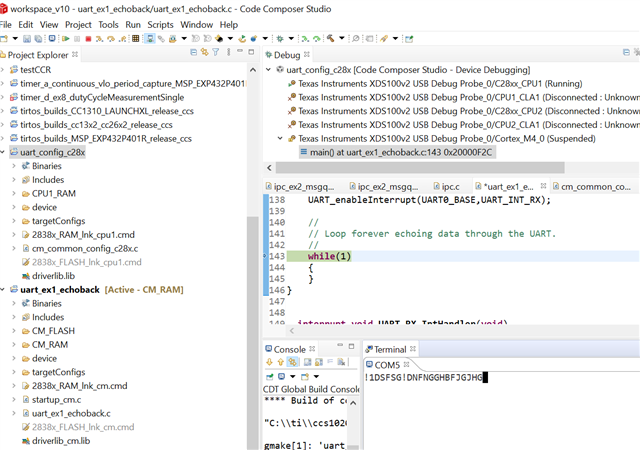


  •    取消 while(UART_isDataAvailable(UART0_BASE))后变奇数但最后一次发送为什么不触发中断?实际测试过程也是少接收一个字节数据

  • 取消 while(UART_isDataAvailable(UART0_BASE))后变奇数但最后一次发送为什么不触发中断?

    您现在使用的是controlcard?直接测试例程是测试成功了?

    对于controlcard,可以将 GPIO 84 连接到 GPIO 29,将 GPIO 85 连接到 GPIO 28,以便您可以使用控制卡的内部 ftdi 转换器并尝试运行串行终端。请注意,您可以运行相同的引脚复用器配置(84,85)和示例,因为 GPIO 28、29 硬连线到内部 ftdi。 

    您也可以在CCS Debug Session -> View -> Terminal -> Connect Serial Terminal 中打开串口终端(设置波特率参数,点击确定)。

    这是一个字符回显的例程。不太理解您所说的偶次是什么意思

  • 光标放在CCS的 Terminal 内,在键盘上输入 12345

    而后,如下面视频所示

    uart.zip