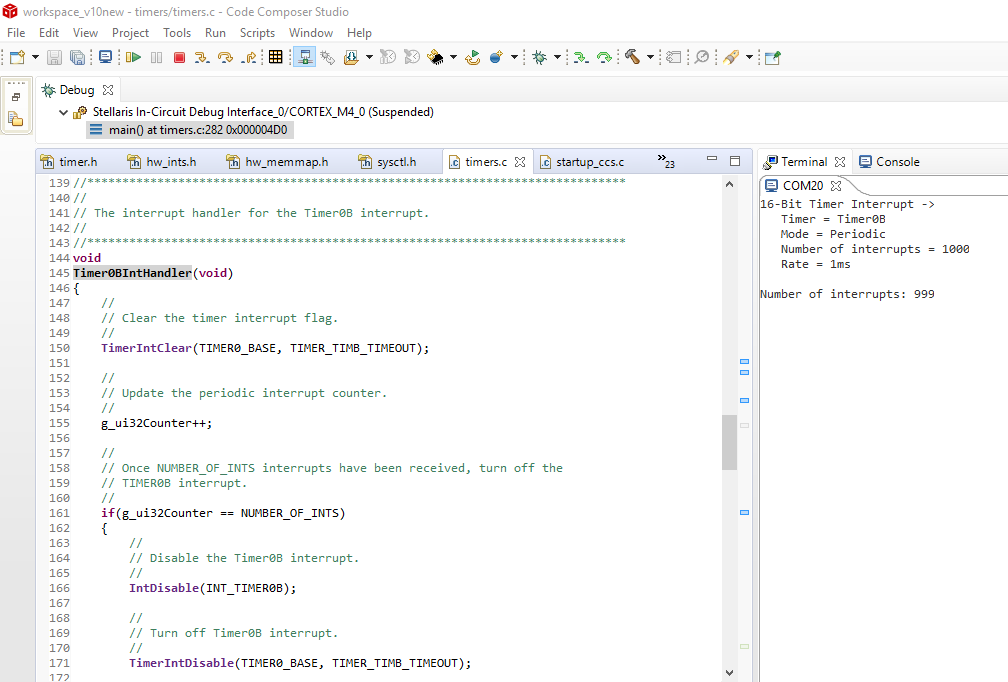
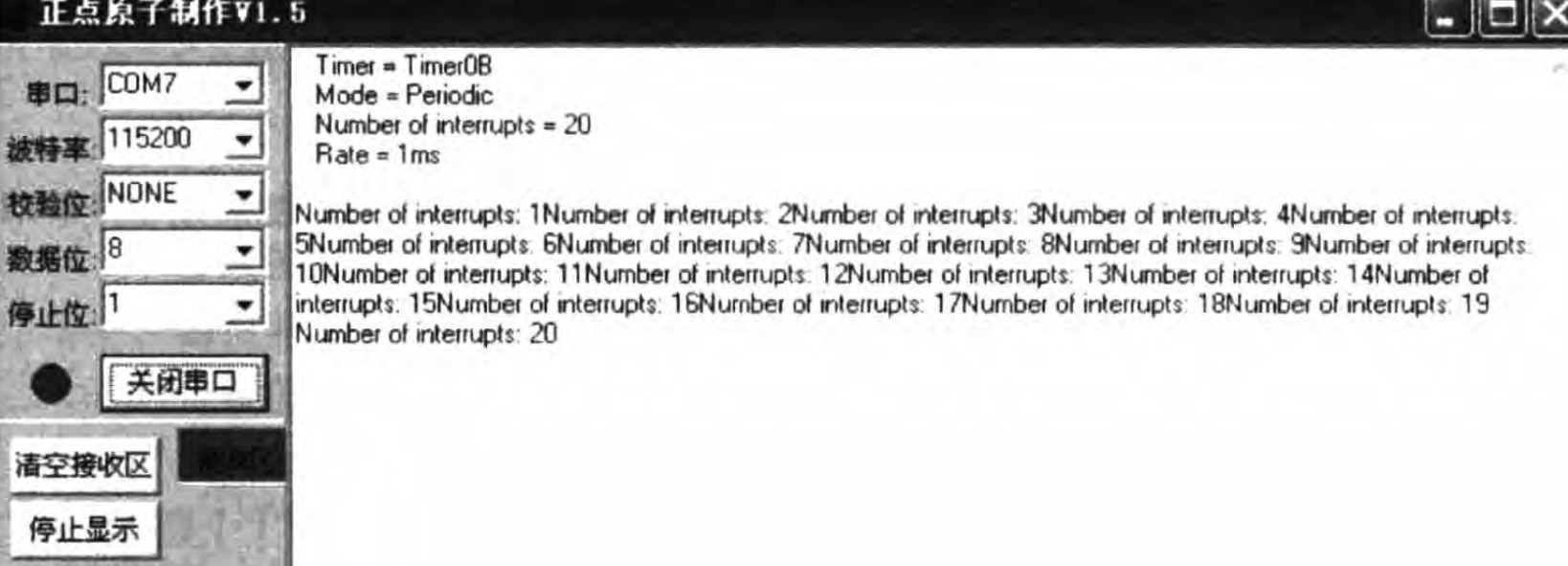
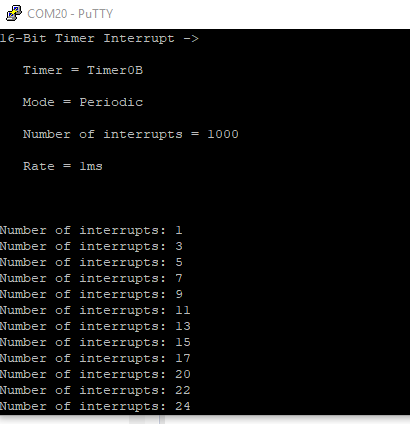
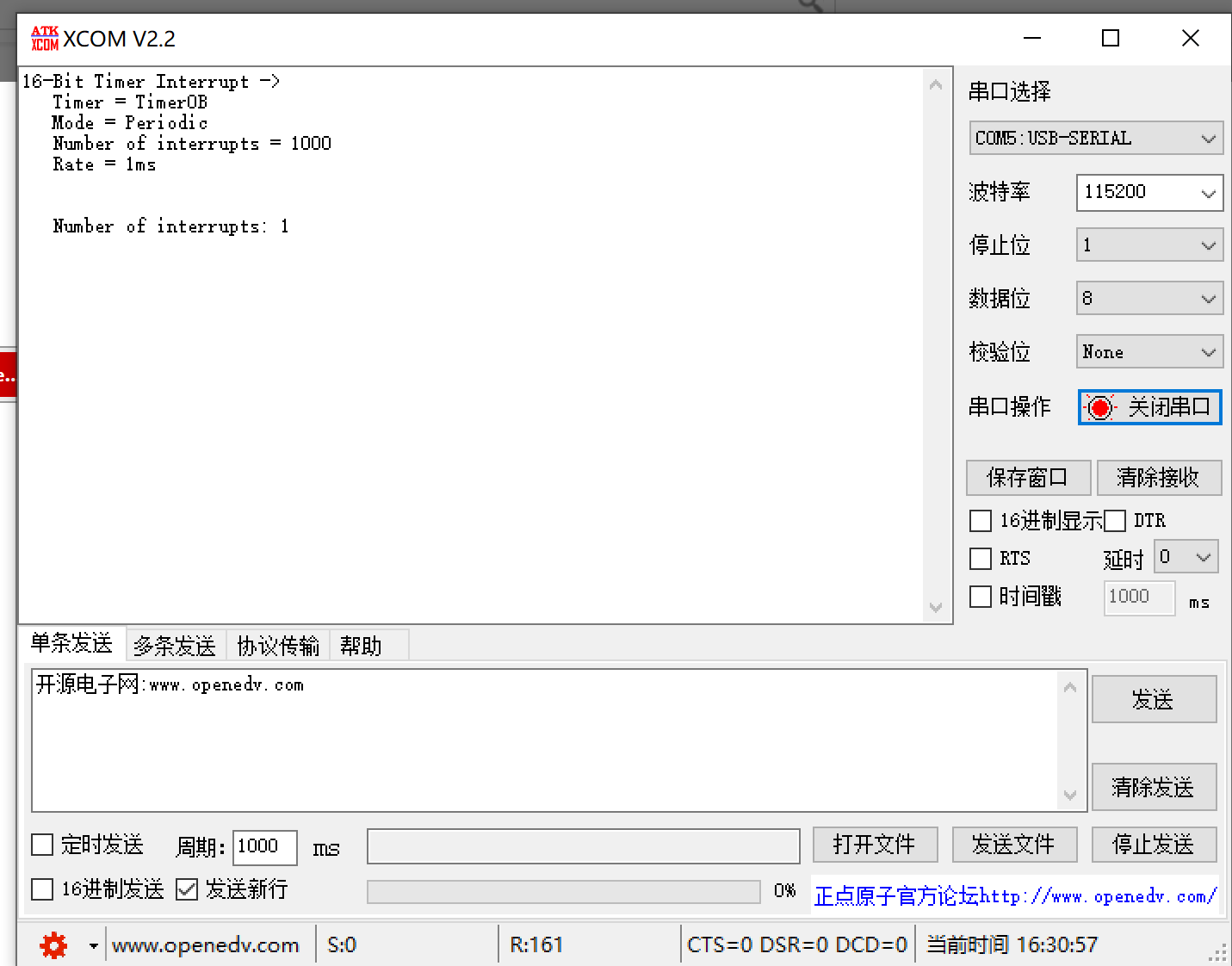
本人在编写用定时器控制单片机中断20次的实验中,发现无法进入第二次中断,进入第一次中断后就一直在while循环,也清除了标志位,麻烦大神帮看一下
//*****************************************************************************
//
// timers.c - Timers example.
//
// Copyright (c) 2013 Texas Instruments Incorporated.  All rights reserved.
// Software License Agreement
//
// Texas Instruments (TI) is supplying this software for use solely and
// exclusively on TI's microcontroller products. The software is owned by
// TI and/or its suppliers, and is protected under applicable copyright
// laws. You may not combine this software with "viral" open-source
// software in order to form a larger program.
//
// THIS SOFTWARE IS PROVIDED "AS IS" AND WITH ALL FAULTS.
// NO WARRANTIES, WHETHER EXPRESS, IMPLIED OR STATUTORY, INCLUDING, BUT
// NOT LIMITED TO, IMPLIED WARRANTIES OF MERCHANTABILITY AND FITNESS FOR
// A PARTICULAR PURPOSE APPLY TO THIS SOFTWARE. TI SHALL NOT, UNDER ANY
// CIRCUMSTANCES, BE LIABLE FOR SPECIAL, INCIDENTAL, OR CONSEQUENTIAL
// DAMAGES, FOR ANY REASON WHATSOEVER.
//
// This is part of revision 2.0.1.11577 of the DK-TM4C129X Firmware Package.
//
//*****************************************************************************

#include <stdbool.h>
#include <stdint.h>
#include "inc/hw_ints.h"
#include "inc/hw_memmap.h"
#include "driverlib/rom_map.h"
#include "inc/hw_types.h"
#include "inc/hw_gpio.h"
#include "driverlib/pin_map.h"
#include "driverlib/interrupt.h"
#include "driverlib/rom.h"
#include "driverlib/sysctl.h"
#include "driverlib/timer.h"
#include "grlib/grlib.h"
#include "drivers/frame.h"
#include "drivers/kentec320x240x16_ssd2119.h"
#include "drivers/pinout.h"
#include "driverlib/debug.h"
#include "driverlib/gpio.h"
#include "driverlib/uart.h"
#include "inc/hw_uart.h"
#include "utils/uartstdio.h"
#include <stdarg.h>


//*****************************************************************************
//
//! \addtogroup example_list
//! <h1>Timer (timers)</h1>
//!
//! This example application demonstrates the use of the timers to generate
//! periodic interrupts.  One timer is set up to interrupt once per second and
//! the other to interrupt twice per second; each interrupt handler will toggle
//! its own indicator on the display.
//
//*****************************************************************************

//*****************************************************************************

//*****************************************************************************
//
// The error routine that is called if the driver library encounters an error.
//
//*****************************************************************************
#ifdef DEBUG
void
__error__(char *pcFilename, uint32_t ui32Line)
{
}
#endif

//*****************************************************************************
//
// The interrupt handler for the first timer interrupt.
//
//*****************************************************************************

#define NUMBER_OF_INTS 20

static volatile uint32_t g_ui32Counter = 0;


//*****************************************************************************
//
// This example application demonstrates the use of the timers to generate
// periodic interrupts.
//
//*****************************************************************************
void
InitConsole(void)
{
  SysCtlPeripheralEnable(SYSCTL_PERIPH_GPIOA);
  GPIOPinConfigure(GPIO_PA0_U0RX);
  GPIOPinConfigure(GPIO_PA1_U0TX);
  SysCtlPeripheralEnable(SYSCTL_PERIPH_UART0);
  UARTClockSourceSet(UART0_BASE, UART_CLOCK_PIOSC);
  GPIOPinTypeUART(GPIO_PORTA_BASE,GPIO_PIN_0|GPIO_PIN_1);
  UARTStdioConfig(0,115200,16000000);
}
int main(void)
{
        uint32_t ui32PrevCount = 0;

        SysCtlClockSet(SYSCTL_SYSDIV_1|SYSCTL_USE_OSC|SYSCTL_OSC_MAIN|SYSCTL_XTAL_16MHZ);
        InitConsole();
        UARTprintf("16 - Bit Timer Interrupt - >");
        UARTprintf("\n Timer = Timer0B");
        UARTprintf("\n Mode = Periodic");
        UARTprintf("\n Number of interrupts = %d",NUMBER_OF_INTS);
        UARTprintf("\n Rate = 1ms\n\n");
        ROM_SysCtlPeripheralEnable(SYSCTL_PERIPH_GPION);
        ROM_SysCtlDelay(1);
        ROM_GPIOPinTypeGPIOOutput(GPIO_PORTN_BASE, GPIO_PIN_0);
        SysCtlPeripheralEnable(SYSCTL_PERIPH_TIMER0);
        TimerConfigure(TIMER0_BASE, TIMER_CFG_SPLIT_PAIR | TIMER_CFG_PERIODIC);

        TimerLoadSet(TIMER0_BASE, TIMER_B, SysCtlClockGet()/50);

        IntEnable(INT_TIMER0B);
        TimerIntEnable(TIMER0_BASE, TIMER_TIMB_TIMEOUT);
        IntMasterEnable();
        TimerIntRegister(TIMER0_BASE, TIMER_B, Timer0IntHandler);
        g_ui32Counter = 0;
        TimerEnable(TIMER0_BASE, TIMER_B);
        while(1){
       if(ui32PrevCount != g_ui32Counter)
        {
          UARTprintf("Number of interrupts : %d\r",g_ui32Counter);
          ui32PrevCount = g_ui32Counter;
          ROM_GPIOPinWrite(GPIO_PORTN_BASE, GPIO_PIN_0, GPIO_PIN_0);
        }

        }
}

void Timer0IntHandler(void)
{
    //
    // Clear the timer interrupt.
    //

    TimerIntClear(TIMER0_BASE, TIMER_TIMB_TIMEOUT);
    g_ui32Counter++;
    /*if(g_ui32Counter == NUMBER_OF_INTS)
    {


        // Read the current state of the GPIO pin and
        // write back the opposite state
    IntDisable(INT_TIMER0B);
    TimerIntDisable(TIMER0_BASE, TIMER_TIMB_TIMEOUT);
    TimerIntClear(TIMER0_BASE, TIMER_TIMB_TIMEOUT);
    }*/

                ROM_GPIOPinWrite(GPIO_PORTN_BASE, GPIO_PIN_0, 0);
}