This thread has been locked.

If you have a related question, please click the "Ask a related question" button in the top right corner. The newly created question will be automatically linked to this question.

BQ40Z80: BQ40Z80 damaged when connected to the battery

Part Number: BQ40Z80
Other Parts Discussed in Thread: LM74502

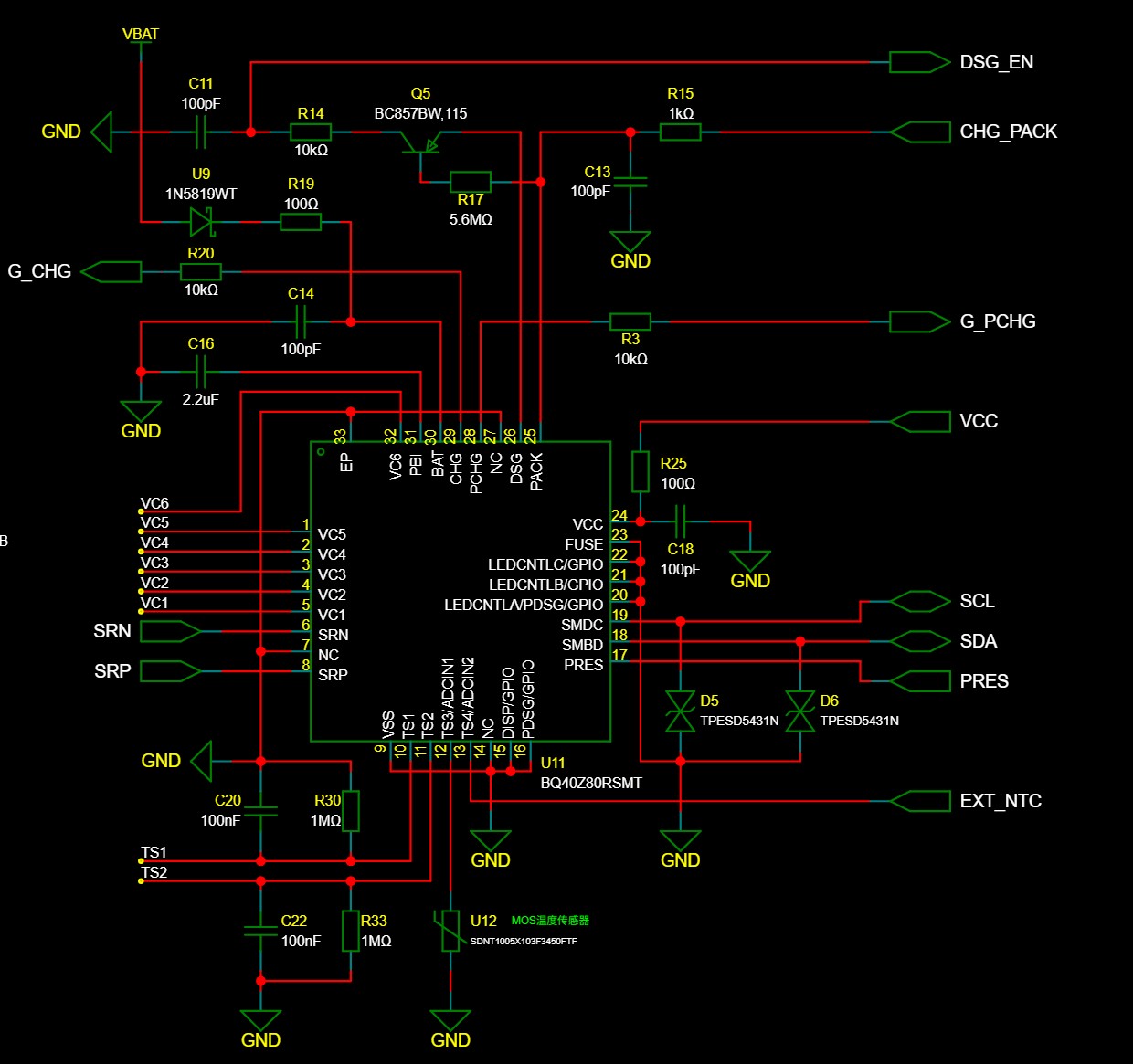
I designed a BMS based on the BQ40Z80, featuring separate and parallel charge/discharge paths. I've observed a very strange phenomenon: when a new board is connected directly to the battery (i.e., hard-powered), the BQ40Z80 chip has a high probability of being instantly damaged, manifesting as a complete loss of communication. The specific observations are as follows:

1. This issue does not occur when VBAT is low. However, when VBAT exceeds 24V, the likelihood of failure increases dramatically.

2. I suspect this is caused by input capacitance (Cin) on the board, which—during power-up—creates a resonant condition leading to voltage overshoot that destroys the chip. During debugging, I reduced Cin from 3 µF to 300 nF and added a 3.9 Ω resistor in series at the capacitor input. This nearly eliminated the visible spark during power-up, yet the chip still failed, and the "failure threshold voltage" did not increase.

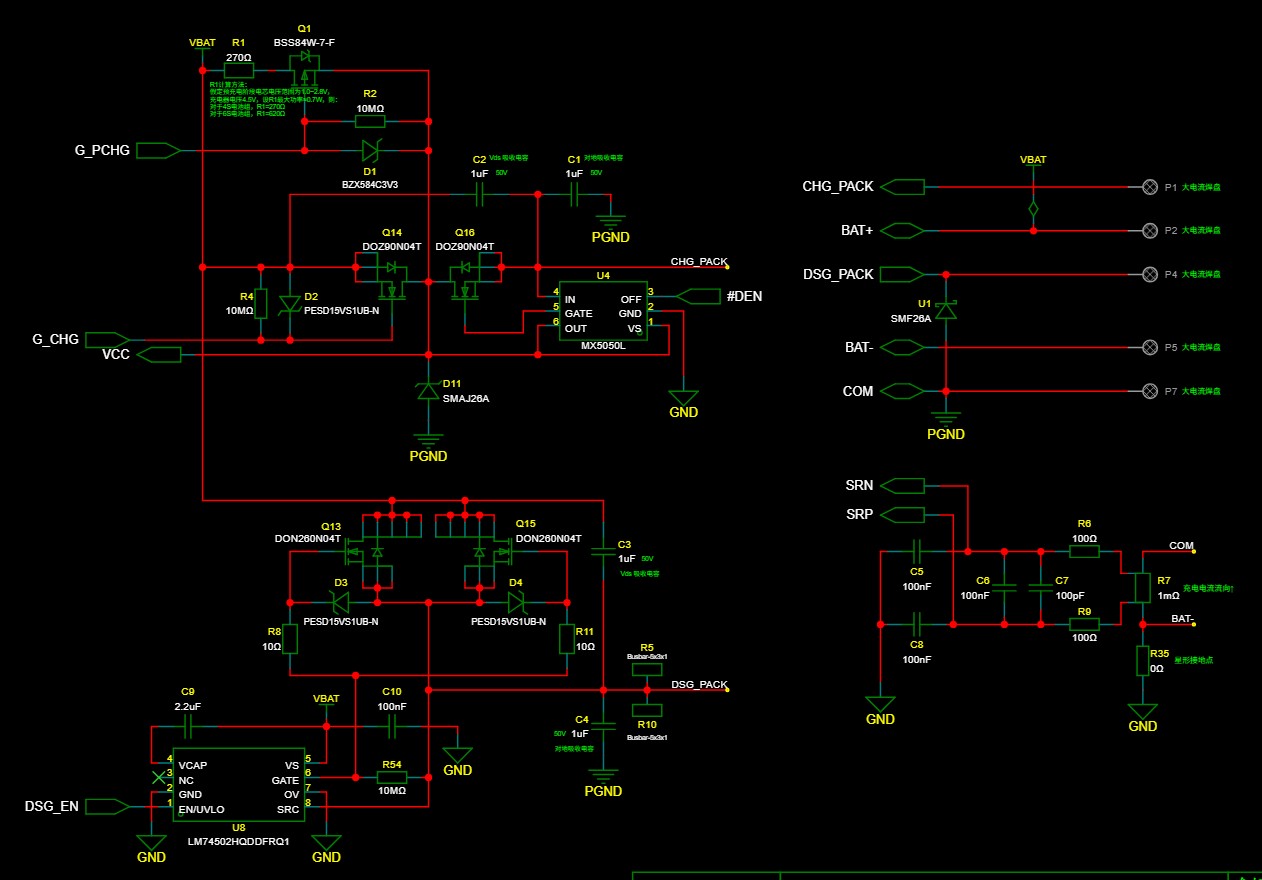
3. The board actually includes a TVS diode (SMF26A), with its cathode tied to VCC and anode to GND. In theory, because the charge/discharge MOSFETs have body diodes, any voltage spikes originating from either the battery or the CHG_PACK line should be clamped by this TVS.

Could any experts please share insights or suggestions on what might be causing this issue?
Thank you very much in advance for your help!

Schematic diagram (partial):
  • 感谢您对TI产品的关注。
    我们正在核实您的问题,请等待我们的答复。

  • Thank you very much for your support. Fortunately, the issue appears to have been resolved with the following approach:
    The BQ40Z80 has three power supply pins: VBAT, VCC, and PACK. According to the official reference schematic, each of these pins is filtered using an RC network (100 Ω + 100 pF). However, this capacitance value is far too small to effectively absorb the voltage spikes generated at the moment the board is connected to the battery. After replacing all three capacitors with 100 nF ones, the problem was immediately resolved.
    Additionally, a quick note for others: in my schematic, I placed a TVS diode at the VCC pin to clamp transients coming from various directions. This method has been verified to work effectively in practice. However, the TVS breakdown voltage must be carefully selected. After thorough testing and consideration, I believe that SMF26A / SMA26A / SMB26A are the most suitable choices, as they align well with 2S–6S battery configurations. While SMx24A parts can also be used, they may cause noticeable leakage current when paired with higher-voltage batteries—so avoid them unless absolutely necessary.
  • Hello,

    Thanks for you update.

    Regards,

    Links

  • 你好,我看了一下你的图,有几个问题请教一下:

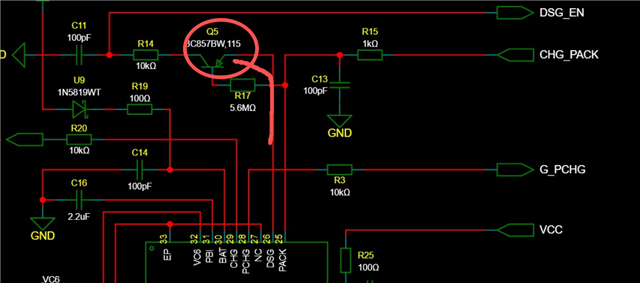
    1,芯片的DSG的引脚中间加个了一个Q5 PNP作用是什么?

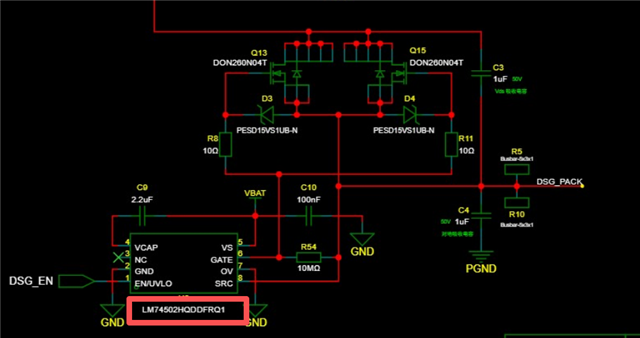
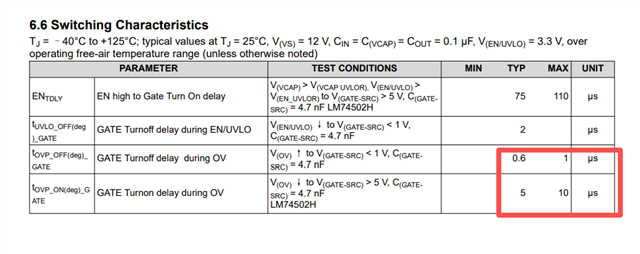
    2,我看你DSG使用了个驱动芯片, 这个LM74502 芯片使用效果怎么样,我看它的从检测到上升、下降包括延时的时间非常短,真驱动真有这么强吗?