


Other Parts Discussed in Thread: CC1310
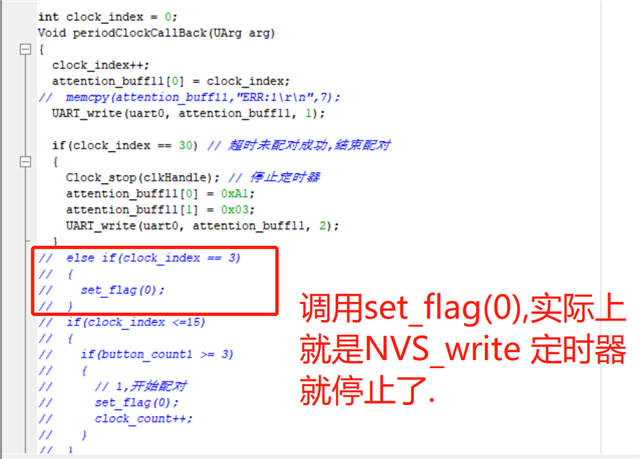
CC1310在调试过程中,NVS_write 和 Clock会有冲突.比如先调用NVS_write ,然后调用启动Clock,Clock不能启动.或者Clock启动了,调用NVS_write 后,Clock中止了.
This thread has been locked.
If you have a related question, please click the "Ask a related question" button in the top right corner. The newly created question will be automatically linked to this question.
CC1310在调试过程中,NVS_write 和 Clock会有冲突.比如先调用NVS_write ,然后调用启动Clock,Clock不能启动.或者Clock启动了,调用NVS_write 后,Clock中止了.
Nick您好,
我使用的是Easylink TX的示例.
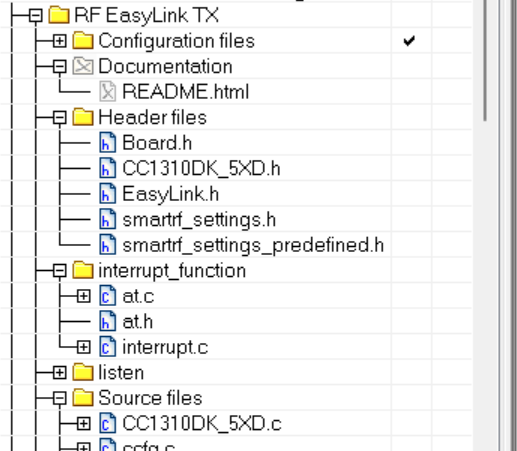
这是调用NVS_write的代码
void my_nvs_write(uint8_t * buff,uint16_t offset,uint16_t len)
{
//保证四字节对齐 如果无对齐自动补齐
len = fix4(len);
NVS_write(nvsHandle, offset, buff, len, NVS_WRITE_ERASE | NVS_WRITE_VALIDATE);
}
在调用NVS_write 后,调用定时器或者调用串口打印,都不能成功,如果不调用NVS_write,调用定时器或者调用串口打印都正常.
被这个问题困扰很久了,现在项目就卡在这个问题上面,请帮忙分析下原因和解决办法,谢谢.
Jacky
这个是其中一个文件
#include <stdint.h>
#include <stdbool.h>
#include <ti/drivers/Watchdog.h>
#include <ti/drivers/power/PowerCC26XX.h>
#include <ti/drivers/NVS.h>
#include <driverlib/flash.h>
#include "CC1310DK_5XD.h"
#include "string.h"
#include <ti/drivers/UART.h>
#include "Board.h"
#include "string.h"
#include "task/UartTask.h"
#include "interrupt_function/at.h"
#include "EasyLink.h"
//#include <ti/sysbios/knl/Semaphore.h>
#include <ti/sysbios/knl/Task.h>
#include <ti/sysbios/knl/Clock.h>
#include <ti/drivers/Power.h>
#include <ti/drivers/power/PowerCC26XX.h>
#include <driverlib/trng.h>
NVS_Handle nvsHandle;
uint32_t waitTime = 2;
int button_count1 = 0;
extern UART_Handle uart0;
/************************辅助函数部分*****************************************/
/*!
* @def fix4
* @brief 字节补齐函数,使用此函数要让自己的buffer扩大3个字节
* @para 要补齐的长度
* @return NULL
*/
uint16_t fix4(uint16_t length)
{
uint8_t remainder = 0;
if(length == 1)
{
length += 3;
}
else if(length == 2)
{
length += 2;
}
else if(length == 3)
{
length += 1;
}
else
{
remainder = length % 4;
if(remainder == 1)
{
length += 3;
}
else if(remainder == 2)
{
length += 2;
}
else if(remainder == 3)
{
length += 1;
}
}
return length;
}
uint8_t my_memcmp( const void *src1, const void *src2, unsigned int len )
{
const uint8_t *pSrc1;
const uint8_t *pSrc2;
pSrc1 = src1;
pSrc2 = src2;
while ( len-- )
{
if( *pSrc1++ != *pSrc2++ )
return FALSE;
}
return TRUE;
}
uint8_t input_adjust(uint8_t adjust)
{
if(adjust >= '0' && adjust <= '9' || (adjust >= 'A' && adjust <= 'F'))
return true;
return false;
}
/*********************************************************************
* @fn Change_ASCII_HEX
*
* @brief 将ASCII码转换成16进制数
*
* @param p转换后存储的位置,q要转换的字符串,ss要转换的长度
*
* @return none
*/
/*********************************************************************
*********************************************************************/
void Change_ASCII_HEX(uint8_t *p,uint8_t *q,int ss)
{
int i = 0;
while(i < ss)
{
if(q[i]>='0' && q[i]<='9')
{
p[i]=q[i]-'0' + 0x00;
}
else if(q[i]>='a' && q[i]<='f')
{
p[i]=q[i]-'a'+0x0a;
}
else if(q[i]>='A' && q[0]<='F')
{
p[i]=q[i]-'A'+0x0a;
}
i++;
}
}
/*********************************************************************
* @fn toadd
*
* @brief 将相邻的两个16进制数相加
*
* @param p转换后存储的位置,q要转换的16进制数组,ss要转换的长度
*
* @return none
*/
/*********************************************************************
*********************************************************************/
void toadd(uint8_t * p,uint8_t *q,int ss)
{
int i = 0;
int j = 0;
while(j < ss)
{
p[j] = q[i] * 0x10 + q[i + 1];
j++;
i += 2;
}
}
// 5分钟定时器回调函数
Clock_Handle pairHandle;
int pair_clock_count = 0;
uint8_t attention_buff11[20] = {0};
Void pairClockCallBack(UArg arg)
{
memcpy(attention_buff11,"ERR:1\r\n",7);
UART_write(uart0, attention_buff11, 7);
PIN_setOutputValue(pinHandle, Board_LED2, 0);
pair_clock_count++;
if(pair_clock_count == 1) // 按钮触发就马上回调了
{
}
else if(pair_clock_count == 2) // 这才是真正的回调
{
// 如果还处于配对模式, 退出配对模式
if(read_flag() == 0)
{
set_flag(2);
PIN_setOutputValue(pinHandle, Board_LED1, 1);
PIN_setOutputValue(pinHandle, Board_LED2, 1);
}
Clock_stop(pairHandle); // 停止定时器
pair_clock_count = 0;
}
}
static void pairClockInit()
{
Clock_Struct period_ClockStruct1;
Clock_Params clkParams1;
Clock_Params_init(&clkParams1);
//clkParams.period = 5 * 60 * 1000 * 1000 / Clock_tickPeriod; // 5分钟
clkParams1.period = 1* 30 * 1000 * 1000 / Clock_tickPeriod; // 测试1分钟
clkParams1.startFlag = FALSE;
pairHandle = Clock_create(pairClockCallBack,1,&clkParams1,NULL);
}
Clock_Handle clkHandle;
int clock_count = 0;
// 定时器回调函数,发送配对数据包
//Void periodClockCallBack(UArg arg)
//{
// clock_count ++;
// if(clock_count == 1) // 按钮触发就马上回调了
// {
//// memcpy(attention_buff11,"ERR:1\r\n",7);
//// UART_write(uart0, attention_buff11, 7);
// }
// else if(clock_count == 2) // 这才是真正的回调
// {
// if(button_count1 >= 3) // 15秒触发3次按钮,开始进入配对,开启5分钟定时器
// {
// // 1,开始配对
// set_flag(0);
// //PIN_setOutputValue(pinHandle, Board_LED2, 0);
// Clock_stop(clkHandle); // 停止定时器
//
// my_watchdog_start(1);
// CPUdelay(8000*50);
//
// // 2,开启5分钟定时器
// Clock_start(pairHandle);
// }
// else
// {
// Clock_stop(clkHandle); // 停止定时器
// }
//
// button_count1 = 0;
// clock_count = 0;
// }
//}
int clock_index = 0;
Void periodClockCallBack(UArg arg)
{
clock_index++;
attention_buff11[0] = clock_index;
// memcpy(attention_buff11,"ERR:1\r\n",7);
UART_write(uart0, attention_buff11, 1);
if(clock_index == 30) // 超时未配对成功,结束配对
{
Clock_stop(clkHandle); // 停止定时器
attention_buff11[0] = 0xA1;
attention_buff11[1] = 0x03;
UART_write(uart0, attention_buff11, 2);
}
// else if(clock_index == 3)
// {
// set_flag(0);
// }
// if(clock_index <=15)
// {
// if(button_count1 >= 3)
// {
// // 1,开始配对
// set_flag(0);
// clock_count++;
// }
// }
// else if(clock_index == 16)
// {
// if(clock_count == 0)
// {
// memcpy(attention_buff11,"ERR:1\r\n",7);
// UART_write(uart0, attention_buff11, 7);
// Clock_stop(clkHandle); // 停止定时器
// clock_index = 0;
// }
// }
// else if(clock_index >= 30)
// {
// if(read_flag() == 0) // 没有配对成功
// {
// set_flag(2);
// PIN_setOutputValue(pinHandle, Board_LED1, 1);
// PIN_setOutputValue(pinHandle, Board_LED2, 1);
// }
// Clock_stop(clkHandle); // 停止定时器
// clock_index = 0;
// }
}
static void btnClockInit()
{
Clock_Struct period_ClockStruct;
Clock_Params clkParams;
Clock_Params_init(&clkParams);
clkParams.period = 1 * 1000 * 1000 / Clock_tickPeriod; // 15秒
clkParams.startFlag = FALSE;
//Clock_construct(&period_ClockStruct, periodClockCallBack, 1, &clkParams);
// Error_Block *eb;
clkHandle = Clock_create(periodClockCallBack,1,&clkParams,NULL);
}
static Watchdog_Handle watchdog;
void watchdogInit()
{
Watchdog_init();
Watchdog_Params params;
Watchdog_Params_init(¶ms);
params.debugStallMode = Watchdog_DEBUG_STALL_ON;
params.resetMode = Watchdog_RESET_ON;
watchdog = Watchdog_open(0, ¶ms); // 打开看门狗
// 定时器初始化
btnClockInit();
pairClockInit();
//Clock_start(clkHandle); // 2秒
}
// 按钮中断触发事件
void set_btnClock_start()
{
// button_count1++;
// if(button_count1 == 1) // 第一次触发开始计时
// {
Clock_start(clkHandle);
//Clock_start(pairHandle);
// }
}
/************************看门狗函数部分*****************************************/
/*!
* @def my_watchdog_start
* @brief 启动看门狗,设置看门狗时间
* @para 看门狗时间 此时间不准
* @return NULL
*/
void my_watchdog_start(uint32_t time_milliseconds)
{
Watchdog_close(watchdog);
Watchdog_setReload(watchdog,Watchdog_convertMsToTicks(watchdog,time_milliseconds));
}
/************************flash存储部分*****************************************/
/*!
* @def init_my_nvs
* @brief 初始化nvs
* @para 无
* @return NULL
*/
void init_my_nvs(void)
{
NVS_init();
nvsHandle = NVS_open(CC1310DK_5XD_NVS1F000, NULL);
}
/*!
* @def my_nvs_read
* @brief 读取nvs中相应位置的数据
* @para 读取数据后存储的位置
* @para 读取flash的位置相对初始位置的偏移量
* @para 要读取的数据的长度,若无四字节对齐,自动对齐,最大补齐长度3。最好设置存储的buff长度增加3
* @return NULL
*/
void my_nvs_read(uint8_t * buff,uint16_t offset,uint16_t len)
{
//保证四字节对齐 如果无对齐自动补齐
len = fix4(len);
NVS_read(nvsHandle, offset, buff, len);
}
/*!
* @def my_nvs_write
* @brief 向nvs中读取数据
* @para 要存储的数据源
* @para 写入flash的位置相对初始位置的偏移量
* @para 要写入的数据的长度,若无四字节对齐,自动对齐,最大补齐长度3。最好设置写入的buff长度增加3
* @return NULL
*/
void my_nvs_write(uint8_t * buff,uint16_t offset,uint16_t len)
{
//保证四字节对齐 如果无对齐自动补齐
len = fix4(len);
NVS_write(nvsHandle, offset, buff, len, NVS_WRITE_ERASE | NVS_WRITE_VALIDATE);
}
int Create_configString(char* buf)
{
int len = 0;
char buf1[] = {"Baud rate |"},buf2[6] = {0},buf3[] = {"\r\nAddress |"},buf4[4] = {0},\
buf5[] = {"\r\nPower |"},buf6[2] = {0},buf7[] = {"dBm\r\nFrequency |"},buf8[10] = {0};
int buf2len = 0;
if (NVS_Buff[0] == '0')
{
switch(NVS_Buff[1])
{
case '0':
memcpy(buf2,"2400",4);
buf2len = 4;
break;
case '1':
memcpy(buf2,"4800",4);
buf2len = 4;
break;
case '2':
memcpy(buf2,"9600",4);
buf2len = 4;
break;
case '3':
memcpy(buf2,"19200",5);
buf2len = 5;
break;
case '4':
memcpy(buf2,"38400",5);
buf2len = 5;
break;
case '5':
memcpy(buf2,"57600",5);
buf2len = 5;
break;
case '6':
memcpy(buf2,"115200",6);
buf2len = 6;
break;
default:
memcpy(buf2,"115200",6);
buf2len = 6;
break;
}
}
else
{
memcpy(buf2,"115200",6);
buf2len = 6;
}
// 地址
if (input_adjust(NVS_Buff[2]) && input_adjust(NVS_Buff[3]) &&
input_adjust(NVS_Buff[4]) && input_adjust(NVS_Buff[5]))
{
memcpy(buf4,NVS_Buff + 2,4);
}
else
{
memcpy(buf4,"0000",4);
}
if( ((NVS_Buff[6] - '0')*10 + (NVS_Buff[7] - '0')) <=14)
{
memcpy(buf6,NVS_Buff + 6,2);
}
else
{
memcpy(buf6,"15",2);
}
int range_value = ((NVS_Buff[8] - '0') * 1000) + ((NVS_Buff[9] - '0') * 100) + ((NVS_Buff[10] - '0') * 10) + (NVS_Buff[11] - '0');
if (range_value < 27 && range_value >= 0)
{
range_value = range_value * 5 + 8630;
memcpy(buf8,"868.0MHz\r\n",10);
buf8[4] = (range_value % 10) + '0';
buf8[2] = (range_value % 100 / 10) + '0';
buf8[1] = (range_value % 1000 / 100) + '0';
}
else
{
memcpy(buf8,"868.0MHz\r\n",10);
}
memcpy(buf,buf1,sizeof(buf1)-1);
len += (sizeof(buf1)-1);
memcpy(buf + len,buf2,buf2len);
len += buf2len;
memcpy(buf + len,buf3,sizeof(buf3)-1);
len += (sizeof(buf3)-1);
memcpy(buf + len,buf4,sizeof(buf4));
len += sizeof(buf4);
memcpy(buf + len,buf5,sizeof(buf5)-1);
len += (sizeof(buf5)-1);
memcpy(buf + len,buf6,sizeof(buf6));
len += sizeof(buf6);
memcpy(buf + len,buf7,sizeof(buf7)-1);
len += (sizeof(buf7)-1);
memcpy(buf + len,buf8,sizeof(buf8));
len += sizeof(buf8);
return len;
}
/************************串口命令部分*****************************************/
volatile static uint8_t sn_respondflag;
uint8_t attention_buff[20] = {0};
void write_address(uint8_t *command)
{
my_nvs_read(attention_buff, 0, 12);
memcpy(attention_buff+2,command,4);
my_nvs_write(attention_buff, 0, 12);
}
// 设置配对模式
void set_flag(int a)
{
// 记录为1
char bb[2] ={0};
if(a==1)
{
bb[0] = 0x01;
}
else if(a == 0)
{
bb[0] = 0;
}
else if(a == 2)
{
bb[0] = 0x02;
}
my_nvs_read(attention_buff, 0, 18);
// memcpy(attention_buff+16,(uint8_t*)bb,1);
attention_buff[16] = bb[0];
my_nvs_write(attention_buff, 0, 18);
my_watchdog_start(1);
CPUdelay(8000*50);
}
// 读取配对模式
int read_flag(void)
{
my_nvs_read(attention_buff, 0, 18);
//my_memcmp(attention_buff[16],"BPS",1)
if(attention_buff[16] == 0xFF || attention_buff[16] == 2)
{
return 2;
}
else if(attention_buff[16] == 0)
{
return 0;
}
// if(attention_buff[16] == 2)
// {
// return 2;
// }
// else if(attention_buff[16] == 0xFF || attention_buff[16] == 0)
// {
// return 0;
// }
else if(attention_buff[16] == 1)
{
return 1;
}
return 0;
}
static uint8_t Get_Random()
{
uint32_t ln_random;
Power_setDependency(PowerCC26XX_PERIPH_TRNG);
TRNGEnable();
while (!(TRNGStatusGet() & TRNG_NUMBER_READY))
{
}
ln_random = TRNGNumberGet(TRNG_LOW_WORD);
TRNGDisable();
Power_releaseDependency(PowerCC26XX_PERIPH_TRNG);
return ln_random;
}
uint8_t adjust_atcommand(uint8_t *command,uint8_t len)
{
uint8_t * P = command;
int32_t range_value = 0;
if(my_memcmp(P,"AT+",3) == FALSE)
{
return STATUS_CMD_ERR;
}
else
{
P += 3;
//修改波特率,注意修改后要切換波特率
if(my_memcmp(P,"BPS",3))
{
P += 4;
range_value = ((P[0] - 48) * 10) + (P[1] - 48);
//输入参数不正确,打印错误信息
if((len - 3 - 4) != 2 || range_value < 0 || range_value > 6)
{
memcpy(attention_buff,"ERR:1\r\n",7);
UART_write(uart0, attention_buff, 7);
memset(attention_buff,0,20);
return STATUS_CMD_PARAMENT_ERR;
}
//输入参数正确,保存,打印成功信息
else
{
my_nvs_read(attention_buff, 0, 12);
memcpy(attention_buff,P,2);
my_nvs_write(attention_buff, 0, 12);
memset(attention_buff,0,20);
memcpy(attention_buff,"BPS:",4);
memcpy(attention_buff+4,P,2);
memcpy(attention_buff+4+2,"\r\n",2);
UART_write(uart0, attention_buff, 8);
memset(attention_buff,0,20);
my_watchdog_start(1);
CPUdelay(8000*50);
return STATUS_CMD_BPS;
}
}
if(my_memcmp(P,"ADDR",4))
{
P += 5;
//输入参数不正确,打印错误信息
if((len - 3 - 5) != 4)
{
memcpy(attention_buff,"LEN:1\r\n",7);
UART_write(uart0, attention_buff, 7);
}
else if(input_adjust(P[0]) == false)
{
memcpy(attention_buff,"P0:1\r\n",6);
UART_write(uart0, attention_buff, 6);
}
if((len - 3 - 5) != 4 || input_adjust(P[0]) ==
false|| input_adjust(P[1]) == false ||
input_adjust(P[2]) == false || input_adjust(P[3]) == false)
{
memcpy(attention_buff,"ARR:1\r\n",7);
UART_write(uart0, attention_buff, 7);
memset(attention_buff,0,20);
return STATUS_CMD_PARAMENT_ERR;
}
else
{
my_nvs_read(attention_buff, 0, 12);
memcpy(attention_buff+2,P,4);
my_nvs_write(attention_buff, 0, 12);
memcpy(attention_buff,"ADDR:",5);
memcpy(attention_buff+5,P,4);
memcpy(attention_buff+5+4,"\r\n",2);
UART_write(uart0, attention_buff, 11);
memset(attention_buff,0,20);
my_watchdog_start(1);
CPUdelay(8000*50);
return STATUS_CMD_ADDR;
}
}
if(my_memcmp(P,"START",5))
{
//sn_respondflag = 1;
//Clock_start(clkHandle);
//my_nvs_read(attention_buff, 0, 18);
memcpy(attention_buff,"START\r\n",7);
UART_write(uart0, attention_buff+16, 1);
// 记录为1
my_nvs_read(attention_buff, 0, 18);
// memcpy(attention_buff+2,P,4);
char bb[2] ={0};
bb[0] = 1;
memcpy(attention_buff+16,(uint8_t*)bb,1);
my_nvs_write(attention_buff, 0, 18);
my_watchdog_start(1);
CPUdelay(8000*50);
return STATUS_CMD_POW;
}
if(my_memcmp(P,"PAIRNO",6))
{
//sn_respondflag = 1;
//Clock_start(clkHandle);
//my_nvs_read(attention_buff, 0, 18);
memcpy(attention_buff,"START\r\n",7);
UART_write(uart0, attention_buff+16, 1);
// 记录为1
my_nvs_read(attention_buff, 0, 18);
// memcpy(attention_buff+2,P,4);
char bb[2] ={0};
bb[0] = 0xFF;
memcpy(attention_buff+16,(uint8_t*)bb,1);
my_nvs_write(attention_buff, 0, 18);
my_watchdog_start(1);
CPUdelay(8000*50);
return STATUS_CMD_POW;
}
if(my_memcmp(P,"STOP",4))
{
//sn_respondflag = 0;
//Clock_stop(clkHandle);
// 记录为0
my_nvs_read(attention_buff, 0, 18);
// memcpy(attention_buff+2,P,4);
char bb[2] ={0};
bb[0] = 0;
memcpy(attention_buff+16,(uint8_t*)bb,1);
my_nvs_write(attention_buff, 0, 18);
set_btnClock_start();
memcpy(attention_buff,"STOP\r\n",6);
UART_write(uart0, attention_buff, 6);
my_watchdog_start(1);
CPUdelay(8000*50);
return STATUS_CMD_POW;
}
if(my_memcmp(P,"READ",4))
{
// 读取
my_nvs_read(attention_buff, 0, 18);
UART_write(uart0, attention_buff+16, 1);
return STATUS_CMD_POW;
}
if(my_memcmp(P,"RANDOM",6))
{
// 随机值
uint8_t address_buff[20] = {0};
my_nvs_read(attention_buff, 0, 12);
// address_buff[2] = Get_Random1();
// address_buff[3] = Get_Random1();
address_buff[0] = attention_buff[2];
address_buff[1] = attention_buff[3];
//attention_buff[0] = (uint8_t)Get_Random();
UART_write(uart0, address_buff, 2);
return STATUS_CMD_POW;
}
if(my_memcmp(P,"DADDR",5))
{
//network();
memcpy(attention_buff,"DADDR\r\n",7);
UART_write(uart0, attention_buff, 7);
return STATUS_CMD_POW;
}
// if(my_memcmp(P,"START",5))
// {
// //sn_respondflag = 1;
// Clock_start(clkHandle);
// memcpy(attention_buff,"START\r\n",7);
// UART_write(uart0, attention_buff, 7);
// return STATUS_CMD_POW;
// }
//
// if(my_memcmp(P,"STOP",4))
// {
// //sn_respondflag = 0;
// Clock_stop(clkHandle);
// memcpy(attention_buff,"STOP\r\n",6);
// UART_write(uart0, attention_buff, 6);
// return STATUS_CMD_POW;
// }
if(my_memcmp(P,"POW",3))
{
P += 4;
range_value = ((P[0] - 48) * 10) + (P[1] - 48);
//输入参数不正确,打印错误信息
if((len - 3 - 4) != 2 || (range_value != 6 && range_value != 10 &&\
range_value != 13 && range_value != 14 && range_value != 15))
{
memcpy(attention_buff,"ERR:1\r\n",7);
UART_write(uart0, attention_buff, 7);
memset(attention_buff,0,20);
return STATUS_CMD_PARAMENT_ERR;
}
//输入参数正确,保存,打印成功信息,重启
else
{
my_nvs_read(attention_buff, 0, 12);
memcpy(attention_buff+6,P,2);
my_nvs_write(attention_buff, 0, 12);
memcpy(attention_buff,"POW:",4);
memcpy(attention_buff+4,P,2);
memcpy(attention_buff+4+2,"\r\n",2);
UART_write(uart0, attention_buff, 8);
memset(attention_buff,0,20);
my_watchdog_start(1);
CPUdelay(8000*50);
return STATUS_CMD_POW;
}
}
if(my_memcmp(P,"CGCN",4))
{
P += 5;
range_value = ((P[0] - 48) * 1000) + ((P[1] - 48)*100) + ((P[2] - 48)*10) + (P[3] - 48);
//输入参数不正确,打印错误信息
if((len - 3 - 5) != 4 || range_value < 0 || range_value > 26 )
{
memcpy(attention_buff,"ERR:1\r\n",7);
UART_write(uart0, attention_buff, 7);
memset(attention_buff,0,20);
return STATUS_CMD_PARAMENT_ERR;
}
else
{
my_nvs_read(attention_buff, 0, 12);
memcpy(attention_buff+8,P,4);
my_nvs_write(attention_buff, 0, 12);
memcpy(attention_buff,"CGCN:",5);
memcpy(attention_buff+5,P,4);
memcpy(attention_buff+5+4,"\r\n",2);
UART_write(uart0, attention_buff, 11);
memset(attention_buff,0,20);
my_watchdog_start(1);
CPUdelay(8000*50);
return STATUS_CMD_CGCN;
}
}
if (my_memcmp(P,"CONFIG",6))
{
char i[80];
int slen = Create_configString(i);
UART_write(uart0, i, slen);
return STATUS_CMD_CONFIG;
}
}
return STATUS_CMD_ERR;
}
void update_bps(uint8_t * para)
{
//flash中无数据,默认115200
if(para[0] == 0xff && para[1] == 0xff)
{
uatr_init(115200);
waitTime = 1;
}
// 00波特率2400
else if(para[0] == '0' && para[1] == '0')
{
uatr_init(2400);
waitTime = 16;
}
// 01波特率4800
else if(para[0] == '0' && para[1] == '1')
{
uatr_init(4800);
waitTime = 8;
}
// 02波特率9600
else if(para[0] == '0' && para[1] == '2')
{
uatr_init(9600);
waitTime = 4;
}
// 03波特率19200
else if(para[0] == '0' && para[1] == '3')
{
uatr_init(19200);
waitTime = 2;
}
// 04波特率38400
else if(para[0] == '0' && para[1] == '4')
{
uatr_init(38400);
waitTime = 2;
}
// 05波特率57600
else if(para[0] == '0' && para[1] == '5')
{
uatr_init(57600);
waitTime = 2;
}
// 06波特率115200
else
{
uatr_init(115200);
waitTime = 1;
}
}
您好,
不好意思由于一些原因回复晚了。这边是我们工程师的一些问题:
原文如下:
1) Which version of the SDK are they using?
2) What is the symptom in your two fail cases? Does the clock start API return a fail status? Can you post the fail status?
3) NVS_write can take some time to complete, depending on how much you're writing and whether the write trigger a compaction. Are you waiting for NVS_write to return before starting the clock? Or are you starting the clock in a different thread?
