AM2434: LP-AM243 development board+BP-CC3351 development board cannot start WiFi application after burning according to the document instructions.

Part Number: AM2434
Other Parts Discussed in Thread: SYSCONFIG, UNIFLASH

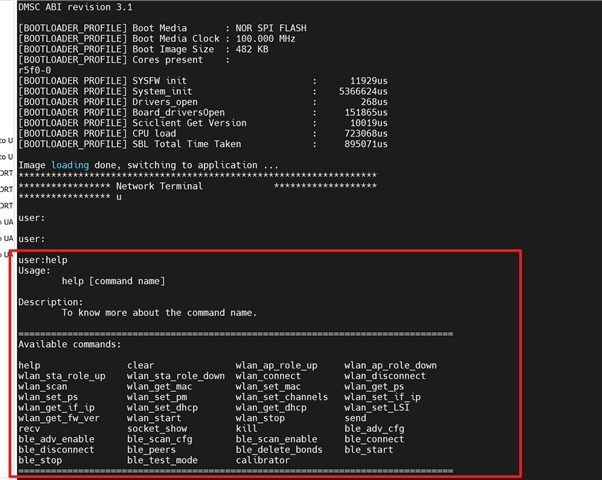
After following this document:CC33XX MCU User's Guide , the WiFi application did not start and remained stuck on "Image loading done, switching to application ..." interface.What is the reason for this?

Snipaste_2025-12-31_19-19-00.png

  • Hello, we have received your case. The investigation will take some time. Thank you for your patience.

  • Okay, please handle this issue as soon as possible. Thank you

  • Okay, please handle this issue as soon as possible. Thank you

  • Hi,

    It does not seem to be related to WiFi (yet).

    Seems like the application cannot be loaded.

    Some of the possible reasons:

    • Does the actual programming go well?
    • some AM243 boards are secured and some not. This is why we have two directories on the SDK, one for secured flavor and the other for non-secured. Can you try both and see?
    • Maybe you forgot to add the application code to the script? can you share the script you are using for programming?
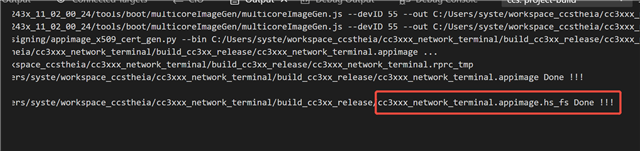
  • 1、The compilation is complete, generating cc3xxx_network_terminal.apimage.hs_fs


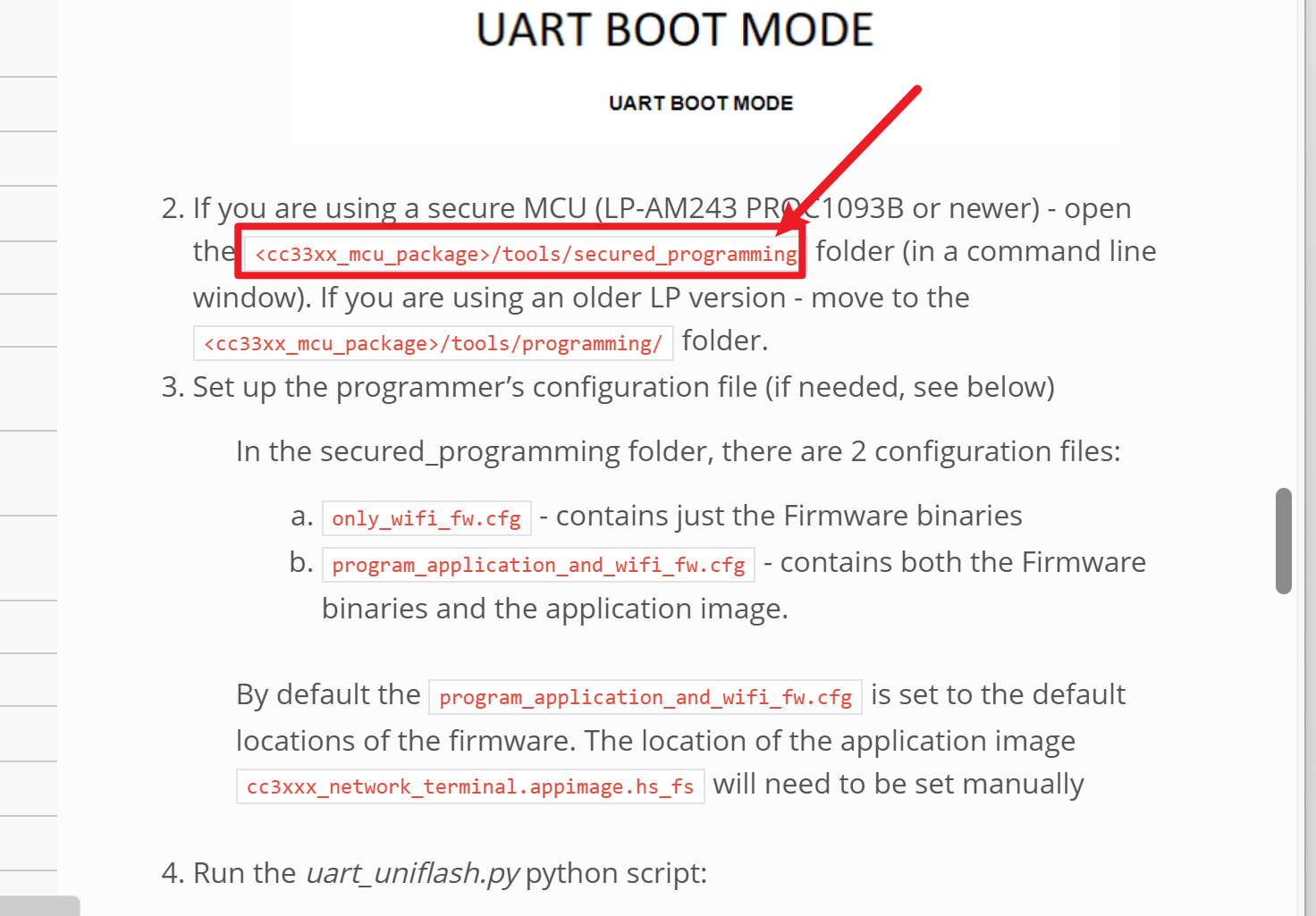
    2、We are using a secure method, do you want me to try another way? I can try this.


    3、Did not forget to add the application in the script.This is the program_application_and_wifi_fw.cfg script that I am using.

    #-----------------------------------------------------------------------------#
    #                                                                             #
    #      DEFAULT CONFIGURATION FILE TO BE USED WITH THE FLASHWRITER SCRIPT      #
    #                                                                             #
    #-----------------------------------------------------------------------------#
    #
    # By default this config file,
    # - points to pre-built flash writer, bootloader for this LP
    # - The application image points to relative path of the ipc echo application image for this LP
    #   - Make sure this application is built before running this script
    # - You can customized this config file to point to your own bootloader and/or application images
    # - You can use --operation=flashverify if you just want to verify the flash contents and not flash the file.
    #
    
    # --flash-writer=./sbl_uart_uniflash.release.tiimage
    # First point to sbl_uart_uniflash binary, which function's as a server to flash one or more files
    --flash-writer=./sbl_uart_uniflash.release.hs_fs.tiimage 
    
    # Now send one or more files to flash or flashverify as needed. The order of sending files does not matter
    
    # Program the OSPI PHY tuning attack vector
    --operation=flash-phy-tuning-data
    
    # --file=./sbl_ospi.release.tiimage --operation=flash --flash-offset=0x0
    # When sending bootloader make sure to flash at offset 0x0. ROM expects bootloader at offset 0x0
    --file=./sbl_ospi.release.hs_fs.tiimage --operation=flash --flash-offset=0x0
    
    #Network Terminal appimage file (cc3xxx_network_terminal.appimage.hs_fs)
    --file=./cc3xxx_network_terminal.appimage.hs_fs --operation=flash --flash-offset=0x80000
    
    #Wifi FW container (cc33xx_fw.bin)
    --file=../wifi_fw/cc33xx_fw.bin --operation=flash --flash-offset=0x800000
    
    #Wifi RAM Bootloafer container (cc33xx_2nd_loader.bin)
    --file=../wifi_fw/cc33xx_2nd_loader.bin --operation=flash --flash-offset=0x900000
    
    #cc33xx Conf configurations file (cc33xx-conf.bin)
    --file=../wifi_fw/cc33xx-conf.bin --operation=flash --flash-offset=0xa00000
    

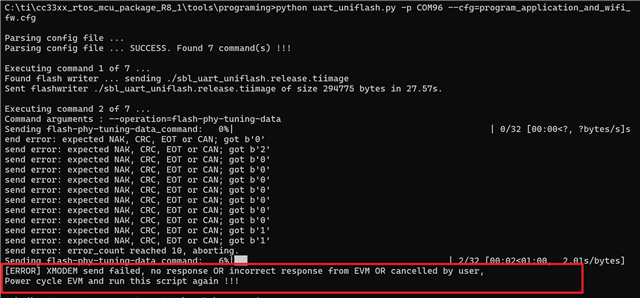
  • I tried running the script in non secure mode twice, but encountered an error. The error is as follows,This is the program_application_and_wifi_fw.cfg script.

    #-----------------------------------------------------------------------------#
    #                                                                             #
    #      DEFAULT CONFIGURATION FILE TO BE USED WITH THE FLASHWRITER SCRIPT      #
    #                                                                             #
    #-----------------------------------------------------------------------------#
    #
    # By default this config file,
    # - points to pre-built flash writer, bootloader for this LP
    # - The application image points to relative path of the ipc echo application image for this LP
    #   - Make sure this application is built before running this script
    # - You can customized this config file to point to your own bootloader and/or application images
    # - You can use --operation=flashverify if you just want to verify the flash contents and not flash the file.
    #
    
    # --flash-writer=./sbl_uart_uniflash.release.tiimage
    # First point to sbl_uart_uniflash binary, which function's as a server to flash one or more files
    --flash-writer=./sbl_uart_uniflash.release.tiimage 
    
    # Now send one or more files to flash or flashverify as needed. The order of sending files does not matter
    
    # Program the OSPI PHY tuning attack vector
    --operation=flash-phy-tuning-data
    
    # --file=./sbl_ospi.release.tiimage --operation=flash --flash-offset=0x0
    # When sending bootloader make sure to flash at offset 0x0. ROM expects bootloader at offset 0x0
    --file=./sbl_ospi.release.tiimage --operation=flash --flash-offset=0x0
    
    #Network Terminal appimage file (cc3xxx_network_terminal.appimage)
    --file=./cc3xxx_network_terminal.appimage --operation=flash --flash-offset=0x80000
    
    #Wifi FW container (cc33xx_fw.bin)
    --file=../wifi_fw/cc33xx_fw.bin --operation=flash --flash-offset=0x800000
    
    #Wifi RAM Bootloafer container (cc33xx_2nd_loader.bin)
    --file=../wifi_fw/cc33xx_2nd_loader.bin --operation=flash --flash-offset=0x900000
    
    #cc33xx Conf configurations file (cc33xx-conf.bin)
    --file=../wifi_fw/cc33xx-conf.bin --operation=flash --flash-offset=0xa00000
    

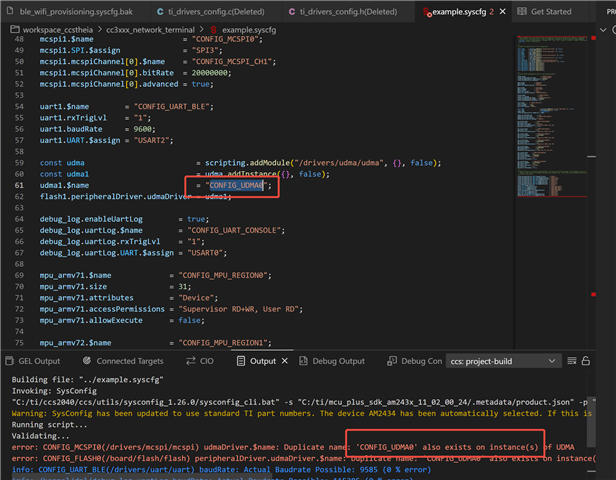
  • Starting to compile cc3xxx_network_terminal, there was an error in the example. syscfg file. Later, I used the SysConfig GUI tool to make some changes, but I'm not sure if the changes were correct. This is the modified example. syscfg file.

    /**
     * These arguments were used when this file was generated. They will be automatically applied on subsequent loads
     * via the GUI or CLI. Run CLI with '--help' for additional information on how to override these arguments.
     * @cliArgs --device "AM243x_ALX_beta" --part "ALX" --package "ALX" --context "r5fss0-0" --product "MCU_PLUS_SDK_AM243x@11.02.00"
     * @v2CliArgs --device "AM2434" --package "FCCSP (ALX)" --variant "AM2434-E" --context "r5fss0-0" --product "MCU_PLUS_SDK_AM243x@11.02.00"
     * @versions {"tool":"1.26.1+4441"}
     */
    
    /**
     * Import the modules used in this configuration.
     */
    const flash      = scripting.addModule("/board/flash/flash", {}, false);
    const flash1     = flash.addInstance();
    const gpio       = scripting.addModule("/drivers/gpio/gpio", {}, false);
    const gpio1      = gpio.addInstance();
    const gpio2      = gpio.addInstance();
    const mcspi      = scripting.addModule("/drivers/mcspi/mcspi", {}, false);
    const mcspi1     = mcspi.addInstance();
    const uart       = scripting.addModule("/drivers/uart/uart", {}, false);
    const uart1      = uart.addInstance();
    const udma       = scripting.addModule("/drivers/udma/udma", {}, false);
    const udma1      = udma.addInstance();
    const debug_log  = scripting.addModule("/kernel/dpl/debug_log");
    const mpu_armv7  = scripting.addModule("/kernel/dpl/mpu_armv7", {}, false);
    const mpu_armv71 = mpu_armv7.addInstance();
    const mpu_armv72 = mpu_armv7.addInstance();
    const mpu_armv73 = mpu_armv7.addInstance();
    const mpu_armv74 = mpu_armv7.addInstance();
    const mpu_armv75 = mpu_armv7.addInstance();
    const mpu_armv76 = mpu_armv7.addInstance();
    const mpu_armv77 = mpu_armv7.addInstance();
    
    /**
     * Write custom configuration values to the imported modules.
     */
    flash1.$name                         = "CONFIG_FLASH0";
    flash1.peripheralDriver.$name        = "CONFIG_OSPI0";
    flash1.peripheralDriver.inputClkFreq = 50000000;
    flash1.peripheralDriver.dmaEnable    = true;
    flash1.peripheralDriver.child.$name  = "drivers_ospi_v0_ospi_v0_template0";
    
    gpio1.$name          = "WLAN_EN";
    gpio1.pinDir         = "OUTPUT";
    gpio1.rx             = true;
    gpio1.GPIO_n.$assign = "PRG0_PRU0_GPO12";
    
    gpio2.$name          = "WLAN_IRQ";
    gpio2.trigType       = "RISE_EDGE";
    gpio2.intrOut        = "9";
    gpio2.rx             = true;
    gpio2.GPIO_n.$assign = "PRG0_PRU0_GPO18";
    
    mcspi1.$name                    = "CONFIG_MCSPI0";
    mcspi1.SPI.$assign              = "SPI3";
    mcspi1.mcspiChannel[0].$name    = "CONFIG_MCSPI_CH1";
    mcspi1.mcspiChannel[0].bitRate  = 20000000;
    mcspi1.mcspiChannel[0].advanced = true;
    mcspi1.child.$name              = "drivers_mcspi_v0_mcspi_v0_template0";
    
    uart1.$name        = "CONFIG_UART_BLE";
    uart1.rxTrigLvl    = "1";
    uart1.baudRate     = 9600;
    uart1.UART.$assign = "USART2";
    
    udma1.$name                        = "CONFIG_UDMA0";
    flash1.peripheralDriver.udmaDriver = udma1;
    
    const udma2       = udma.addInstance({}, false);
    udma2.$name       = "CONFIG_UDMA1";
    mcspi1.udmaDriver = udma2;
    
    debug_log.enableUartLog        = true;
    debug_log.uartLog.$name        = "CONFIG_UART_CONSOLE";
    debug_log.uartLog.rxTrigLvl    = "1";
    debug_log.uartLog.UART.$assign = "USART0";
    
    const uart_v0_template  = scripting.addModule("/drivers/uart/v0/uart_v0_template", {}, false);
    const uart_v0_template1 = uart_v0_template.addInstance({}, false);
    uart_v0_template1.$name = "drivers_uart_v0_uart_v0_template0";
    uart1.child             = uart_v0_template1;
    debug_log.uartLog.child = uart_v0_template1;
    
    mpu_armv71.$name             = "CONFIG_MPU_REGION0";
    mpu_armv71.size              = 31;
    mpu_armv71.attributes        = "Device";
    mpu_armv71.accessPermissions = "Supervisor RD+WR, User RD";
    mpu_armv71.allowExecute      = false;
    
    mpu_armv72.$name             = "CONFIG_MPU_REGION1";
    mpu_armv72.size              = 15;
    mpu_armv72.accessPermissions = "Supervisor RD+WR, User RD";
    
    mpu_armv73.$name             = "CONFIG_MPU_REGION2";
    mpu_armv73.baseAddr          = 0x41010000;
    mpu_armv73.size              = 15;
    mpu_armv73.accessPermissions = "Supervisor RD+WR, User RD";
    
    mpu_armv74.$name             = "CONFIG_MPU_REGION3";
    mpu_armv74.baseAddr          = 0x70000000;
    mpu_armv74.size              = 21;
    mpu_armv74.accessPermissions = "Supervisor RD+WR, User RD";
    
    mpu_armv75.$name             = "CONFIG_MPU_REGION4";
    mpu_armv75.baseAddr          = 0x60000000;
    mpu_armv75.size              = 28;
    mpu_armv75.accessPermissions = "Supervisor RD, User RD";
    
    mpu_armv76.$name       = "CONFIG_MPU_REGION5";
    mpu_armv76.size        = 17;
    mpu_armv76.baseAddr    = 0x4B00000;
    mpu_armv76.attributes  = "CUSTOM";
    mpu_armv76.tex         = 0;
    mpu_armv76.isCacheable = false;
    
    mpu_armv77.$name       = "CONFIG_MPU_REGION6";
    mpu_armv77.baseAddr    = 0x20100000;
    mpu_armv77.size        = 18;
    mpu_armv77.attributes  = "CUSTOM";
    mpu_armv77.tex         = 0;
    mpu_armv77.isCacheable = false;
    
    /**
     * Pinmux solution for unlocked pins/peripherals. This ensures that minor changes to the automatic solver in a future
     * version of the tool will not impact the pinmux you originally saw.  These lines can be completely deleted in order to
     * re-solve from scratch.
     */
    flash1.peripheralDriver.OSPI.$suggestSolution      = "OSPI0";
    flash1.peripheralDriver.OSPI.CLK.$suggestSolution  = "OSPI0_CLK";
    flash1.peripheralDriver.OSPI.CSn0.$suggestSolution = "OSPI0_CSn0";
    flash1.peripheralDriver.OSPI.D3.$suggestSolution   = "OSPI0_D3";
    flash1.peripheralDriver.OSPI.D2.$suggestSolution   = "OSPI0_D2";
    flash1.peripheralDriver.OSPI.D1.$suggestSolution   = "OSPI0_D1";
    flash1.peripheralDriver.OSPI.D0.$suggestSolution   = "OSPI0_D0";
    mcspi1.SPI.CLK.$suggestSolution                    = "PRG0_PRU0_GPO16";
    mcspi1.SPI.D0.$suggestSolution                     = "PRG0_PRU0_GPO13";
    mcspi1.SPI.D1.$suggestSolution                     = "PRG0_PRU0_GPO14";
    mcspi1.mcspiChannel[0].CSn.$suggestSolution        = "PRG0_PRU0_GPO17";
    uart1.UART.RXD.$suggestSolution                    = "GPMC0_AD0";
    uart1.UART.TXD.$suggestSolution                    = "GPMC0_AD1";
    debug_log.uartLog.UART.RXD.$suggestSolution        = "UART0_RXD";
    debug_log.uartLog.UART.TXD.$suggestSolution        = "UART0_TXD";
    

  • Hi,

    In this case you probably have the secured version.

    The fact that the application does not load is not related to the BP itself as the Wi-Fi is not even started.

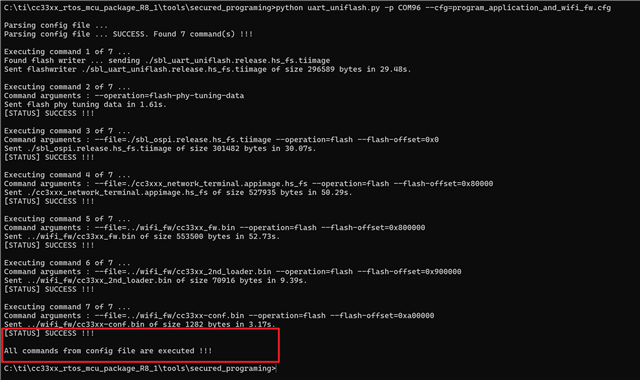
    Can you show the actual execution of the secured script?

    Also, did you make any changes to the network_terminal example?

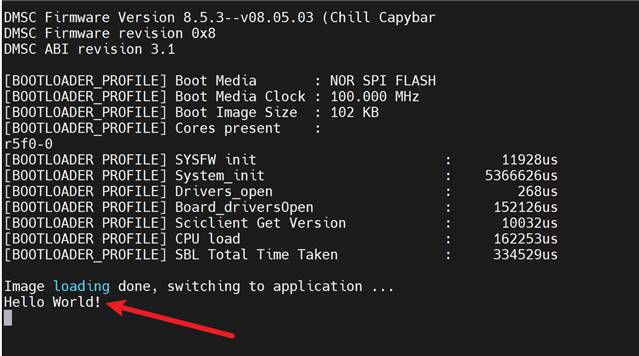
    What I would do to make sure whether it is an AM243 issue or something else, is use the basic hello_world example from the core SDK of AM243.

    I imported it to my workspace from C:\ti\mcu_plus_sdk_am243x_08_05_00_24\examples\hello_world, compiled and got hello_world_am243x-lp_r5fss0-0_freertos_ti-arm-clang.appimage.

    After flashing and rebooting, I got the following:

    DMSC Firmware Version 8.5.3--v08.05.03 (Chill Capybar
    DMSC Firmware revision 0x8
    DMSC ABI revision 3.1
    
    [BOOTLOADER_PROFILE] Boot Media       : NOR SPI FLASH
    [BOOTLOADER_PROFILE] Boot Media Clock : 100.000 MHz
    [BOOTLOADER_PROFILE] Boot Image Size  : 55 KB
    [BOOTLOADER_PROFILE] Cores present    :
    r5f0-0
    [BOOTLOADER PROFILE] SYSFW init                       :      10850us
    [BOOTLOADER PROFILE] System_init                      :    5367700us
    [BOOTLOADER PROFILE] Drivers_open                     :        268us
    [BOOTLOADER PROFILE] Board_driversOpen                :     156544us
    [BOOTLOADER PROFILE] Sciclient Get Version            :      10023us
    [BOOTLOADER PROFILE] CPU load                         :       1620us
    [BOOTLOADER_PROFILE] SBL Total Time Taken             :     178301us
    
    Image loading done, switching to application ...
    Hello World!
    Please do the same and let me know if you see it.
  • 1. The actual execution of the script is as follows:

    This is the program_application_and_wifi_fw.cfg script and uart_uniflash.py python script that I am using.

    #-----------------------------------------------------------------------------#
    #                                                                             #
    #      DEFAULT CONFIGURATION FILE TO BE USED WITH THE FLASHWRITER SCRIPT      #
    #                                                                             #
    #-----------------------------------------------------------------------------#
    #
    # By default this config file,
    # - points to pre-built flash writer, bootloader for this LP
    # - The application image points to relative path of the ipc echo application image for this LP
    #   - Make sure this application is built before running this script
    # - You can customized this config file to point to your own bootloader and/or application images
    # - You can use --operation=flashverify if you just want to verify the flash contents and not flash the file.
    #
    
    # --flash-writer=./sbl_uart_uniflash.release.tiimage
    # First point to sbl_uart_uniflash binary, which function's as a server to flash one or more files
    --flash-writer=./sbl_uart_uniflash.release.hs_fs.tiimage 
    
    # Now send one or more files to flash or flashverify as needed. The order of sending files does not matter
    
    # Program the OSPI PHY tuning attack vector
    --operation=flash-phy-tuning-data
    
    # --file=./sbl_ospi.release.tiimage --operation=flash --flash-offset=0x0
    # When sending bootloader make sure to flash at offset 0x0. ROM expects bootloader at offset 0x0
    --file=./sbl_ospi.release.hs_fs.tiimage --operation=flash --flash-offset=0x0
    
    #Network Terminal appimage file (cc3xxx_network_terminal.appimage.hs_fs)
    --file=./cc3xxx_network_terminal.appimage.hs_fs --operation=flash --flash-offset=0x80000
    
    #Wifi FW container (cc33xx_fw.bin)
    --file=../wifi_fw/cc33xx_fw.bin --operation=flash --flash-offset=0x800000
    
    #Wifi RAM Bootloafer container (cc33xx_2nd_loader.bin)
    --file=../wifi_fw/cc33xx_2nd_loader.bin --operation=flash --flash-offset=0x900000
    
    #cc33xx Conf configurations file (cc33xx-conf.bin)
    --file=../wifi_fw/cc33xx-conf.bin --operation=flash --flash-offset=0xa00000
    

    import os
    import sys
    import time
    import shlex
    import struct
    import argparse
    
    try:
        import serial
        from tqdm import tqdm
        from xmodem import XMODEM, XMODEM1k
    except ImportError:
        print('[ERROR] Dependant modules not installed, use below pip command to install them. MAKE sure proxy for pip is setup if needed.')
        print('')
        print('python -m pip install pyserial tqdm xmodem --proxy={http://your proxy server:port or leave blank if no proxy}')
        sys.exit()
    
    BOOTLOADER_UNIFLASH_BUF_SIZE                         = 1024*1024 # 1 MB This has to be a 256 KB aligned value, because flash writes will be block oriented
    BOOTLOADER_UNIFLASH_HEADER_SIZE                      = 32 # 32 B
    
    BOOTLOADER_UNIFLASH_FILE_HEADER_MAGIC_NUMBER         = 0x46554C42 # BLUF
    BOOTLOADER_UNIFLASH_RESP_HEADER_MAGIC_NUMBER         = 0x52554C42 # BLUR
    
    BOOTLOADER_UNIFLASH_OPTYPE_FLASH                     = 0xF0
    BOOTLOADER_UNIFLASH_OPTYPE_FLASH_VERIFY              = 0xF1
    BOOTLOADER_UNIFLASH_OPTYPE_FLASH_XIP                 = 0xF2
    BOOTLOADER_UNIFLASH_OPTYPE_FLASH_VERIFY_XIP          = 0xF3
    BOOTLOADER_UNIFLASH_OPTYPE_FLASH_TUNING_DATA         = 0xF4
    BOOTLOADER_UNIFLASH_OPTYPE_FLASH_ERASE               = 0xFE
    BOOTLOADER_UNIFLASH_OPTYPE_EMMC_FLASH                = 0xF5
    BOOTLOADER_UNIFLASH_OPTYPE_EMMC_VERIFY               = 0xF6
    
    BOOTLOADER_UNIFLASH_STATUSCODE_SUCCESS                = 0x00000000
    BOOTLOADER_UNIFLASH_STATUSCODE_MAGIC_ERROR            = 0x10000001
    BOOTLOADER_UNIFLASH_STATUSCODE_OPTYPE_ERROR           = 0x20000001
    BOOTLOADER_UNIFLASH_STATUSCODE_FLASH_ERROR            = 0x30000001
    BOOTLOADER_UNIFLASH_STATUSCODE_FLASH_VERIFY_ERROR     = 0x40000001
    BOOTLOADER_UNIFLASH_STATUSCODE_FLASH_ERASE_ERROR      = 0x50000001
    
    optypewords = {
        "flash" : BOOTLOADER_UNIFLASH_OPTYPE_FLASH,
        "flashverify" : BOOTLOADER_UNIFLASH_OPTYPE_FLASH_VERIFY,
        "flash-xip" : BOOTLOADER_UNIFLASH_OPTYPE_FLASH_XIP,
        "flashverify-xip" : BOOTLOADER_UNIFLASH_OPTYPE_FLASH_VERIFY_XIP,
        "flash-phy-tuning-data" : BOOTLOADER_UNIFLASH_OPTYPE_FLASH_TUNING_DATA,
        "erase" : BOOTLOADER_UNIFLASH_OPTYPE_FLASH_ERASE,
        "flash-emmc":BOOTLOADER_UNIFLASH_OPTYPE_EMMC_FLASH,
        "flashverify-emmc":BOOTLOADER_UNIFLASH_OPTYPE_EMMC_VERIFY,
    }
    
    statuscodes = {
        BOOTLOADER_UNIFLASH_STATUSCODE_SUCCESS : "[STATUS] SUCCESS !!!\n",
        BOOTLOADER_UNIFLASH_STATUSCODE_MAGIC_ERROR : "[STATUS] ERROR: Incorrect magic number in file header !!!\n",
        BOOTLOADER_UNIFLASH_STATUSCODE_OPTYPE_ERROR : "[STATUS] ERROR: Invalid file operation type sent !!!\n",
        BOOTLOADER_UNIFLASH_STATUSCODE_FLASH_ERROR : "[STATUS] ERROR: Flashing failed !!!\n",
        BOOTLOADER_UNIFLASH_STATUSCODE_FLASH_VERIFY_ERROR : "[STATUS] ERROR: Flash verify failed !!!\n",
        BOOTLOADER_UNIFLASH_STATUSCODE_FLASH_ERASE_ERROR : "[STATUS] ERROR: Flash erase failed !!!\n",
    }
    
    TMP_SUFFIX = ".tmp"
    
    g_script_description = '''
    MCU+SDK utility script to flash images to device flash.
    '''
    
    g_cfg_file_description = '''
    Configuration file which has a list of files with
    options for flashing. This should be given as option=value pairs
    separated by space just like in command line. Only give the long
    options in the config file i.e --flash-offset=0x80000 and not -o 0x80000
    
    Example, below can be a line in the config file, myconfig.cfg
    --file=am64x-evm/sbl_ospi.release.tiimage --operation=flash --flash-offset=0x0
    
    and then the script can be called:
    python uart_uniflash.py -p <COM port> --cfg=myconfig.cfg
    '''
    
    def open_serial_port(serial_port, baudrate, timeout=10):
        ser = None
        try:
            ser = serial.Serial(port=serial_port, baudrate=baudrate, timeout=10)
        except serial.serialutil.SerialException:
            print('[ERROR] Serial port [' + serial_port + '] not found or not accessible !!!')
            sys.exit()
        return ser
    
    def close_serial_port(ser):
        ser.close()
    
    def get_numword(s):
        numword = None
        if(s.startswith('0x')):
            numword = int(s, 16)
        else:
            numword = int(s, 10)
        return numword
    
    # Add the file header with metadata to the file to be sent. Expects a validated linecfg
    def create_temp_file(linecfg):
        '''
        File header struct used in the target side :
    
        typedef struct Bootloader_UniflashFileHeader_s
        {
            uint32_t magicNumber;
            /* BOOTLOADER_UNIFLASH_FILE_HEADER_MAGIC_NUMBER */
    
            uint32_t operationTypeAndFlags;
            /* LSByte - Operation Type:flash, verify flash or erase */
    
            uint32_t offset;
            /* Offset to flash, verify flash or erase flash */
    
            uint32_t eraseSize;
            /* Size of flash to erase */
    
            uint32_t actualFileSize;
            /* Size of the file sent. This is needed because xmodem returns a padded file size */
    
            uint32_t rsv1;
            uint32_t rsv2;
            uint32_t rsv3;
            /* Reserved */
        } Bootloader_UniflashFileHeader;
    
        So we need to use same struct to pack in python
        '''
        file_header_str = '<LLLLLLLL'
    
        if(linecfg.optype in ("erase", "flash-phy-tuning-data")):
            # No separate file required
            tempfilename = "{}_command".format(linecfg.optype)
        else:
            tempfilename = linecfg.filename + TMP_SUFFIX
    
        f = open(tempfilename, "wb")
    
        # Construct the header now, first define the reserved word
        rsv_word = 0xDEADBABE
    
        # Determine the offset if applicable
        offset_val = rsv_word
        if(linecfg.optype not in ("flash-xip", "flashverify-xip", "flash-phy-tuning-data")):
            offset_val = get_numword(linecfg.offset) 
    
        # Determine the erase size if applicable
        erase_size_val = rsv_word
        if(linecfg.optype in ("erase")):
            erase_size_val = get_numword(linecfg.erase_size)
    
        # Determine the actual file size if applicable, no original file in case of erase or phy tuning
        actual_file_size = 0
        if(linecfg.optype not in ("erase","flash-phy-tuning-data")):
            actual_file_size = os.path.getsize(linecfg.filename)
    
        file_header = struct.pack(file_header_str, 
                                  BOOTLOADER_UNIFLASH_FILE_HEADER_MAGIC_NUMBER,
                                  optypewords[linecfg.optype],
                                  offset_val,
                                  erase_size_val,
                                  actual_file_size,
                                  rsv_word, rsv_word, rsv_word
                                 )
    
        # Write header to file
        f.write(file_header)
    
        # No original file in case of erase or phy tuning
        if(linecfg.optype not in ("erase","flash-phy-tuning-data")):
            # copy the original file to this file
            original_file = open(linecfg.filename, "rb")
            f.write(original_file.read())
            original_file.close()
    
        f.close()
    
        return tempfilename
    
    # Parse response header sent from EVM
    def parse_response_evm(filename):
        f = open(filename, "rb")
        resp_bytes = f.read(16)
        f.close()
    
        status = None
    
        resp_magic = int.from_bytes(resp_bytes[0:4], 'little')
        resp_status = int.from_bytes(resp_bytes[4:8], 'little')
    
        if(resp_magic == BOOTLOADER_UNIFLASH_RESP_HEADER_MAGIC_NUMBER):
            if resp_status in statuscodes.keys():
                status = statuscodes[resp_status]
            else:
                status = "[ERROR] Invalid status code in response !!!"
        else:
            status = "[ERROR] Incorrect magic number in Response Header !!!"
    
        return status
    
    # Sends the file to EVM via xmodem, receives response from EVM and returns the response status
    def xmodem_send_receive_file(filename, serialport, baudrate=115200, get_response=True):
        status = False
        timetaken = 0
        if not os.path.exists(filename):
            print('[ERROR] File [' + filename + '] not found !!!')
            sys.exit()
    
        stream = open(filename, 'rb')
    
        bar = tqdm(total=os.path.getsize(filename), unit="bytes", leave=False, desc="Sending {}".format(filename.replace(TMP_SUFFIX, "")))
    
        ser = open_serial_port(serialport, baudrate)
    
        def getc(size, timeout=1):
            return ser.read(size) or None
    
        def putc(data, timeout=1):
            bar.update(len(data))  
            bar.refresh()
            return ser.write(data)
    
        try:
            modem = XMODEM1k(getc, putc)
            tstart = time.time()
            status = modem.send(stream, quiet=True, timeout=10, retry=10)
            tstop = time.time()
            timetaken = round(tstop-tstart, 2)
        except:
            status = False
    
        stream.close()
    
        if( status is False ) :
            print("")
            print ("[ERROR] XMODEM send failed, no response OR incorrect response from EVM OR cancelled by user,")
            print ("Power cycle EVM and run this script again !!!")
            sys.exit()
    
        resp_status = 0
    
        # Don't do the receive if get_response is False
        if(get_response):
            respfilename = "resp.dat"
            try:
                respfile = open(respfilename, "wb")
                status = modem.recv(respfile, quiet=True, timeout=2000)
                respfile.close()
                resp_status = parse_response_evm(respfilename)
                os.remove(respfilename)
            except:
                status = None
            if( status is None ) :
                print("")
                print ("[ERROR] XMODEM recv failed, no response OR incorrect response from EVM OR cancelled by user,")
                print ("Power cycle EVM and run this script again !!!")
                sys.exit()
    
        close_serial_port(ser)
    
        bar.close()
    
        return resp_status, timetaken
    
    def send_file_by_parts(l_cfg, s_port):
        orig_f_name = l_cfg.filename
        orig_offset = l_cfg.offset
    
        f = open(orig_f_name, "rb")
        f_bytes = f.read()
        f.close()
    
        num_parts   = int(len(f_bytes) / BOOTLOADER_UNIFLASH_BUF_SIZE)
        remain_size = len(f_bytes) % BOOTLOADER_UNIFLASH_BUF_SIZE
        total_time_taken = 0
    
    
        for i in range(0, num_parts):
    
            start = i*BOOTLOADER_UNIFLASH_BUF_SIZE
            end = start+BOOTLOADER_UNIFLASH_BUF_SIZE
    
            part_data = f_bytes[start:end]
            part_filename = orig_f_name + ".part{}".format(i+1)
            # make the partial file
            f = open(part_filename, "wb")
            f.write(part_data)
            f.close()
    
            # temporarily change this to the partial filename
            l_cfg.filename = part_filename
            l_cfg.offset = hex(get_numword(orig_offset) + i*BOOTLOADER_UNIFLASH_BUF_SIZE)
    
            # send the partial file normally
            tempfilename = create_temp_file(l_cfg)
            status, timetaken = xmodem_send_receive_file(tempfilename, s_port)
            total_time_taken += timetaken
    
            # delete the temporary file
            os.remove(part_filename)
            os.remove(tempfilename)
    
        # Send the last part, if there were residual bytes
        if(remain_size > 0):
            start = num_parts*BOOTLOADER_UNIFLASH_BUF_SIZE
            end = -1 # Read till the end of original file
    
            part_data = f_bytes[start:end]
            part_filename = orig_f_name + ".part{}".format(num_parts+1)
    
            # make the partial file
            f = open(part_filename, "wb")
            f.write(part_data)
            f.close()
    
            # temporarily change this to the partial filename
            l_cfg.filename = part_filename
            l_cfg.offset = hex(get_numword(orig_offset) + num_parts*BOOTLOADER_UNIFLASH_BUF_SIZE)
    
            # send the partial file normally
            tempfilename = create_temp_file(l_cfg)
            status, timetaken = xmodem_send_receive_file(tempfilename, s_port)
            total_time_taken += timetaken
    
            # delete the temporary file
            os.remove(part_filename)
            os.remove(tempfilename)
    
        # revert back the original filename and offset
        l_cfg.filename = orig_f_name
        l_cfg.offset = orig_offset
    
        return status, total_time_taken
    
    def main(argv):
        serialport = None
        config_file = None
        cmd_flash_writer_found = False
        ops_invalid = False
    
        cmdlinecfg = LineCfg(cfg_src="cmd")
    
        my_parser = argparse.ArgumentParser(description=g_script_description)
        my_parser.add_argument('-p', '--serial-port', required=True, help="[Mandatory argument] Serial port to use for the transfer. COM3, COM4 etc if on windows and /dev/ttyUSB1,/dev/ttyUSB2 etc if on linux.")
        my_parser.add_argument('-f', '--file', required=False, help="Filename to send for an operation. Not required if using config mode (--cfg)")
        my_parser.add_argument('-o', '--flash-offset', required=False, help="Offset (in hexadecimal format starting with a 0x) at which the flash/verify flash is to be done. Not required if using config mode (--cfg)")
        my_parser.add_argument('--operation', required=False, help='Operation to be done on the file => "flash" or "flashverify" or "erase" or "flash-xip" or "flashverify-xip" or "flash-phy-tuning-data" or "flash-emmc" or "flashverify-emmc". Not required if using config mode (--cfg)')
        my_parser.add_argument('--flash-writer', required=False, help="Special option. This will load the sbl_uart_uniflash binary which will be booted by ROM. Other arguments are irrelevant and hence ignored when --flash-writer argument is present. Not required if using config mode (--cfg)")
        my_parser.add_argument('--erase-size', required=False, help='Size of flash to erase. Only valid when operation is "erase"')
        my_parser.add_argument('--cfg', required=False, help=g_cfg_file_description)
    
        args = my_parser.parse_args()
        
        serialport = args.serial_port
        config_file = args.cfg
        cmdlinecfg.filename = args.file
        cmdlinecfg.offset = args.flash_offset
        cmdlinecfg.optype = args.operation
        cmdlinecfg.flashwriter = args.flash_writer
        cmdlinecfg.erase_size = args.erase_size
    
        if(config_file != None):
            # Check if file exists
            if not os.path.exists(config_file):
                print('[ERROR] Configuration file [' + config_file + '] not found !!!')
                sys.exit()
    
            print("")
            print("Parsing config file ...")
            filecfg = FileCfg(config_file)
            parse_status = filecfg.parse()
    
            if(parse_status != 0):
                print(parse_status)
                sys.exit()
            else:
                # No errors, can proceed to flash
                print("Parsing config file ... SUCCESS. Found {} command(s) !!!".format(len(filecfg.cfgs)))
                print("")
    
                if(filecfg.flash_writer_index != None):
                    # Found flash writer, flash it
                    cfg_flash_writer_file = filecfg.cfgs[filecfg.flash_writer_index].flashwriter
                    print("Executing command {} of {} ...".format(1, len(filecfg.cfgs)))
                    print("Found flash writer ... sending {}".format(cfg_flash_writer_file))
                    status, timetaken = xmodem_send_receive_file(cfg_flash_writer_file, serialport, get_response=False)
                    print("Sent flashwriter {} of size {} bytes in {}s.".format(cfg_flash_writer_file, os.path.getsize(cfg_flash_writer_file), timetaken))
                    print("")
    
                # loop through cfgs and lines, skip the process for flashwriter
                for i in range(0, len(filecfg.cfgs)):
                    if(i != filecfg.flash_writer_index):
                        line = filecfg.lines[i]
                        linecfg = filecfg.cfgs[i]
                        print("Executing command {} of {} ...".format(i+1, len(filecfg.cfgs)))
                        print("Command arguments : {}".format(line.rstrip('\n')))
                        # Check if the size of application image is larger than buffer size in target side.
                        f_size = 0
                        if linecfg.filename is not None:
                            f_size = os.path.getsize(linecfg.filename)
                        
                        if((f_size + BOOTLOADER_UNIFLASH_HEADER_SIZE >= BOOTLOADER_UNIFLASH_BUF_SIZE) and (linecfg.optype in ["flash", "flashverify"])):
                            # Send by parts
                            status, timetaken = send_file_by_parts(linecfg, serialport)
                        else:
                            # Send normally
                            tempfilename = create_temp_file(linecfg)
                            status, timetaken = xmodem_send_receive_file(tempfilename, serialport, get_response=True)
    
                        orig_filename = linecfg.filename
                        if(linecfg.optype == "erase"):
                            print("Sent flash erase command.")
                        elif(linecfg.optype == "flash-phy-tuning-data"):
                            print("Sent flash phy tuning data in {}s.".format(timetaken))
                        else:
                            print("Sent {} of size {} bytes in {}s.".format(orig_filename, os.path.getsize(orig_filename), timetaken))
                        print(status)
                        # Delete the tempfile if it exists
                        if(os.path.exists(tempfilename)):
                            os.remove(tempfilename)
    
                print("All commands from config file are executed !!!")
    
        else:
            # Validate the cmdline config
            status = cmdlinecfg.validate()
            if(status != 0):
                print(status)
                if(cmdlinecfg.exit_now == True):
                    sys.exit(2)
            # If flash writer was found, send it first
            if(cmdlinecfg.found_flashwriter_cmd == True):
                print("Found flash writer ... sending {}".format(cmdlinecfg.flashwriter))
                status, timetaken = xmodem_send_receive_file(cmdlinecfg.flashwriter, serialport, get_response=False)
                print("Sent flashwriter {} of size {} bytes in {}s.".format(cmdlinecfg.flashwriter, os.path.getsize(cmdlinecfg.flashwriter), timetaken))
                print("")
    
            if(cmdlinecfg.ops_invalid == False):
                # Check if the size of application image is larger than buffer size in target side.
                f_size = 0
                if cmdlinecfg.filename is not None:
                    f_size = os.path.getsize(cmdlinecfg.filename)
    
                if((f_size + BOOTLOADER_UNIFLASH_HEADER_SIZE >= BOOTLOADER_UNIFLASH_BUF_SIZE) and (cmdlinecfg.optype in ["flash", "flashverify"])):
                    # Send by parts
                    status, timetaken = send_file_by_parts(cmdlinecfg, serialport)
                else:
                    # Send normally
                    tempfilename = create_temp_file(cmdlinecfg)
                    status, timetaken = xmodem_send_receive_file(tempfilename, serialport)
                    # Delete the tempfile if it exists
                    if(os.path.exists(tempfilename)):
                        os.remove(tempfilename)
    
                orig_filename = cmdlinecfg.filename
                if(cmdlinecfg.optype == "erase"):
                    print("Sent flash erase command.")
                elif(cmdlinecfg.optype == "flash-phy-tuning-data"):
                    print("Sent flash phy tuning data in {}s.".format(timetaken))
                else:
                    print("Sent {} of size {} bytes in {}s.".format(orig_filename, os.path.getsize(orig_filename), timetaken))
                print(status)
    
    # Class definitions used
    class LineCfg():
        def __init__(self, line=None, filename=None, optype=None, offset=None, erase_size=None, flashwriter=None, cfg_src="cfg"):
            self.line = line
            self.filename = filename
            self.optype = optype
            self.offset = offset
            self.flashwriter = flashwriter
            self.erase_size = erase_size
            self.found_flashwriter_cmd = False
            self.ops_invalid = False
            self.cfg_src = cfg_src
            self.exit_now = False
    
        # Takes a string of comma separated key=value pairs and parses into a dictionary
        def parse_to_dict(self, config_string):
            config_dict = dict()
            splitter = shlex.shlex(config_string, posix=True)
            splitter.commenters="#"
            splitter.whitespace = ' '
            splitter.whitespace_split = True
    
            for key_value_pair in splitter:
                kv = key_value_pair.strip()
                if not kv:
                    continue
                kv_t = kv.split('=', 1)
                if(len(kv_t)==1):
                    #error, no value
                    pass
                else:
                    config_dict[kv_t[0]] = kv_t[1]
    
            return config_dict
    
        def validate(self):
            status = 0
            optypes = list(optypewords.keys())
            # Check if called by config file parser or direct command line
            if(self.line!=None and self.cfg_src=="cfg"):
                # Called from config_file
                config_dict = self.parse_to_dict(self.line)
    
                if not config_dict:
                    status = "invalid_line"
                else:
                    # check for flashwriter
                    if "--flash-writer" not in config_dict.keys():
                        # it is okay not to have a flashwriter, in this case
                        # user is expected to have flashed the flashwriter upfront
                        # Check for other arguments
                        # check if file is present
                        if "--operation" not in config_dict.keys():
                            status = "[ERROR] No file operation specified !!!"
                            return status
                        else:
                            self.optype = config_dict["--operation"]
    
                        if(self.optype == "flash" or self.optype == "flashverify" or self.optype == "erase" or self.optype == "flash-emmc" or\
                            self.optype == "flashverify-emmc"):
                            if "--flash-offset" not in config_dict.keys():
                                status = "[ERROR] Operation selected was {}, but no offset provided !!!".format(self.optype)
                                return status
                            else:
                                self.offset = config_dict["--flash-offset"]
    
                        if(self.optype == "flash" or self.optype == "flashverify" or self.optype == "flash-xip" or self.optype == "flashverify-xip" or\
                            self.optype == "flash-emmc" or self.optype == "flashverify-emmc"):
                            if "--file" not in config_dict.keys():
                                status = "[ERROR] Operation selected was {}, but no filename provided !!!".format(self.optype)
                                return status
                            else:
                                self.filename = config_dict["--file"]
    
                        if(self.optype == "erase"):
                            if "--erase-size" not in config_dict.keys():
                                status = "[ERROR] Operation selected was {}, but no erase size provided !!!".format(self.optype)
                                return status
                            else:
                                self.erase_size = config_dict["--erase-size"]
    
                        #No errors in parsing, now validate params to the extent possible
    
                        if(self.optype not in ("erase", "flash-phy-tuning-data")):
                            try:
                                f = open(self.filename)
                            except FileNotFoundError:
                                status = "[ERROR] File not found !!!"
                                return status
    
                        if(self.optype not in optypes):
                            status = "[ERROR] Invalid File Operation type !!!"
                            return status
    
                    else:
                        # we have a flash writer argument, other arguments are moot
                        self.flashwriter = config_dict["--flash-writer"]
    
                        try:
                            f = open(self.flashwriter)
                        except FileNotFoundError:
                            status = "[ERROR] Flashwriter file not found !!!"
                            return status
    
            elif(self.line==None and self.cfg_src=="cmd"):
                # Called from main, with cmd line arguments
                # We have the filename, optype etc already filled
                if(self.flashwriter != None):
                    self.found_flashwriter_cmd = True
                else:
                    self.found_flashwriter_cmd = False
    
                if(self.optype == None):
                    # mandatory arg. If no flashwriter, caller should exit now
                    self.ops_invalid = True
                    self.exit_now = not self.found_flashwriter_cmd
                    if(self.found_flashwriter_cmd == False):
                        status = "[ERROR] No operation type mentioned !!!"
                        return status
                    else:
                        pass
                else:
                    if((self.optype == "flash" or self.optype == "flashverify" or self.optype == "erase" or self.optype == "flashverify-emmc") and (self.offset == None)):
                        self.ops_invalid = True
                        self.exit_now = not self.found_flashwriter_cmd
                        # flash/verify flash/erase, but no offset given. exit with help if no flashwriter
                        if(self.found_flashwriter_cmd == False):
                            status = "[ERROR] Operation selected was {}, but no offset was provided !!!".format(self.optype)
                            return status
                        else:
                            pass
    
                    if((self.optype == "flash" or self.optype == "flashverify" or self.optype == "flash-xip" or self.optype == "flashverify-xip" or self.optype == "flashverify-emmc") and (self.filename == None)):
                        self.ops_invalid = True
                        self.exit_now = not self.found_flashwriter_cmd
                        # flash/verify flash/erase, but no filename given. exit with help if no flashwriter
                        if(self.found_flashwriter_cmd == False):
                            status = "[ERROR] Operation selected was {}, but no filename was provided !!!".format(self.optype)
                            return status
                        else:
                            pass
    
                    if(self.optype == "erase" and self.erase_size == None):
                        self.ops_invalid = True
                        self.exit_now = not self.found_flashwriter_cmd
                        # erase command found, but no erase size given. exit with help if no flashwriter
                        if(self.found_flashwriter_cmd == False):
                            status = "[ERROR] Operation selected was {}, but no erase size was provided !!!".format(self.optype)
                            return status
                        else:
                            pass
    
                    if(self.optype not in optypes):
                        self.ops_invalid = True
                        self.exit_now = not self.found_flashwriter_cmd
                        # erase command found, but no erase size given. exit with help if no flashwriter
                        if(self.found_flashwriter_cmd == False):
                            status = "[ERROR] Invalid File Operation type !!!"
                            return status
                        else:
                            pass
                    if(self.optype not in ("erase", "flash-phy-tuning-data")):
                        try:
                            f = open(self.filename)
                        except FileNotFoundError:
                            self.ops_invalid = True
                            self.exit_now = not self.found_flashwriter_cmd
                            # erase command found, but no erase size given. exit with help if no flashwriter
                            if(self.found_flashwriter_cmd == False):
                                status = "[ERROR] File not found !!!"
                                return status
                            else:
                                pass
            else:
                # Should not hit this
                status = -1
            return status
    
    class FileCfg():
        def __init__(self, filename=None):
            self.filename = filename
            self.lines = list()
            self.cfgs = list()
            self.errors = list()
            self.flash_writer_index = None
    
        def parse(self):
            f = open(self.filename, "r")
            lines = f.readlines()
            f.close()
            parse_status = 0
            linecount = 0
            found_fw = False
            valid_cfg_count = 0
    
            for line in lines:
                linecfg = LineCfg(line=line)
                status = linecfg.validate()
    
                if(status != 0 and status != "invalid_line"):
                    self.errors.append("[ERROR] Parsing error found on line {} of {}\n{}\n".format(linecount+1, self.filename, status))
                else:
                    if(status != "invalid_line"):
                        if(linecfg.flashwriter != None):
                            if(found_fw == True):
                                # error, another instance of flashwriter found
                                flash_writer_error_msg = "[ERROR] Redefinition of flash writer !!!"
                                self.errors.append("[ERROR] Parsing error found on line {} of {}\n{}\n".format(linecount+1, self.filename, flash_writer_error_msg))
                            else:
                                found_fw = True
                                self.cfgs.append(linecfg)
                                self.lines.append(line.rstrip('\n'))
                                self.flash_writer_index = valid_cfg_count
                                valid_cfg_count += 1
                        else:
                            self.cfgs.append(linecfg)
                            self.lines.append(line.rstrip('\n'))
                            valid_cfg_count += 1
                linecount += 1
    
            if(len(self.errors) > 0):
                # Some commands have errors
                parse_status = "Parsing config file ... ERROR. {} error(s).\n\n".format(len(self.errors)) + "\n".join(self.errors)
    
            return parse_status
    
    if __name__ == "__main__":
       main(sys.argv[1:])

    2. When compiling the cc3xxx_network_terminal there was an error in the example. syscfg file, the example. syscfg file was modified.Later, I used the SysConfig GUI tool to make some changes, but I'm not sure if the changes were correct. This is the modified example. syscfg file.

    /**
     * These arguments were used when this file was generated. They will be automatically applied on subsequent loads
     * via the GUI or CLI. Run CLI with '--help' for additional information on how to override these arguments.
     * @cliArgs --device "AM243x_ALX_beta" --part "ALX" --package "ALX" --context "r5fss0-0" --product "MCU_PLUS_SDK_AM243x@11.02.00"
     * @v2CliArgs --device "AM2434" --package "FCCSP (ALX)" --variant "AM2434-E" --context "r5fss0-0" --product "MCU_PLUS_SDK_AM243x@11.02.00"
     * @versions {"tool":"1.26.1+4441"}
     */
    
    /**
     * Import the modules used in this configuration.
     */
    const flash      = scripting.addModule("/board/flash/flash", {}, false);
    const flash1     = flash.addInstance();
    const gpio       = scripting.addModule("/drivers/gpio/gpio", {}, false);
    const gpio1      = gpio.addInstance();
    const gpio2      = gpio.addInstance();
    const mcspi      = scripting.addModule("/drivers/mcspi/mcspi", {}, false);
    const mcspi1     = mcspi.addInstance();
    const uart       = scripting.addModule("/drivers/uart/uart", {}, false);
    const uart1      = uart.addInstance();
    const udma       = scripting.addModule("/drivers/udma/udma", {}, false);
    const udma1      = udma.addInstance();
    const debug_log  = scripting.addModule("/kernel/dpl/debug_log");
    const mpu_armv7  = scripting.addModule("/kernel/dpl/mpu_armv7", {}, false);
    const mpu_armv71 = mpu_armv7.addInstance();
    const mpu_armv72 = mpu_armv7.addInstance();
    const mpu_armv73 = mpu_armv7.addInstance();
    const mpu_armv74 = mpu_armv7.addInstance();
    const mpu_armv75 = mpu_armv7.addInstance();
    const mpu_armv76 = mpu_armv7.addInstance();
    const mpu_armv77 = mpu_armv7.addInstance();
    
    /**
     * Write custom configuration values to the imported modules.
     */
    flash1.$name                         = "CONFIG_FLASH0";
    flash1.peripheralDriver.$name        = "CONFIG_OSPI0";
    flash1.peripheralDriver.inputClkFreq = 50000000;
    flash1.peripheralDriver.dmaEnable    = true;
    flash1.peripheralDriver.child.$name  = "drivers_ospi_v0_ospi_v0_template0";
    
    gpio1.$name          = "WLAN_EN";
    gpio1.pinDir         = "OUTPUT";
    gpio1.rx             = true;
    gpio1.GPIO_n.$assign = "PRG0_PRU0_GPO12";
    
    gpio2.$name          = "WLAN_IRQ";
    gpio2.trigType       = "RISE_EDGE";
    gpio2.intrOut        = "9";
    gpio2.rx             = true;
    gpio2.GPIO_n.$assign = "PRG0_PRU0_GPO18";
    
    mcspi1.$name                    = "CONFIG_MCSPI0";
    mcspi1.SPI.$assign              = "SPI3";
    mcspi1.mcspiChannel[0].$name    = "CONFIG_MCSPI_CH1";
    mcspi1.mcspiChannel[0].bitRate  = 20000000;
    mcspi1.mcspiChannel[0].advanced = true;
    mcspi1.child.$name              = "drivers_mcspi_v0_mcspi_v0_template0";
    
    uart1.$name        = "CONFIG_UART_BLE";
    uart1.rxTrigLvl    = "1";
    uart1.baudRate     = 9600;
    uart1.UART.$assign = "USART2";
    
    udma1.$name                        = "CONFIG_UDMA0";
    flash1.peripheralDriver.udmaDriver = udma1;
    
    const udma2       = udma.addInstance({}, false);
    udma2.$name       = "CONFIG_UDMA1";
    mcspi1.udmaDriver = udma2;
    
    debug_log.enableUartLog        = true;
    debug_log.uartLog.$name        = "CONFIG_UART_CONSOLE";
    debug_log.uartLog.rxTrigLvl    = "1";
    debug_log.uartLog.UART.$assign = "USART0";
    
    const uart_v0_template  = scripting.addModule("/drivers/uart/v0/uart_v0_template", {}, false);
    const uart_v0_template1 = uart_v0_template.addInstance({}, false);
    uart_v0_template1.$name = "drivers_uart_v0_uart_v0_template0";
    uart1.child             = uart_v0_template1;
    debug_log.uartLog.child = uart_v0_template1;
    
    mpu_armv71.$name             = "CONFIG_MPU_REGION0";
    mpu_armv71.size              = 31;
    mpu_armv71.attributes        = "Device";
    mpu_armv71.accessPermissions = "Supervisor RD+WR, User RD";
    mpu_armv71.allowExecute      = false;
    
    mpu_armv72.$name             = "CONFIG_MPU_REGION1";
    mpu_armv72.size              = 15;
    mpu_armv72.accessPermissions = "Supervisor RD+WR, User RD";
    
    mpu_armv73.$name             = "CONFIG_MPU_REGION2";
    mpu_armv73.baseAddr          = 0x41010000;
    mpu_armv73.size              = 15;
    mpu_armv73.accessPermissions = "Supervisor RD+WR, User RD";
    
    mpu_armv74.$name             = "CONFIG_MPU_REGION3";
    mpu_armv74.baseAddr          = 0x70000000;
    mpu_armv74.size              = 21;
    mpu_armv74.accessPermissions = "Supervisor RD+WR, User RD";
    
    mpu_armv75.$name             = "CONFIG_MPU_REGION4";
    mpu_armv75.baseAddr          = 0x60000000;
    mpu_armv75.size              = 28;
    mpu_armv75.accessPermissions = "Supervisor RD, User RD";
    
    mpu_armv76.$name       = "CONFIG_MPU_REGION5";
    mpu_armv76.size        = 17;
    mpu_armv76.baseAddr    = 0x4B00000;
    mpu_armv76.attributes  = "CUSTOM";
    mpu_armv76.tex         = 0;
    mpu_armv76.isCacheable = false;
    
    mpu_armv77.$name       = "CONFIG_MPU_REGION6";
    mpu_armv77.baseAddr    = 0x20100000;
    mpu_armv77.size        = 18;
    mpu_armv77.attributes  = "CUSTOM";
    mpu_armv77.tex         = 0;
    mpu_armv77.isCacheable = false;
    
    /**
     * Pinmux solution for unlocked pins/peripherals. This ensures that minor changes to the automatic solver in a future
     * version of the tool will not impact the pinmux you originally saw.  These lines can be completely deleted in order to
     * re-solve from scratch.
     */
    flash1.peripheralDriver.OSPI.$suggestSolution      = "OSPI0";
    flash1.peripheralDriver.OSPI.CLK.$suggestSolution  = "OSPI0_CLK";
    flash1.peripheralDriver.OSPI.CSn0.$suggestSolution = "OSPI0_CSn0";
    flash1.peripheralDriver.OSPI.D3.$suggestSolution   = "OSPI0_D3";
    flash1.peripheralDriver.OSPI.D2.$suggestSolution   = "OSPI0_D2";
    flash1.peripheralDriver.OSPI.D1.$suggestSolution   = "OSPI0_D1";
    flash1.peripheralDriver.OSPI.D0.$suggestSolution   = "OSPI0_D0";
    mcspi1.SPI.CLK.$suggestSolution                    = "PRG0_PRU0_GPO16";
    mcspi1.SPI.D0.$suggestSolution                     = "PRG0_PRU0_GPO13";
    mcspi1.SPI.D1.$suggestSolution                     = "PRG0_PRU0_GPO14";
    mcspi1.mcspiChannel[0].CSn.$suggestSolution        = "PRG0_PRU0_GPO17";
    uart1.UART.RXD.$suggestSolution                    = "GPMC0_AD0";
    uart1.UART.TXD.$suggestSolution                    = "GPMC0_AD1";
    debug_log.uartLog.UART.RXD.$suggestSolution        = "UART0_RXD";
    debug_log.uartLog.UART.TXD.$suggestSolution        = "UART0_TXD";

    3. Can you show me the script you used to flashing the hello-world_am243x-lp_r5fss0-0-freertos_ti-arm-clang.appimage?.cfg and .py files, I'll try flashing hello-world.

  • I tried flashing the hello_world example into it, and there was Hello World! output

  • Hi,

    The fact that hello world works means that the procedure is OK.

    For what I can tell, you do not see anything on the terminal because of some changes made in respect to the syscfg and specifically the UDMA.

    For example, the UART that prints to the terminal may use the same UDMA and hence cannot print now.

    Can you tell why you needed to change? the default compilation should not throw any error unless you changed something.

    If possible, please check out of the box without making any modifications to the network_terminal.