
器件型号: TMS320F28335
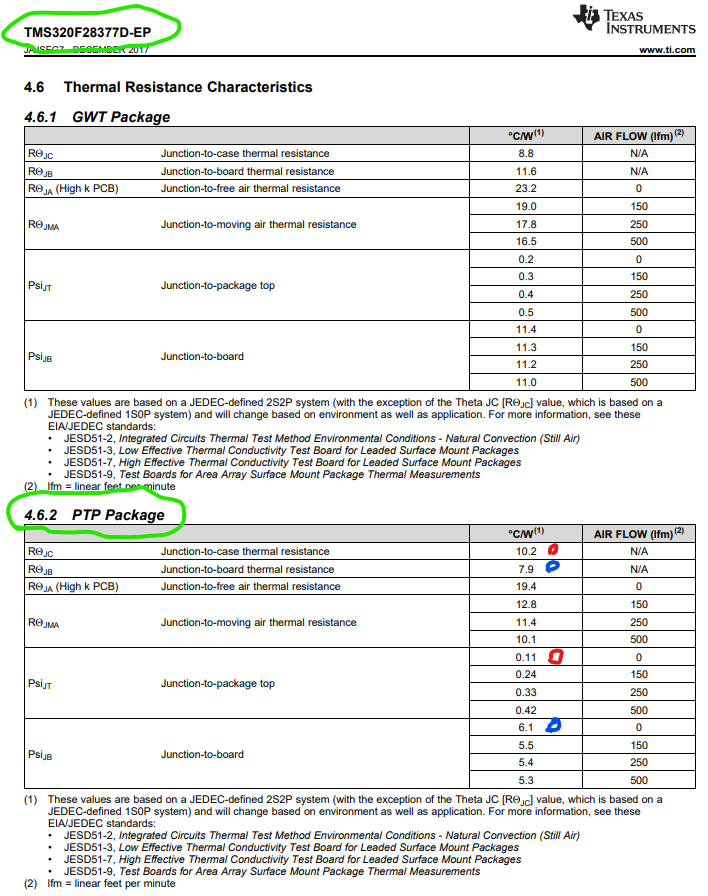
RJB (7.9 度/W) 和 PsiJB (6.1 度/W【无空气】)的值相似、但我不理解为什么 RJC (10.2 度/W) 和 PsiJT (0.11 度/W【无空气】)相差约 100 倍。 请说明。 
This thread has been locked.
If you have a related question, please click the "Ask a related question" button in the top right corner. The newly created question will be automatically linked to this question.
器件型号: TMS320F28335
RJB (7.9 度/W) 和 PsiJB (6.1 度/W【无空气】)的值相似、但我不理解为什么 RJC (10.2 度/W) 和 PsiJT (0.11 度/W【无空气】)相差约 100 倍。 请说明。 

您好:
我来看看这个应用手册: https://www.ti.com/lit/an/spra953d/spra953d.pdf、 它更详细地介绍了如何计算这些热系数、并提供了一些关于 PsiJT 参数与 ThetaJA 的见解。
此致、
Matthew
如果 spra953d.pdf 中列出了这些差异、请告诉我页码。
https://www.ti.com/lit/an/spra953d/spra953d.pdf 共有 15 页。
我是否应该参考第 8/15 和 9/15 页?
还请告诉我项目编号、如 3ΨJT T Ü V、Junction to Top of Package 等
是的、请查看第 8 页和第 9 页。 这将更详细地介绍如何推导 PsiJt 系数。 您将在第 8 页的底部看到:
对于塑料封装、与 4°C/W–2°C/W–15°C/W 的值相比、ΨJT Ω 通常是 0.5°C/W RθJC。 与较厚的封装相比、较薄的封装具有 ΨJT μ m 值更小。 ΨJT 嵌入式散热垫的封装的 μ W 值接近零。 您应注意、R θ ΨJT 会因电路板结构和气流条件而异、如表 3-1 所示。 通过建模获得了表 3-1 中的值。
此致、
Matthew