Part Number: TMS320F28335
您好,
我目前在使用 DSP (TMS320F28335) 與 FPGA板子 (PYNQ-Z2) 用 spi 通訊作溝通。
希望能夠以 DSP 作為 master 傳送浮點數數值 (例如: 0.12 0.121 0.122 ......) 到 作為 slave 的 FPGA ,但在測試時 FPGA 接收到的值有些會有錯誤。
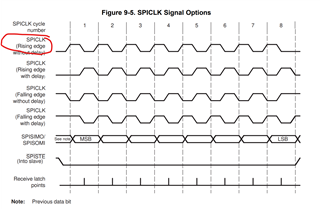
原先猜測是會多一個0在最前面 (以2進制表示時),像是我原先要傳 1111111111111111 結果會變成 0111111111111111, 多的1會被推到下一列,試著手動全部往前推一位後仍然會一些值是錯的,
想知道這個問題是什麼導致的,以及該如何修正。
以下是往後移一位之後的部分結果 (紅色字為有嚴重錯誤):
0.120 -> 0.11951171606779099
0.121 -> 0.12099999934434891
0.122 -> 0.12200000137090683
0.123 -> 0.12300000339746475
0.124 -> 0.12399999797344208
0.125 -> 0.1259765774011612
0.126 -> 0.12502342462539673
0.127 -> 0.12797658145427704
0.128 -> 0.12702342867851257
0.129 -> 0.12997658550739288
0.130 -> 0.12902343273162842
......
另外,DSP這邊是以範例:
來做更改的,以下是我更改過的程式碼:
#include "DSP28x_Project.h"     // Device Headerfile and Examples Include File
//#include "DSP2833x_Device.h"

//
// Function Prototypes
//
//__interrupt void ISRTimer2(void);
void delay_loop(void);
void spi_xmit(Uint16 a);
void spi_fifo_init(void);
void spi_init(void);
void error(void);

union datatype{
    float f_type;
    Uint16 u_type[2];
};
union datatype sdata;
union datatype rdata;

char data_switch=0;

//
// Main
//
void main(void)
{

    sdata.f_type = 0.12;

    //
    // Step 1. Initialize System Control:
    // PLL, WatchDog, enable Peripheral Clocks
    // This example function is found in the DSP2833x_SysCtrl.c file.
    //
    InitSysCtrl();

    //
    // Step 2. Initialize GPIO:
    // This example function is found in the DSP2833x_Gpio.c file and
    // illustrates how to set the GPIO to it's default state.
    //
    // InitGpio();  // Skipped for this example

    //
    // Setup only the GP I/O only for SPI-A functionality
    // This function is found in DSP2833x_Spi.c
    //
    InitSpiaGpio();

    //
    // Step 3. Clear all interrupts and initialize PIE vector table:
    // Disable CPU interrupts
    //
    DINT;

    //
    // Initialize PIE control registers to their default state.
    // The default state is all PIE interrupts disabled and flags
    // are cleared.
    // This function is found in the DSP2833x_PieCtrl.c file.
    //
    InitPieCtrl();

    //
    // Disable CPU interrupts and clear all CPU interrupt flags:
    //
    IER = 0x0000;
    IFR = 0x0000;

    //
    // Initialize the PIE vector table with pointers to the shell Interrupt
    // Service Routines (ISR).
    // This will populate the entire table, even if the interrupt
    // is not used in this example.  This is useful for debug purposes.
    // The shell ISR routines are found in DSP2833x_DefaultIsr.c.
    // This function is found in DSP2833x_PieVect.c.
    //
    InitPieVectTable();

    //
    // Step 4. Initialize all the Device Peripherals:
    // This function is found in DSP2833x_InitPeripherals.c
    //
    // InitPeripherals();    // Not required for this example
    spi_fifo_init();         // Initialize the Spi FIFO
    spi_init();              // init SPI

    //
    // Step 5. User specific code:
    //

    //
    // Interrupts are not used in this example.
    //


    int count = 0;
    for(;;)
    {
        if(count < 100)
        {
            spi_xmit(sdata.u_type[data_switch]);

            while(SpiaRegs.SPIFFRX.bit.RXFFST !=1)
            {

            }
            rdata.u_type[data_switch] = SpiaRegs.SPIRXBUF;

            if(data_switch==0)
            {
                data_switch=1;
            }
            else
            {
                sdata.f_type = sdata.f_type + 0.001;
                count ++;
                data_switch=0;
            }

            delay_loop();
        }
    }
}

//
// delay_loop - Step 7. Insert all local Interrupt Service Routines (ISRs) and
// functions here:
//
void
delay_loop()
{
    long      i;
    for (i = 0; i < 1000000; i++)
    {

    }
}

//
// error -
//
void
error(void)
{
    __asm("     ESTOP0");						// Test failed!! Stop!
    for (;;);
}

//
// spi_init -
//
void
spi_init()
{
    SpiaRegs.SPICCR.all =0x000F;	// Reset on, rising edge, 16-bit char bits

    //
    // Enable master mode, normal phase, enable talk, and SPI int disabled.
    //
    SpiaRegs.SPICTL.all =0x0006;
    SpiaRegs.SPIBRR =0x007F;
    SpiaRegs.SPICCR.all =0x008F;   // Relinquish SPI from Reset
    SpiaRegs.SPIPRI.bit.FREE = 1;  // Set so breakpoints don't disturb xmission

}

//
// spi_xmit -
//
void
spi_xmit(Uint16 a)
{
    SpiaRegs.SPITXBUF=a;
}

//
// spi_fifo_init -
//
void
spi_fifo_init()
{
    //
    // Initialize SPI FIFO registers
    //
    SpiaRegs.SPIFFTX.all=0xE040;
    SpiaRegs.SPIFFRX.all=0x204f;
    SpiaRegs.SPIFFCT.all=0x0;
}
再麻煩替小弟我解惑了!!