Other Parts Discussed in Thread: C2000WARE, CONTROLSUITE
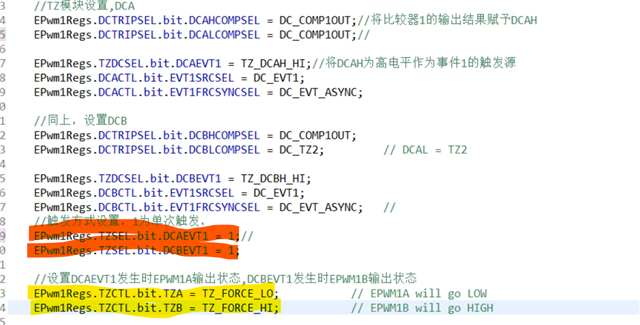
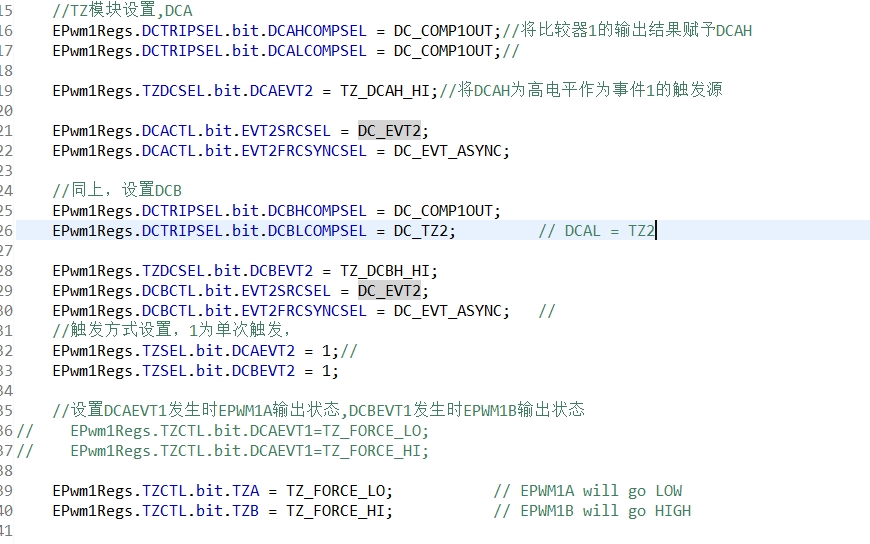
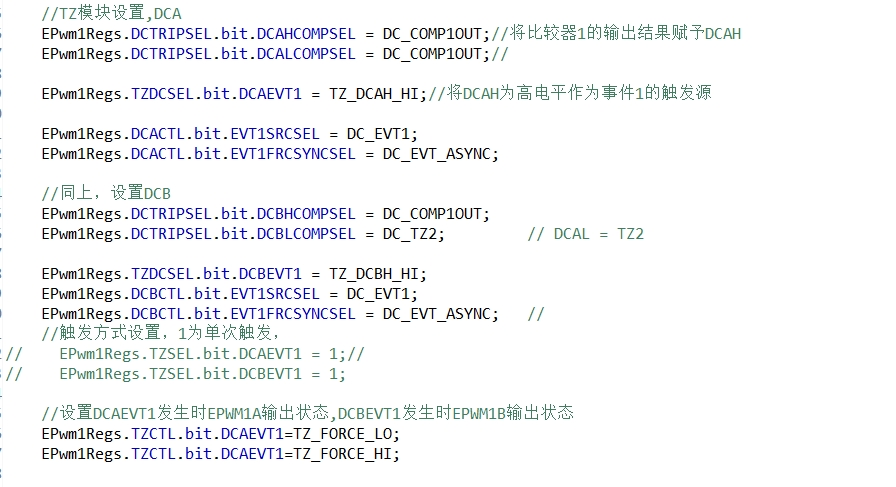
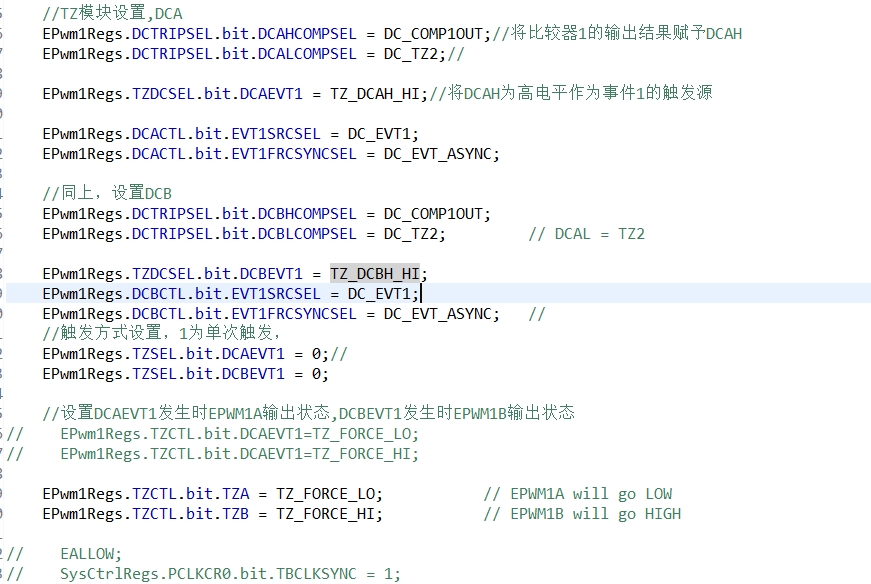
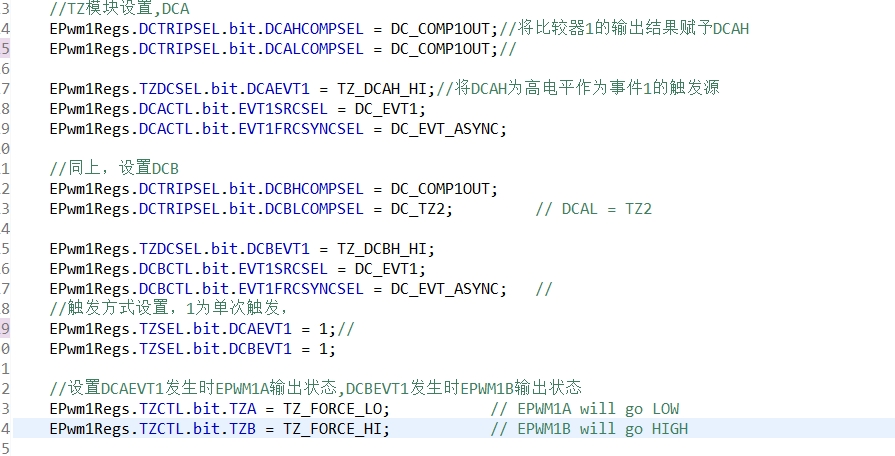
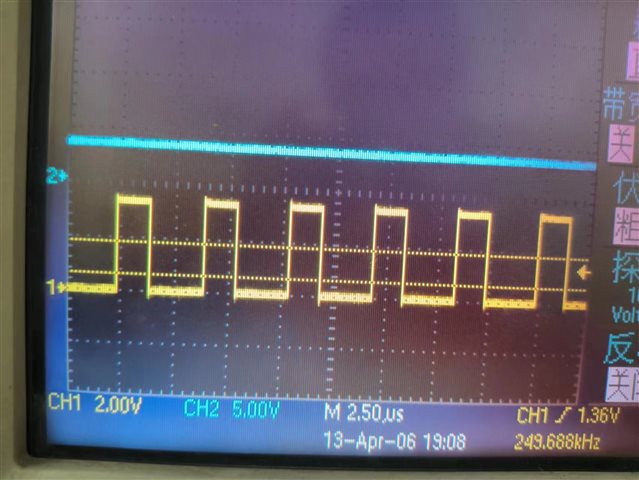
按照如图设置了epwm1的DC以及TZ模块,当COMP1OUT输出高电平时,EPWM1A输出低电平,EPWM1B输出高电平,但是现在COMP1OUT有输出了,但是EPWM1输出并未发生变化
This thread has been locked.
If you have a related question, please click the "Ask a related question" button in the top right corner. The newly created question will be automatically linked to this question.
按照如图设置了epwm1的DC以及TZ模块,当COMP1OUT输出高电平时,EPWM1A输出低电平,EPWM1B输出高电平,但是现在COMP1OUT有输出了,但是EPWM1输出并未发生变化
有试过例程吗?
C:\ti\c2000\C2000Ware_5_00_00_00\device_support\f2803x\examples\c28\epwm_dcevent_trip
C:\ti\c2000\C2000Ware_5_00_00_00\device_support\f2803x\examples\c28\epwm_dcevent_trip_comp
C:\ti\c2000\C2000Ware_5_00_00_00\device_support\f2803x\examples\c28\epwm_trip_zone
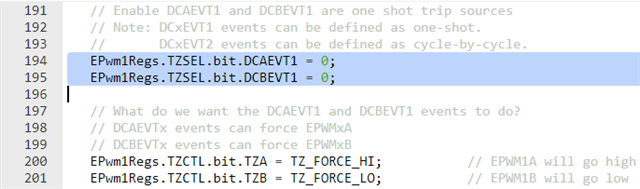
您好,因为其它代码涉及项目所以不能上传所有的代码。。但是我现在用TI的例程C:\ti\controlSUITE\device_support\f2803x\v130\DSP2803x_examples_ccsv5\epwm_dcevent_trip_comp,对其做一定配置后也不能实现我想要的效果
//###########################################################################
// Description:
//! \addtogroup f2803x_example_list
//! <h1>ePWM DC Event Trip Comparator (epwm_dcevent_trip_comp)</h1>
//!
//! In this example ePWM1 is configured for PWM Digital Compare Event
//! Trip using Comparator1A and comparator1B pin inputs.
//! DCAEVT1, DCBEVT1 events are triggered by increasing the voltage on
//! COMP1B pin to be higher than that of COMP1A pin.
//! In this example:
//! - ePWM1 has DCAEVT1 and DCBEVT1 as one shot trip sources
//! DCAEVT1 will pull EPWM1A high
//! DCBEVT1 will pull EPWM1B low
//!
//! Initially make the voltage level at COMP1A to be higher than that of COMP1B.
//! Increase voltage on inverting side of comparator(COMP1B pin) to trigger
//! a DCAEVT1, and DCBEVT1. ePWM1 will react to DCAEVT1 and DCBEVT1 as a 1 shot
//! trip. View the EPWM1A/B waveforms on an oscilloscope to see the effect of
//! the events.
//!
//! \b External \b Connections \n
//! - EPWM1A is on GPIO0
//! - EPWM1B is on GPIO1
//! - COMP1A is on ADCA2
//! - COMP1B is on ADCB2
//! - pull COMP1B to a higher voltage level than COMP1A.
//
//###########################################################################
// $TI Release: F2803x C/C++ Header Files and Peripheral Examples V130 $
// $Release Date: May 8, 2015 $
// $Copyright: Copyright (C) 2009-2015 Texas Instruments Incorporated -
// http://www.ti.com/ ALL RIGHTS RESERVED $
//###########################################################################
#include "DSP28x_Project.h" // Device Headerfile and Examples Include File
// Prototype statements for functions found within this file.
void InitEPwm1Example(void);
__interrupt void epwm1_tzint_isr(void);
// Global variables used in this example
Uint32 EPwm1TZIntCount;
Uint32 EPwm2TZIntCount;
void main(void)
{
// Step 1. Initialize System Control:
// PLL, WatchDog, enable Peripheral Clocks
// This example function is found in the DSP2803x_SysCtrl.c file.
InitSysCtrl();
// Step 2. Initialize GPIO:
// This example function is found in the DSP2803x_Gpio.c file and
// illustrates how to set the GPIO to it's default state.
// InitGpio(); // Skipped for this example
// For this case just init GPIO pins for ePWM1, ePWM2, and TZ pins
InitEPwm1Gpio();
// Step 3. Clear all interrupts and initialize PIE vector table:
// Disable CPU interrupts
DINT;
// Initialize the PIE control registers to their default state.
// The default state is all PIE interrupts disabled and flags
// are cleared.
// This function is found in the DSP2803x_PieCtrl.c file.
InitPieCtrl();
// Disable CPU interrupts and clear all CPU interrupt flags:
IER = 0x0000;
IFR = 0x0000;
// Initialize the PIE vector table with pointers to the shell Interrupt
// Service Routines (ISR).
// This will populate the entire table, even if the interrupt
// is not used in this example. This is useful for debug purposes.
// The shell ISR routines are found in DSP2803x_DefaultIsr.c.
// This function is found in DSP2803x_PieVect.c.
InitPieVectTable();
// Interrupts that are used in this example are re-mapped to
// ISR functions found within this file.
EALLOW; // This is needed to write to EALLOW protected registers
PieVectTable.EPWM1_TZINT = &epwm1_tzint_isr;
EDIS; // This is needed to disable write to EALLOW protected registers
// Step 4. Initialize all the Device Peripherals:
// Not required for this example
EALLOW;
SysCtrlRegs.PCLKCR0.bit.ADCENCLK = 1; // Enable Clock to the ADC
AdcRegs.ADCCTL1.bit.ADCBGPWD = 1; // Comparator shares the internal BG reference of the ADC, must be powered even if ADC is unused
DELAY_US(1000L); // Delay to allow BG reference to settle.
SysCtrlRegs.PCLKCR3.bit.COMP1ENCLK = 1; // Enable clock to the Comparator 1 block
Comp1Regs.COMPCTL.bit.COMPDACEN = 1; // Power up Comparator 1 locally
// Comp1Regs.COMPCTL.bit.COMPSOURCE = 1; // Connect the inverting input to pin COMP1B
////////////////Uncomment following 2 lines to use DAC instead of pin COMP1B //////////////////
Comp1Regs.COMPCTL.bit.COMPSOURCE = 0; // Connect the inverting input to the internal DAC
Comp1Regs.DACVAL.bit.DACVAL = 512; // Set DAC output to midpoint
Comp1Regs.DACCTL.bit.DACSOURCE=0; // Set DAC output to midpoint
//////////////////////////////////////////////////////////////////////////////////////////////
SysCtrlRegs.PCLKCR0.bit.TBCLKSYNC = 0;
EDIS;
InitEPwm1Example();
EALLOW;
SysCtrlRegs.PCLKCR0.bit.TBCLKSYNC = 1;
EDIS;
// Step 5. User specific code, enable interrupts
// Initialize counters:
EPwm1TZIntCount = 0;
// Enable CPU INT3 which is connected to EPWM1-3 INT:
IER |= M_INT2;
// Enable EPWM INTn in the PIE: Group 2 interrupt 1-3
PieCtrlRegs.PIEIER2.bit.INTx1 = 1;
// Enable global Interrupts and higher priority real-time debug events:
EINT; // Enable Global interrupt INTM
ERTM; // Enable Global realtime interrupt DBGM
// Step 6. IDLE loop. Just sit and loop forever (optional):
for(;;)
{
__asm(" NOP");
}
}
__interrupt void epwm1_tzint_isr(void)
{
EPwm1TZIntCount++;
// Leave these flags set so we only take this
// interrupt once
//
// EALLOW;
// EPwm1Regs.TZCLR.bit.OST = 1;
// EPwm1Regs.TZCLR.bit.INT = 1;
// EDIS;
// Acknowledge this interrupt to receive more interrupts from group 2
PieCtrlRegs.PIEACK.all = PIEACK_GROUP2;
}
void InitEPwm1Example()
{
EALLOW;
EPwm1Regs.TBPRD = 6000; // Set timer period
EPwm1Regs.TBPHS.half.TBPHS = 0x0000; // Phase is 0
EPwm1Regs.TBCTR = 0x0000;
// Setup TBCLK
EPwm1Regs.TBCTL.bit.CTRMODE = TB_COUNT_UPDOWN; // Count up/down
EPwm1Regs.TBCTL.bit.PHSEN = TB_DISABLE; // Disable phase loading
EPwm1Regs.TBCTL.bit.HSPCLKDIV = TB_DIV4; // Clock ratio to SYSCLKOUT
EPwm1Regs.TBCTL.bit.CLKDIV = TB_DIV4;
EPwm1Regs.CMPCTL.bit.SHDWAMODE = CC_SHADOW; // Load registers every ZERO
EPwm1Regs.CMPCTL.bit.SHDWBMODE = CC_SHADOW;
EPwm1Regs.CMPCTL.bit.LOADAMODE = CC_CTR_ZERO;
EPwm1Regs.CMPCTL.bit.LOADBMODE = CC_CTR_ZERO;
// Setup compare
EPwm1Regs.CMPA.half.CMPA = 3000;
// Set actions
EPwm1Regs.AQCTLA.bit.CAU = AQ_SET; // Set PWM1A on CAU
EPwm1Regs.AQCTLA.bit.CAD = AQ_CLEAR; // Clear PWM1A on CAD
EPwm1Regs.AQCTLB.bit.CAU = AQ_CLEAR; // Clear PWM1B on CAU
EPwm1Regs.AQCTLB.bit.CAD = AQ_SET; // Set PWM1B on CAD
// Define an event (DCAEVT1) based on TZ1 and TZ2
EPwm1Regs.DCTRIPSEL.bit.DCAHCOMPSEL = DC_COMP1OUT; // DCAH = Comparator 1 output
EPwm1Regs.DCTRIPSEL.bit.DCALCOMPSEL = DC_TZ2; // DCAL = TZ2
EPwm1Regs.TZDCSEL.bit.DCAEVT1 = TZ_DCAH_LOW; // DCAEVT1 = DCAH low(will become active as Comparator output goes low)
EPwm1Regs.DCACTL.bit.EVT1SRCSEL = DC_EVT1; // DCAEVT1 = DCAEVT1 (not filtered)
EPwm1Regs.DCACTL.bit.EVT1FRCSYNCSEL = DC_EVT_ASYNC; // Take async path
// Define an event (DCBEVT1) based on TZ1 and TZ2
EPwm1Regs.DCTRIPSEL.bit.DCBHCOMPSEL = DC_COMP1OUT; // DCBH = Comparator 1 output
EPwm1Regs.DCTRIPSEL.bit.DCBLCOMPSEL = DC_TZ2; // DCAL = TZ2
EPwm1Regs.TZDCSEL.bit.DCBEVT1 = TZ_DCBH_LOW; // DCBEVT1 = (will become active as Comparator output goes low)
EPwm1Regs.DCBCTL.bit.EVT1SRCSEL = DC_EVT1; // DCBEVT1 = DCBEVT1 (not filtered)
EPwm1Regs.DCBCTL.bit.EVT1FRCSYNCSEL = DC_EVT_ASYNC; // Take async path
// Enable DCAEVT1 and DCBEVT1 are one shot trip sources
// Note: DCxEVT1 events can be defined as one-shot.
// DCxEVT2 events can be defined as cycle-by-cycle.
EPwm1Regs.TZSEL.bit.DCAEVT1 = 0;
EPwm1Regs.TZSEL.bit.DCBEVT1 = 0;
// What do we want the DCAEVT1 and DCBEVT1 events to do?
// DCAEVTx events can force EPWMxA
// DCBEVTx events can force EPWMxB
EPwm1Regs.TZCTL.bit.TZA = TZ_FORCE_HI; // EPWM1A will go high
EPwm1Regs.TZCTL.bit.TZB = TZ_FORCE_LO; // EPWM1B will go low
// Enable TZ interrupt
EPwm1Regs.TZEINT.bit.OST = 1;
EDIS;
}
//===========================================================================
// No more.
//===========================================================================